


In a stunning display of technical prowess and geopolitical defiance, Beijing-based artificial intelligence laboratory Z.ai has unveiled its latest large language model, GLM-5.2. Released on June 16, 2026, the model has sent shockwaves through the global tech sector, not only for its competitive performance metrics against established American giants but for the infrastructure—or lack thereof—used to build it. By eschewing Western hardware in favor of indigenous Chinese silicon, Z.ai has signaled a new era of AI development that operates entirely outside the orbit of U.S. export controls.
Main Facts: A New Benchmark for Open-Source
GLM-5.2 arrives as a 744-billion-parameter "Mixture-of-Experts" (MoE) model. Perhaps most impressively, it features a native 1-million-token context window, a five-fold increase over its predecessor, GLM-5.1. This massive capacity allows for the processing of entire software repositories, complex legal documents, and extensive long-form agentic pipelines in a single prompt.
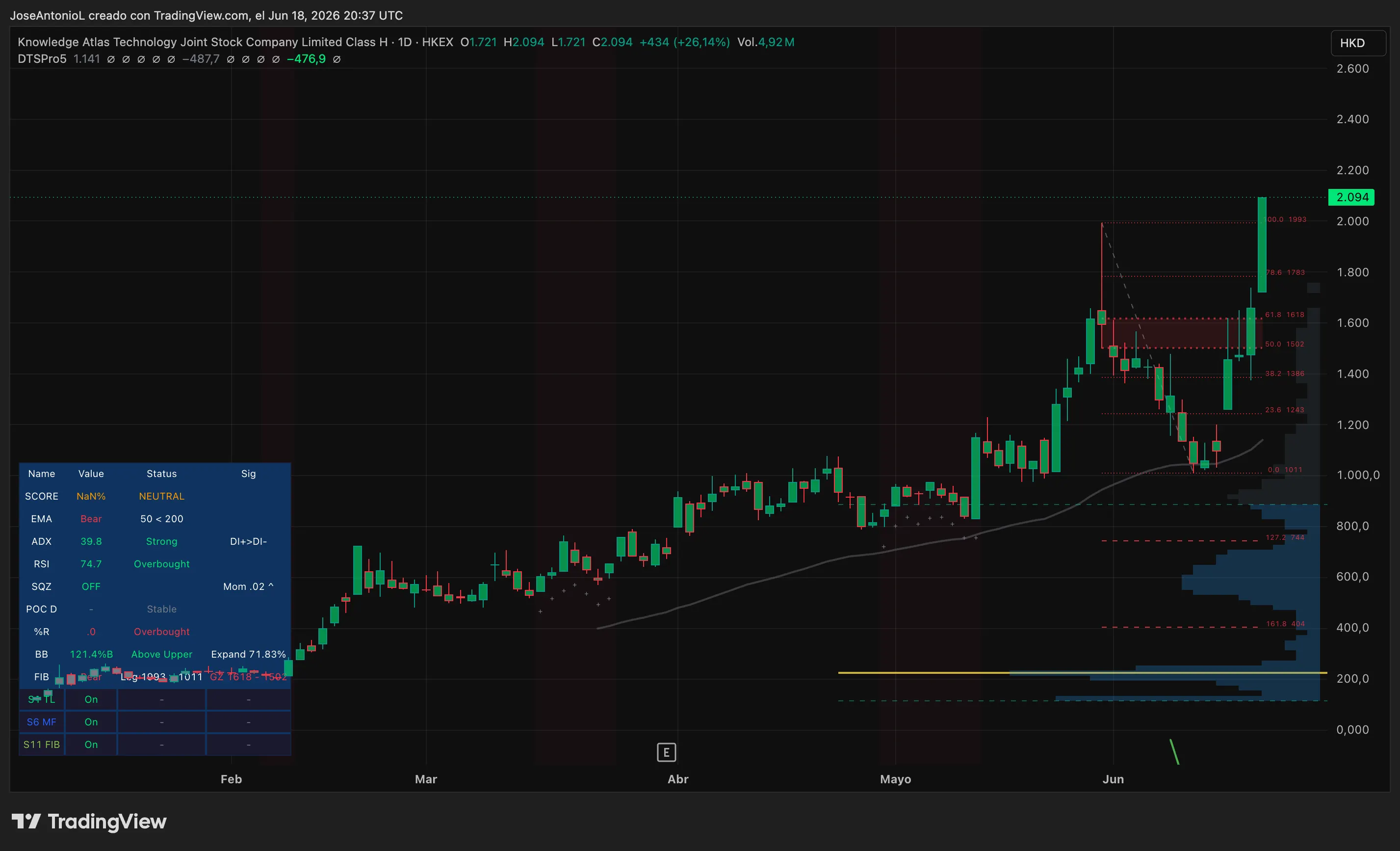
The model is distributed under the MIT license, a strategic move that guarantees it cannot be retroactively restricted or censored by government mandates, cementing its status as a foundational pillar for the global open-source community. This release comes at a time of heightened market volatility; following the announcement of GLM-5.2 and the coincidental regulatory banning of Anthropic’s "Fable" model in competing markets, Z.ai’s stock surged 90% over the last week, reaching an all-time high valuation.
Chronology of a Disrupted Market
The trajectory of Z.ai has been defined by its resilience in the face of escalating trade tensions.
- January 2025: Z.ai is officially added to the U.S. Entity List, a move designed to stifle its access to cutting-edge Western semiconductor technology.
- Early 2026: Reports emerge confirming that Z.ai has successfully transitioned its entire training pipeline to Huawei’s Ascend Atlas servers. By successfully training image generation models without a single American-made chip, the lab proves that U.S. sanctions may be inadvertently fueling domestic innovation.
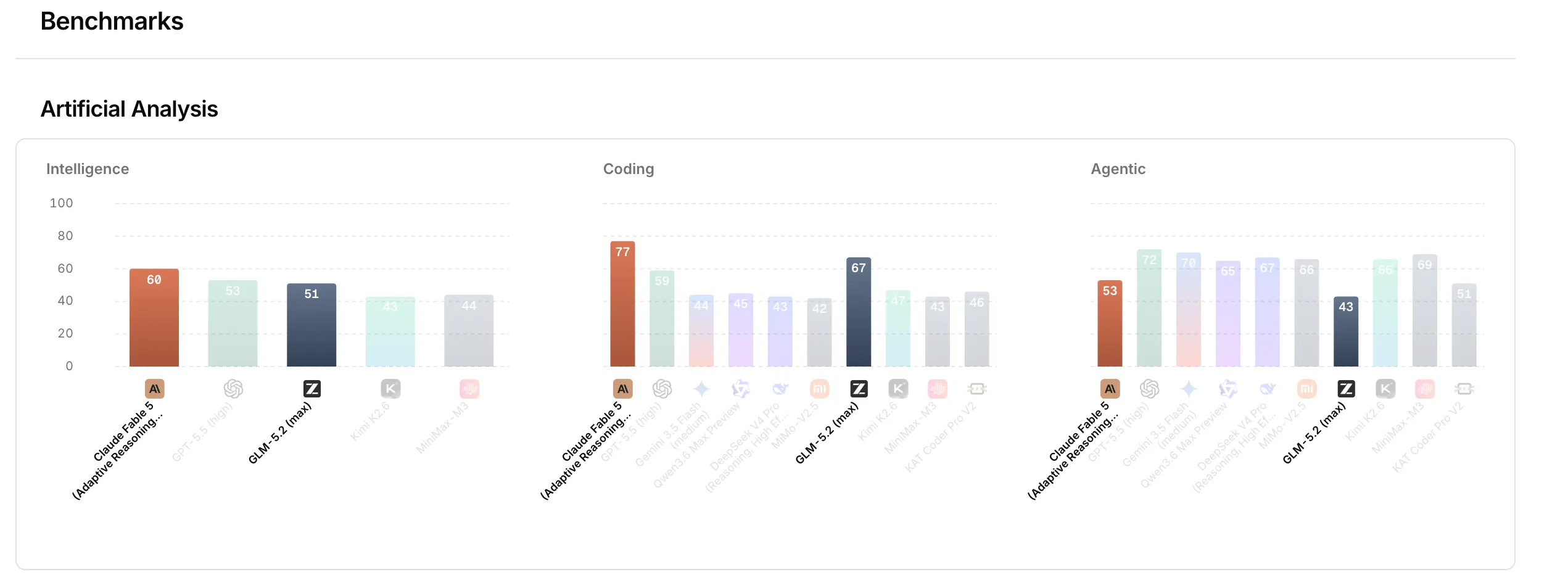
- June 16, 2026: Z.ai drops GLM-5.2. The model immediately demonstrates performance that rivals, and in specific coding benchmarks, surpasses the industry-standard GPT-5.5.
- June 18, 2026: Market reactions culminate in a massive valuation spike for the company, as investors pivot toward firms that have already "sanction-proofed" their supply chains.
Supporting Data: By the Numbers
The debate over whether non-Western AI models can truly compete with the giants of Silicon Valley has been settled by the data. On FrontierSWE—the gold standard for evaluating AI agents on technical projects like systems optimization and applied machine learning—GLM-5.2 achieved a dominance rate of 74.4. While it remains slightly behind the industry-leading Claude Opus 4.8 (75.1), it notably outperformed GPT-5.5, which scored 72.6.
Even more striking is the model’s performance on SWE-bench Pro, which tests an AI’s ability to autonomously resolve real-world GitHub issues. Here, GLM-5.2 logged a pass rate of 62.1%, significantly eclipsing the 58.6% of GPT-5.5 and marking a massive leap over the 58.4% achieved by the previous GLM-5.1 version.
According to the Artificial Intelligence Index, which aggregates nine distinct quality metrics, GLM-5.2 is currently the highest-performing open-source model available. While the model excels in code generation and creative variance, it does show limitations in "SWE-Marathon" tasks—the most grueling of sustained engineering challenges—where it scores 13.0 compared to Opus 4.8’s 26.0.
The Hardware Revolution: Training Without Nvidia
Perhaps the most significant aspect of the GLM-5.2 story is the "how." Stability AI founder Emad Mostaque has estimated the total training cost for the model at approximately $25 million. Remarkably, 80% of this budget was allocated to post-training optimization rather than raw compute, a testament to the efficiency of the Huawei Ascend architecture.
By relying on domestic hardware, Z.ai has eliminated the "Nvidia premium." This approach has significant implications for future scaling. If a 744-billion-parameter model can be trained for a fraction of the cost of its American counterparts, the economic barriers to entry for AI development are fundamentally lowered, threatening the dominance of companies that rely on high-cost, high-dependency supply chains.
For those looking to run the model locally, the community has responded rapidly. Unsloth AI has introduced 2-bit GGUF quantizations, which shrink the model from its original 1.51TB footprint down to 238GB. While this still requires a high-end workstation—specifically 256GB of unified memory or a robust VRAM/RAM combo—it makes "local-first" deployment of a frontier-class model a tangible reality for power users.
Economic and Strategic Implications
The release of GLM-5.2 is not merely a technical milestone; it is an economic warning shot.
Pricing Pressure
The pricing model for GLM-5.2 is predatory by design. With API costs set at $1.40 per million input tokens and $4.40 per million output tokens, Z.ai is significantly cheaper than Claude Opus 4.8, which charges $5 and $25 respectively. This price gap forces a difficult decision upon enterprise customers: prioritize the marginal gains of a closed-source model or embrace the massive cost savings and autonomy offered by a highly capable open-source alternative.
The "Agentic" Shift
GLM-5.2 is optimized for "agentic" workflows. In practical tests, the model proved exceptional at generating diverse, complex game states in a single, zero-shot setup. This capability is ideal for industries that require high-variance outputs, such as procedural game design, complex simulation, and large-scale software refactoring. By allowing developers to handle entire repositories within a single context window, Z.ai is accelerating the transition from "chat-based" AI to "action-based" AI.
Geopolitical Sovereignty
The fact that GLM-5.2 is released under the MIT license is a masterstroke of diplomacy. By giving the weights away to the global community, Z.ai ensures that the model cannot be "switched off" by anyone. It serves as a permanent, immutable artifact of China’s technological progress. The message to the West is clear: attempts to contain the development of AI through export controls on physical silicon have only served to force an acceleration in software efficiency and local hardware independence.
Conclusion: A New Frontier
As the industry watches to see how American regulators and competitors respond, one thing is certain: the era of uncontested American AI dominance is under threat. Z.ai has demonstrated that with the right optimization and a resilient supply chain, a "sovereign" AI model can compete at the highest level of the global hierarchy.
For developers, the choice is no longer just between models, but between philosophies. Whether you choose to run GLM-5.2 on a local workstation or integrate it via API, the model offers a glimpse into a future where the world’s most powerful intelligence is as accessible as it is independent. As we move into the second half of 2026, the global AI race has become less about who has the most chips, and more about who can do the most with the ones they have.
