

In the nascent years of cryptocurrency, Bitcoin was frequently touted as an "uncorrelated asset"—a digital hedge designed to operate independently of the machinations of central banks and traditional financial markets. However, as the asset class matures and institutional adoption reaches a fever pitch, that narrative is undergoing a radical shift. Bitcoin is no longer just a decentralized fringe experiment; it is increasingly functioning as a high-beta component of the global macro-financial machine.
Recent discourse from major market players and technical analysts underscores a growing consensus: Bitcoin’s price discovery is now inextricably linked to the same levers of liquidity, interest rate policy, and risk sentiment that drive the S&P 500 and the U.S. Dollar.
The Maturation of an Asset Class
The evolution of Bitcoin from a niche retail curiosity to an institutional-grade asset has necessitated a change in how traders interpret its price action. As highlighted by Binance India in a recent statement on X (formerly Twitter), Bitcoin’s relationship with traditional assets has moved from intermittent correlation to a more consistent, predictable pattern.
This is not necessarily a departure from its original value proposition, but rather a sign of its integration into the broader capital markets. As Bitcoin enters the portfolios of institutional heavyweights, asset managers, and pension funds, it has become subject to the same portfolio rebalancing flows as gold, tech stocks, and sovereign debt. When global liquidity conditions tighten—often signaled by Federal Reserve hawkishness—Bitcoin now reacts with the same volatility as high-growth equities. Conversely, when the Fed signals a pivot or liquidity expands, Bitcoin is often among the first to capture the resulting capital influx.
Chronology of a Shifting Narrative
To understand where Bitcoin stands today, one must look at the progression of its market behavior over the past several years:
- The "Uncorrelated" Era (2009–2019): For its first decade, Bitcoin was largely driven by retail sentiment, halving cycles, and internal crypto-native adoption. Macroeconomic events, such as the 2013 taper tantrum, had little to no impact on Bitcoin’s idiosyncratic price movements.
- The Liquidity Injection Phase (2020–2021): The COVID-19 pandemic served as a watershed moment. As the Federal Reserve engaged in unprecedented quantitative easing (QE), Bitcoin surged, effectively decoupling from traditional equity market crashes and demonstrating its potential as an inflation hedge.
- The Correlation Spike (2022–2023): As inflation soared and the Fed began a historic tightening cycle, Bitcoin’s price mirrored the sell-off in the Nasdaq. This period shattered the illusion of total independence, as Bitcoin proved highly sensitive to interest rate hikes and the rising U.S. Dollar Index (DXY).
- The Institutional Integration (2024–Present): With the approval of spot Bitcoin ETFs and the entry of firms like BlackRock and Fidelity, the "Macro Link" has become concrete. Bitcoin is now a part of the global risk-on/risk-off cycle, trading in lockstep with macroeconomic indicators.
Technical Analysis: The Fed and the Six-Figure Target
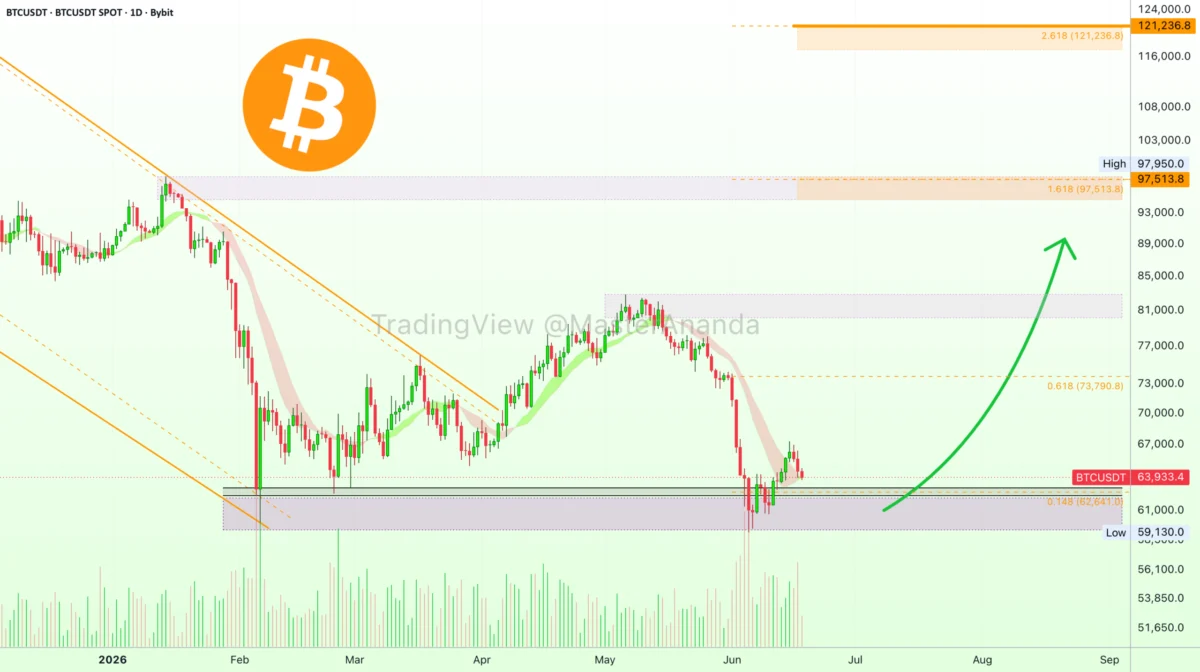
The current technical landscape reflects this macro-sensitivity. A recent analysis by TradingView contributor MasterAnanda provides a compelling case study on how market participants are blending fundamental macro expectations with technical charting.
The analysis highlights a cyclical trend: a 90-day period of expansion followed by a 30-day corrective phase. According to the analyst, Bitcoin has recently navigated a successful re-test of support levels, effectively moving back into a "bullish zone." While the sensationalist headline—"The Fed Says Bitcoin Will Hit $100,000–$120,000"—is a rhetorical flourish rather than a verbatim quote from Jerome Powell, it speaks to the market’s underlying expectation: that if the Federal Reserve pivots toward a more dovish policy, the resulting environment of "easy money" will serve as a primary catalyst for Bitcoin to breach its previous all-time highs.
This analysis relies on the concept of policy stability. By identifying support levels that hold firm despite macro turbulence, analysts are betting that the structural integrity of the Bitcoin market is now strong enough to withstand short-term Fed hawkishness, provided the long-term trend remains one of monetary expansion.
Supporting Data: Decoding the Inputs
For the modern trader, ignoring the "Macro Link" is no longer an option. The inputs that drive the price of Bitcoin today are identical to those monitored on a Bloomberg terminal for traditional equities:

1. Liquidity Expectations
Liquidity is the lifeblood of risk assets. When the Fed increases the size of its balance sheet or keeps interest rates low, the pool of capital searching for yield expands. Because Bitcoin is perceived as a "high-beta" asset—meaning it carries higher risk but offers higher potential reward—it acts as a magnet for this excess liquidity.
2. The U.S. Dollar Index (DXY)
There is a long-standing inverse correlation between the DXY and Bitcoin. A stronger dollar generally equates to a tighter global financial environment, putting downward pressure on dollar-denominated assets like BTC. A weakening dollar, conversely, acts as a tailwind for Bitcoin, which is increasingly viewed by global investors as a non-sovereign hedge against fiat currency debasement.
3. Equity Market Risk Appetite
Bitcoin’s correlation with the S&P 500 and Nasdaq has been high during periods of extreme market stress. When risk-off sentiment prevails, investors tend to liquidate their most volatile assets first. However, during periods of "risk-on" sentiment, Bitcoin often outperforms the broader market, acting as a speculative beta play.
Implications for the Future of Bitcoin Trading
What does this mean for the retail investor or the professional fund manager? It implies a fundamental change in strategy. Crypto-specific drivers—such as the four-year halving cycle, on-chain activity, and ETF net inflows—are still vital, but they are no longer the only factors.
The Holistic Trading Approach
Traders must now balance two distinct sets of data:
- Micro-Drivers: Monitoring ETF flow data, Bitcoin mining hash rates, and derivatives positioning (options open interest and liquidation clusters).
- Macro-Drivers: Watching the Consumer Price Index (CPI), Federal Open Market Committee (FOMC) meeting minutes, and employment data.
The realization that Bitcoin is a macro-sensitive instrument is a sign of legitimacy. It suggests that Bitcoin is being integrated into the global financial architecture rather than remaining a parallel system. While this brings higher correlation with the stock market, it also brings the massive inflow of institutional capital that was previously gated by concerns regarding asset class maturity.
Final Observations: The Path to $100,000+
While technical targets like $100,000 or $120,000 are often discussed in the context of chart patterns, they are increasingly tied to the macro environment. If the Federal Reserve shifts from a restrictive policy to an accommodative one, the resulting surge in global liquidity could provide the exact conditions necessary for Bitcoin to reach these levels.
However, investors should remain cautious. Because Bitcoin is now a "macro-linked" asset, it is also subject to the risks of those markets. A surprise inflation spike or a recessionary event that forces a liquidity crunch could delay these technical breakouts.
In conclusion, the discourse surrounding Bitcoin has shifted from "Will it survive?" to "How does it interact with the global economy?" The answer is clear: Bitcoin has grown up. It is now a primary participant in the global macro conversation, a reality that offers both significant upside potential and a requirement for a more sophisticated, macro-aware approach to trading and portfolio management. As we look toward the remainder of the decade, the confluence of crypto-native scarcity and macro-liquidity trends will likely be the primary engine of Bitcoin’s price discovery.
