

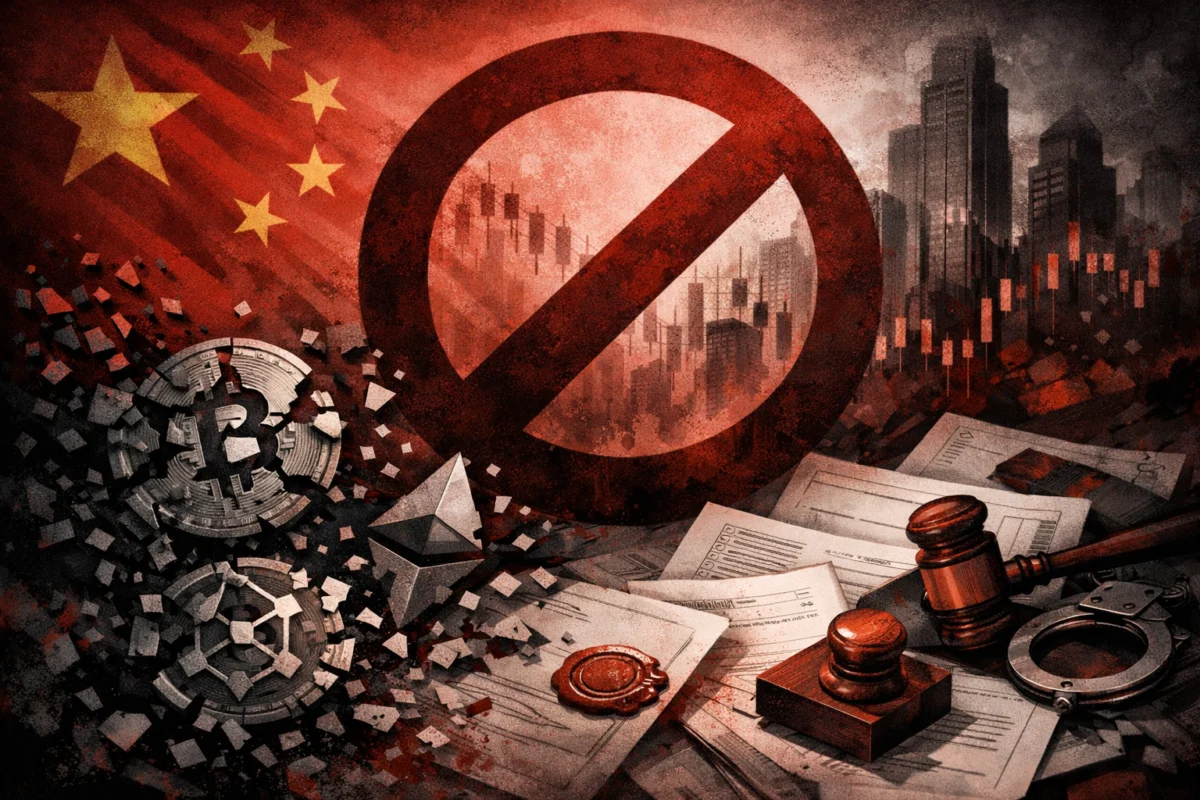
In a move that sends a definitive message to the global fintech sector, Chinese regulators have officially classified the tokenization of real-world assets (RWA) as an illegal financial activity. This landmark decision, delivered through a coordinated notice from seven of the nation’s most powerful financial industry associations, effectively closes the door on the burgeoning RWA sector within mainland China, placing it on the same prohibited list as cryptocurrency trading, stablecoin issuance, and crypto mining.
The directive does more than merely reiterate previous bans; it fundamentally dismantles the "grey area" that many offshore Web3 projects believed they could navigate. By targeting the entire service chain—from technology providers and payment processors to the individual employees working in mainland offices for overseas entities—Beijing has made it clear that distance from the mainland is no longer a shield against enforcement.
The Coordinated Front: A Unified Regulatory Warning
The severity of this crackdown is underscored by the unprecedented level of cross-industry coordination involved. The directive was jointly issued by:
- The China Internet Finance Association
- The China Banking Association
- The China Securities Association
- The China Asset Management Association
- The China Futures Association
- The China Association of Listed Companies
- The China Payment and Clearing Association
By mobilizing these seven pillars of the Chinese financial system, the state has signaled that RWA tokenization is not viewed as a peripheral technology experiment, but as a systemic threat to the nation’s financial stability.
The associations stated categorically that RWA activities possess no legal basis under current Chinese law. They defined tokenization as the unauthorized issuance of tokens or token-like rights representing debt or equity, arguing that such structures introduce dangerous, layered risks. These risks include the use of fictitious assets, the potential for catastrophic operational failure, and the fuel it provides for unchecked speculative trading.
Crucially, the authorities have eliminated any lingering uncertainty regarding the "experimental" status of such projects. The notice clarifies that no Chinese regulator has approved any form of RWA tokenization, effectively voiding claims by developers that their projects were in "trial phases" or awaiting regulatory "sandboxing."
Chronology and Context: From Crypto Curbs to RWA Prohibitions
To understand the current crackdown, one must look at the evolution of China’s digital asset policy:
- 2013-2017: Initial warnings against Bitcoin and the banning of Initial Coin Offerings (ICOs), as the government began to view decentralized finance as a challenge to capital controls.
- 2021: The "Great Mining Ban." China shuttered its massive cryptocurrency mining industry, citing environmental concerns and financial instability, and declared all crypto-related transactions illegal.
- 2023-2024: The rise of RWA. As global interest in tokenizing treasury bills, real estate, and commodities exploded, many Web3 startups sought to bypass mainland bans by claiming their tokenized products were "asset-backed" and therefore legally distinct from speculative cryptocurrencies.
- January 2026: The current crackdown. Beijing formally pivots from targeting "pure" crypto to the "tokenization of assets," closing the loophole that allowed RWA projects to gain a foothold among Chinese investors.
The timing of this announcement is particularly telling. It coincides with China’s intensifying efforts to internationalize the digital yuan (e-CNY) via a new Shanghai-based center for cross-border payments and state-sanctioned blockchain infrastructure. By clearing the landscape of private, unregulated RWA models, Beijing is tightening its monopoly on the digital representation of value.
Legal Breaches: The Criminalization of Tokenized Finance
The notice explicitly maps RWA activity to violations under both China’s Criminal Law and the Securities Law. The regulatory logic is comprehensive:
- Illegal Fundraising: Issuing tokens to the public that promise a return or represent an interest in an underlying asset is being treated as illegal fundraising (or "illegal public deposit-taking").
- Unauthorized Securities Offerings: Facilitating the distribution or trading of these tokens without regulatory approval constitutes an illegal public securities offering.
- Illegal Futures Trading: Any trading model involving leverage, derivatives, or "betting mechanisms" is being classified under the umbrella of illegal futures business operations.
Beyond these technical violations, regulators have rejected the core value proposition of RWA: that the token guarantees ownership or liquidation rights. Authorities argue that regardless of the underlying collateral, the "risk spillovers" to the broader economy are inherently uncontrollable. They contend that the digital layer of the token provides a false sense of security that masks the underlying legal and operational vulnerabilities of the assets being tokenized.
Implications for Web3 and the Global Service Chain
The most significant aspect of this crackdown is its extraterritorial reach. The directive effectively creates a "strict liability" standard for any individual or institution involved in the RWA supply chain.
The Death of the "Offshore" Defense
Many projects believed they could register in jurisdictions like Hong Kong or Singapore while maintaining development teams, marketing agencies, or operational staff in mainland China. The new directive explicitly invalidates this model. Regulators have stated that institutions and individuals who "knew or should have known" they were supporting RWA-related business can be held legally accountable.
This places immense pressure on:
- Technology Outsourcers: Software development firms that write the smart contracts for RWA platforms.
- Marketing Agencies and Influencers: Those who promote these platforms to Chinese users.
- Payment Interface Providers: Firms facilitating the fiat-to-token on-ramps.
- Operational Staff: Even a single employee in a mainland office can now expose an entire offshore project to enforcement actions by Chinese authorities.
Impact on Hong Kong-Linked Operations
The China Securities Regulatory Commission (CSRC) is reportedly urging domestic brokerages to cease all involvement in RWA tokenization, even within the Hong Kong Special Administrative Region. This is a chilling development for the city’s ambitions to become a global hub for tokenized assets. It suggests that if a business model relies on mainland capital or mainland-based personnel, it will be subjected to the same rigid regulatory standards as if it were operating in Beijing or Shanghai.
The Wider Regulatory Vision: Control and Stability
Why has Beijing chosen this specific moment to deliver such a comprehensive ban? Beyond the stated risks of fraud and pyramid schemes, the government is engaged in a strategic re-calibration of its digital economy.
The proliferation of RWA platforms was seen as an end-run around China’s capital controls. By tokenizing assets, investors could theoretically move value across borders with a level of fluidity that threatened the state’s ability to monitor and regulate the flow of capital. By declaring these assets illegal, the government is not just stopping "scams"—it is reinforcing the primacy of the digital yuan and the state-controlled financial system.
Furthermore, the government has explicitly linked this crackdown to the rise of fraud. Regulators noted that the "RWA label" has been used to dress up valueless tokens, Ponzi schemes, and pyramid activities, preying on retail investors who may not fully understand the technical or legal risks of blockchain-based assets.
Conclusion: A New Reality for Fintech
For global fintech startups, the message from Beijing is unambiguous: the era of "regulatory arbitrage" through tokenization is over. Any project that hopes to interact with the Chinese market, or even utilize Chinese labor to service global markets, must now contend with the reality that they are operating in a hostile regulatory environment.
As the industry moves forward, this directive will likely trigger a massive exodus of technical and operational talent from China to more favorable jurisdictions. Conversely, it will force global RWA projects to implement strict geofencing and KYC/AML protocols that effectively exclude the Chinese market entirely.
In the final analysis, China has decided that the risks associated with RWA tokenization—namely, the erosion of capital controls and the promotion of unchecked speculation—far outweigh the technological benefits. For the foreseeable future, the digital landscape in China will be defined by state-led innovation, leaving the decentralized RWA sector to operate entirely outside the reach of the world’s second-largest economy.
