

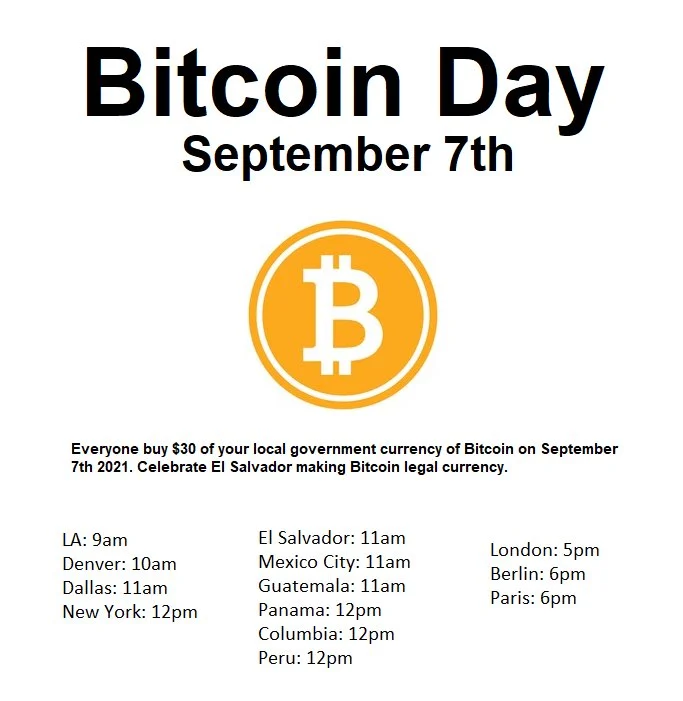
The global financial landscape stands at a historic precipice. Today, September 7, 2021, marks the official activation of El Salvador’s "Bitcoin Law," a landmark legislative achievement that establishes the world’s most decentralized digital asset as official legal tender alongside the U.S. dollar. This unprecedented experiment is the first time a sovereign nation has adopted Bitcoin as a primary currency, setting in motion a shift that has captivated economists, regulators, and the global cryptocurrency community alike.
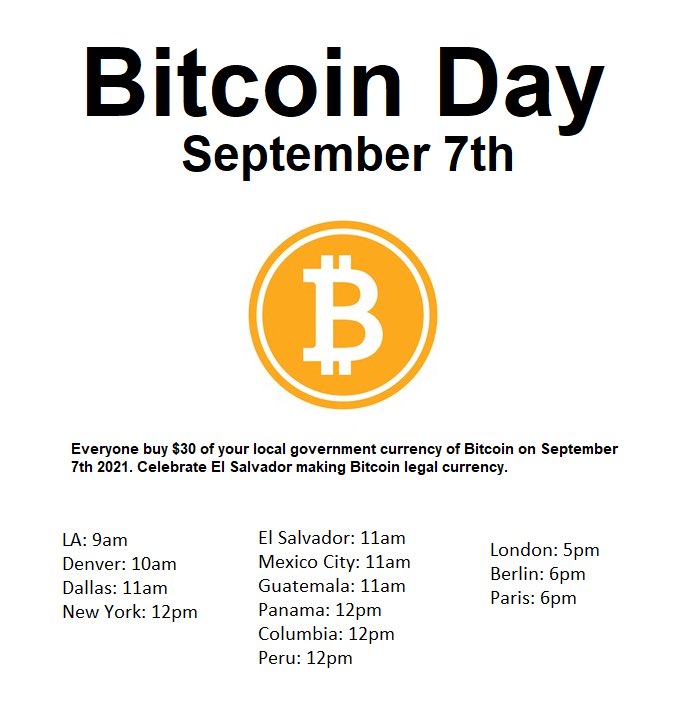
To commemorate this monumental transition, a decentralized grassroots movement has emerged, urging Bitcoin enthusiasts worldwide to participate in a symbolic act of solidarity: the purchase of $30 worth of Bitcoin. This collective gesture is intended not as a market-manipulation tactic, but as a show of support for a nation embarking on a bold journey toward financial sovereignty.
The Genesis of the Movement: From Reddit to Global Solidarity
The initiative originated from a humble thread on the popular social media platform Reddit, specifically within the /r/Bitcoin community. A user posed a seemingly simple, yet evocative question: "So… We all buying $30 worth of Bitcoin on Tuesday?"
The response was immediate and overwhelming. At the time of the proposal’s peak, the thread garnered over 8.9K upvotes and 2.2K comments. While the figure of $30 was selected for its accessibility—referencing the $30 in Bitcoin that the Salvadoran government promised to gift its citizens to incentivize adoption—the spirit of the initiative quickly evolved into something far more significant than a mere transactional event.
As the movement gained traction, the motivations behind the participation became diverse. Some users committed to buying significant amounts, with one contributor famously stating, "I will buy $3000 Tuesday to cover 99 others who aren’t able to pay." Others viewed the move as an ideological statement, explaining, "It’s to show solidarity with our Bitcoin compatriots in El Salvador as they fully adopt Bitcoin as their currency."
However, the movement was not without its skeptics. Critics were quick to point out the potential optics of such a coordinated effort. "Sure. Let’s just coordinate a 100 mil pump of BTC. Correct me if I’m wrong but this sounds greasy," one user noted. Despite these concerns, the momentum proved unstoppable, transcending Reddit to permeate Twitter, Discord, and other digital forums where the "Bitcoin plebs" congregate.
Chronology of the Adoption Event
The rollout of El Salvador’s Bitcoin Law has been marked by a blend of high-stakes political maneuvering and grassroots digital enthusiasm.
- June 2021: President Nayib Bukele announces the intention to make Bitcoin legal tender at the Bitcoin 2021 conference in Miami.
- June 9, 2021: The Legislative Assembly of El Salvador passes the Bitcoin Law with a supermajority, setting a 90-day window for implementation.
- September 6, 2021: As the implementation deadline approached, the online community began to formalize the "Buy $30" campaign, utilizing hashtags like #7SeptemberBuyBTC and #LeyBitcoin to coordinate the effort.
- September 7, 2021 (The Big Day): The law goes into effect. Throughout the day, community members synchronized their purchases to align with 3:00 PM El Salvador time, creating a global ripple effect of buying pressure.
Influencer Engagement and Institutional Support
The movement received an unexpected boost when high-profile figures within the Bitcoin space, most notably Michael Saylor, CEO of MicroStrategy, lent their support. Saylor, who has been a vocal proponent of Bitcoin as a corporate reserve asset, used his massive platform to amplify the message of support for the Salvadoran initiative.
This involvement was met with both cheers and apprehension. Critics within the community warned that such institutional endorsement could be a double-edged sword. "Everyone needs to be aware that this could possibly be leading the sheep to their death," one observer commented. "Very nerve-wracking these narratives are coming out before we hit the huge retracement levels."
The anxiety among some traders stems from the fear that institutional players might use the heightened retail interest surrounding the launch as an opportunity to "sell the news," leading to a price correction. Despite these concerns, the community’s sentiment remains largely optimistic, driven by the belief that the long-term utility of the Bitcoin network far outweighs short-term price volatility.
International Perspectives and Cultural Nuance
The support for El Salvador’s move has been truly global, crossing linguistic and geographical boundaries. In South Korea, local Bitcoin enthusiasts translated the call-to-action, encouraging their peers to join the movement. Interestingly, the support also resonated in Brazil, where the date of September 7 holds additional weight as the country’s Independence Day.
This intersection of national pride and monetary sovereignty has created a unique cultural phenomenon. The "Satoshi Nakamoney" persona, a character within the online community, became a focal point for the movement, providing updates and guidance to ensure that the global community remained synchronized. Tomer Strolight, a prominent voice in the Bitcoin space, noted, "Have you ever felt such benevolence to strangers from different nations, religions, and other affiliations as you do toward bitcoiners?"
Implications for Global Finance
The implementation of the Bitcoin Law in El Salvador carries profound implications for the global financial order:
- Testing the "Hard Money" Thesis: El Salvador is testing whether a nation can effectively utilize a deflationary, decentralized asset as a medium of exchange. If successful, this could provide a template for other developing nations seeking to bypass volatile local currencies or inflationary pressures.
- Financial Inclusion: By utilizing the Lightning Network, the government aims to provide banking-like services to the large portion of the Salvadoran population that remains unbanked. The success of this integration will serve as a critical case study for global development agencies.
- Institutional Skepticism vs. Reality: The International Monetary Fund (IMF) and other traditional financial institutions have expressed concerns regarding the volatility and regulatory risks associated with the move. The coming months will be crucial in determining whether these risks materialize or if the benefits of modernization outweigh the initial friction.
- Market Sentiment and Price Discovery: While the "Buy $30" movement is symbolic, the sheer volume of global retail participation highlights the power of decentralized community action. It challenges traditional top-down market dynamics and demonstrates that Bitcoin’s value proposition is as much about social consensus as it is about technical superiority.
Conclusion: A Turning Point for Cryptocurrency
As the sun sets on the first day of Bitcoin as legal tender in El Salvador, the world watches with bated breath. Whether this day is remembered as a stroke of visionary genius or a cautionary tale remains to be seen. However, the energy displayed by the global community—the memes, the $30 purchases, and the intense, passionate discourse—proves one thing: Bitcoin is no longer just an asset class for speculators.
It has evolved into a global movement that connects individuals across continents, united by a shared vision of monetary freedom. Regardless of the short-term price action, the events of September 7, 2021, have irrevocably changed the trajectory of finance. As Michael Saylor and the "plebs" continue to monitor the market, one thing is certain: the era of Bitcoin as a sovereign currency has officially begun. The world is watching, and the experiment is now live.
