

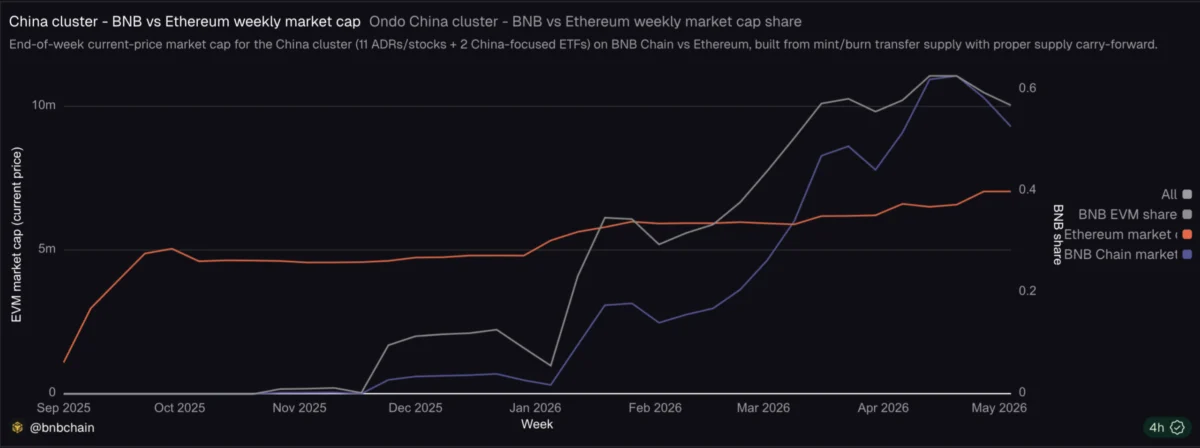
The landscape of decentralized finance (DeFi) is undergoing a structural transition as the boundaries between traditional financial assets and blockchain networks continue to dissolve. In a significant development for the Real-World Asset (RWA) sector, BNB Chain has reportedly surpassed Solana in tokenized stock trading volume, registering a cumulative milestone of $5.2 billion.
This development highlights a growing trend within the digital asset ecosystem: the migration of legacy financial instruments, such as equities, Treasury bills, and credit instruments, onto blockchain ledgers. While Solana has dominated headlines for retail engagement, high-throughput decentralized exchanges, and meme coin markets, BNB Chain’s quiet accumulation of institutional-grade volume suggests a strategic realignment. The network, originally conceived around exchange-led liquidity, is positioning itself as a primary settlement layer for tokenized traditional securities.
Main Facts: BNB Chain’s $5.2 Billion Surge
The milestone of $5.2 billion in tokenized stock trading volume places BNB Chain at the forefront of one of Web3’s most fiercely contested narratives. Tokenized stocks—digital representations of traditional equity shares wrapped in smart contracts—allow global investors to trade, fractionalize, and settle equities 24/7 using blockchain rails.
Several core factors define this development:
- The Volume Milestone: BNB Chain’s cumulative trading volume for tokenized stocks has reached $5.2 billion, outpacing Solana in this specific sub-sector of the RWA market.
- Key Network Drivers: The growth is not isolated to a single application but is instead distributed across specialized RWA issuers and decentralized protocols, including xStocks, bStocks, and infrastructure integrations from major players like Ondo Finance.
- Asset Composition: The volume comprises tokenized representations of blue-chip global equities, allowing users to gain exposure to traditional equity markets without exiting the on-chain ecosystem.
- EVM Compatibility Advantage: As an Ethereum Virtual Machine (EVM)-compatible network, BNB Chain benefits from a standardized token infrastructure (BEP-20), which simplifies integration for developers and institutional issuers accustomed to Ethereum’s ERC-20 standard.
While Solana remains a dominant force in decentralized exchange (DEX) volume and transaction speeds, BNB Chain’s victory in the tokenized stock segment reveals that institutional liquidity and asset wrapping are distributing unevenly across the Layer-1 landscape.
Chronology: The Evolution of RWAs and Tokenized Equities
To understand how BNB Chain achieved this volume milestone, it is necessary to trace the development of tokenized real-world assets from conceptual experiments to multi-billion-dollar trading volumes.
[2020-2021: Early Experiments] ➔ [2022-2023: Rise of Tokenized Treasuries] ➔ [2024: Strategic Expansion & Infrastructure Upgrades] ➔ [Present: The $5.2B Milestone]2020–2021: The Genesis of Synthetic Assets and Regulatory Hurdles
Early attempts at bringing equities on-chain were characterized by synthetic assets—tokens that tracked the price of stocks via decentralized oracles rather than being backed by physical shares. These early iterations faced severe regulatory pushback globally, forcing protocols to pivot toward fully collateralized, legally compliant structures.
2022–2023: The Rise of Tokenized Treasuries and Compliant Wrappers
As global interest rates surged, the demand for on-chain yield shifted from speculative DeFi pools to tokenized U.S. Treasury bills. Issuers like Ondo Finance established secure, legally compliant frameworks for wrapping real-world financial instruments. During this period, BNB Chain began optimizing its infrastructure, lowering gas fees, and introducing enhanced security parameters to attract institutional developers looking for a cheaper alternative to Ethereum.
2024: Strategic Expansion into Tokenized Stocks
With compliant custody and tokenization frameworks established, issuers expanded from debt instruments to equities. Protocols like xStocks and bStocks deployed on BNB Chain, offering fractionalized, backed representations of major public equities. This move capitalized on the chain’s deep, pre-existing liquidity pools and its massive, globally distributed user base.
Present: The $5.2 Billion Milestone
Following consecutive quarters of steady volume growth, official ecosystem updates from the BNB Chain blog confirmed that cumulative tokenized stock volume surpassed the $5.2 billion mark, officially overtaking Solana in this category and establishing BNB Chain as a key venue for equity-based RWAs.
Supporting Data: Analyzing the BNB Chain vs. Solana Dynamics
The competition between BNB Chain and Solana highlights two distinct approaches to network growth and liquidity capture. While Solana has captured retail attention through high-speed DeFi and speculative assets, BNB Chain has leveraged its structural alignment with trading infrastructure to capture RWA volume.
Comparative Network Metrics
| Metric | BNB Chain (RWA Focus) | Solana (Retail/DeFi Focus) |
|---|---|---|
| Tokenized Stock Volume | $5.2 Billion (Cumulative) | Sub-$5 Billion (Cumulative) |
| Primary Architecture | EVM-Compatible (BEP-20) | SVM-Based (SPL Tokens) |
| Key RWA Protocols | xStocks, bStocks, Ondo Finance | Ondo Finance, Lifinity, Pyth-backed integrations |
| Primary Liquidity Driver | Structured Financial Products | Retail Trading, Meme Coins, High-Frequency DEXs |
| Transaction Cost Profile | Low, predictable gas fees | Ultra-low, variable priority fees |
Why BNB Chain Captured the Tokenized Stock Segment
- EVM Compatibility and Developer Familiarity: Most legacy financial institutions and established RWA issuers design their smart contracts for EVM-based networks. BNB Chain’s compatibility allows developers to deploy Ethereum-native codebases with minimal modification, reducing time-to-market.
- Deep Liquidity Corridors: Due to its historical relationship with major centralized trading venues, BNB Chain hosts deep pools of stablecoins (such as USDT and USDC). This liquidity is essential for settling large-scale, tokenized equity transactions without causing significant slippage.
- Institutional Trust and On-Ramps: Institutional players often favor networks with established custody solutions and compliance integrations. BNB Chain’s mature infrastructure ecosystem provides these entities with the necessary security assurances.
Ecosystem Perspectives and Protocol Dynamics
The milestone has drawn reactions from across the web3 and traditional finance sectors, with analysts emphasizing that the RWA sector is moving away from speculative narratives and toward sustainable utility.
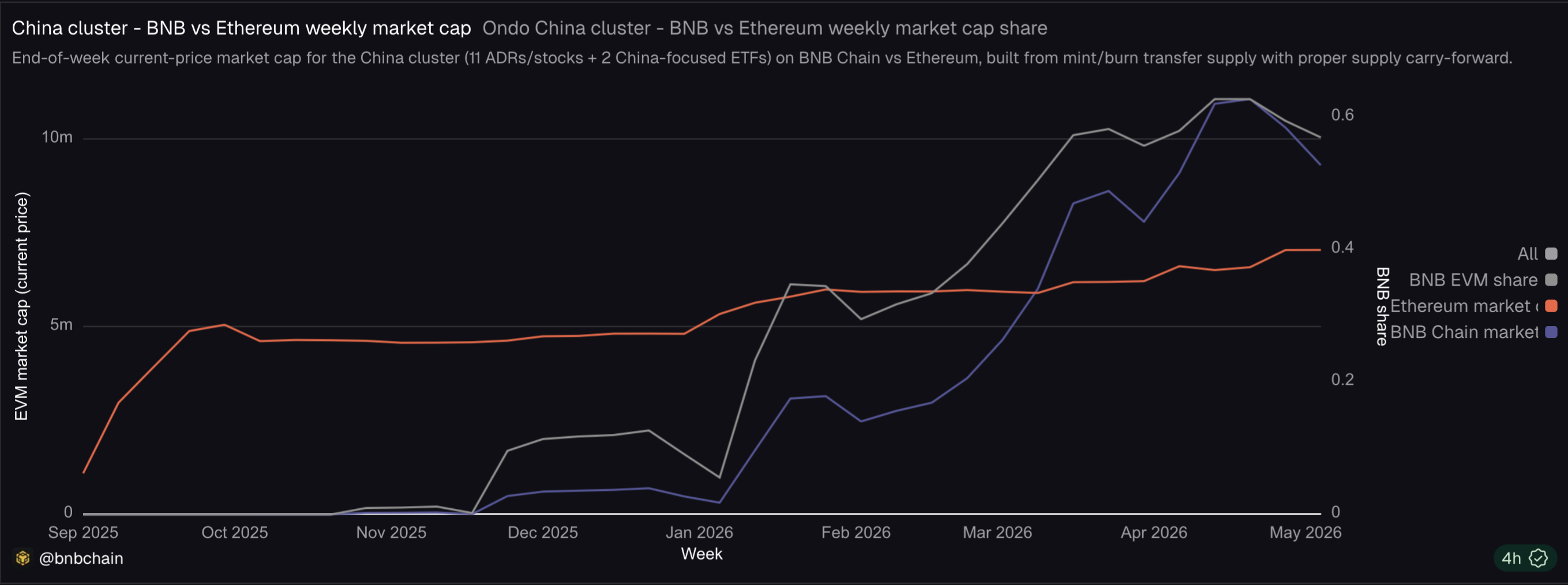
According to updates published on the BNB Chain Blog, the network’s focus remains on expanding the practical utility of its blockchain. The core development team has consistently emphasized that high-throughput, low-latency, and low-cost transactions are key to onboarding the next wave of financial assets.
Industry experts point out that the growth driven by protocols like xStocks and bStocks is structurally different from typical DeFi volume spikes. An analyst from the RWA sector commented:
"Unlike meme coin trading volumes, which are highly volatile and dependent on market sentiment, tokenized stock trading represents structured capital allocation. Investors utilizing these platforms are looking for long-term portfolio diversification, using blockchain as a settlement layer rather than a speculative casino. This volume has a much higher likelihood of becoming sticky over time."
Furthermore, the integration of oracle networks like Chainlink and Pyth has been crucial. These oracles provide real-time, tamper-proof price feeds from traditional stock exchanges (such as NASDAQ and NYSE) to BNB Chain smart contracts, ensuring that tokenized assets accurately reflect their off-chain counterparts during market hours.
Broader Implications: The Convergence of TradFi and DeFi
BNB Chain’s achievement of $5.2 billion in tokenized stock volume carries significant implications for the broader cryptocurrency industry and the future of global finance.
1. The Validation of the RWA Thesis
For years, the tokenization of real-world assets was treated as a theoretical use case. This milestone demonstrates that the market has matured past the proof-of-concept phase. Real assets are actively moving on-chain, and investors are actively trading them. This validation is likely to encourage more traditional financial institutions—such as asset managers, private equity firms, and investment banks—to explore public blockchain issuance.
2. Diversification of Blockchain Utility
For BNB Chain, this milestone offers an opportunity to diversify its reputation. Often viewed primarily as a retail-centric chain closely tied to exchange utility, establishing a leading position in the RWA sector provides the network with an institutional-grade narrative. This shift could help BNB Chain capture market share in institutional custody, enterprise deployment, and cross-border settlement.
3. Regulatory Scrutiny and Compliance Challenges
The growth of tokenized equities will inevitably attract closer scrutiny from global regulators, including the U.S. Securities and Exchange Commission (SEC), the European Securities and Markets Authority (ESMA), and regulators in Asian markets. Tokenized stocks are, by definition, securities.
As volumes scale into the billions, platforms operating on BNB Chain and other networks will face pressure to enforce strict Know-Your-Customer (KYC) and Anti-Money Laundering (AML) protocols. The long-term viability of this market segment depends on how successfully protocols can integrate compliance measures directly into their smart contracts.
4. The Multi-Chain RWA Race
The competition is far from over. While BNB Chain currently leads in tokenized stock volume, Ethereum remains the dominant network for tokenized Treasuries and institutional funds (such as BlackRock’s BUIDL). Meanwhile, Solana’s speed and low fees continue to attract developers building high-frequency RWA trading platforms.
The ultimate winners in the RWA race will not necessarily be the networks with the most transactions or the loudest social media presence. Instead, the market will favor blockchains that offer a secure balance of regulatory compliance, deep liquidity, developer-friendly infrastructure, and robust security. BNB Chain’s $5.2 billion milestone is a clear sign that the network intends to be a major contender in this space.
