

The Decentralized Finance (DeFi) ecosystem, once heralded as the immutable fortress of modern finance, is currently navigating its most precarious period in recent history. As of June 2026, the sector is grappling with a profound erosion of investor confidence, catalyzed by a relentless surge in security breaches and protocol exploits. This crisis of faith has manifested in a dramatic contraction of Total Value Locked (TVL), with data revealing a persistent, month-over-month exodus of capital that shows little sign of immediate reversal.
The Shrinking Horizon: A 39% Decline in Capital Base
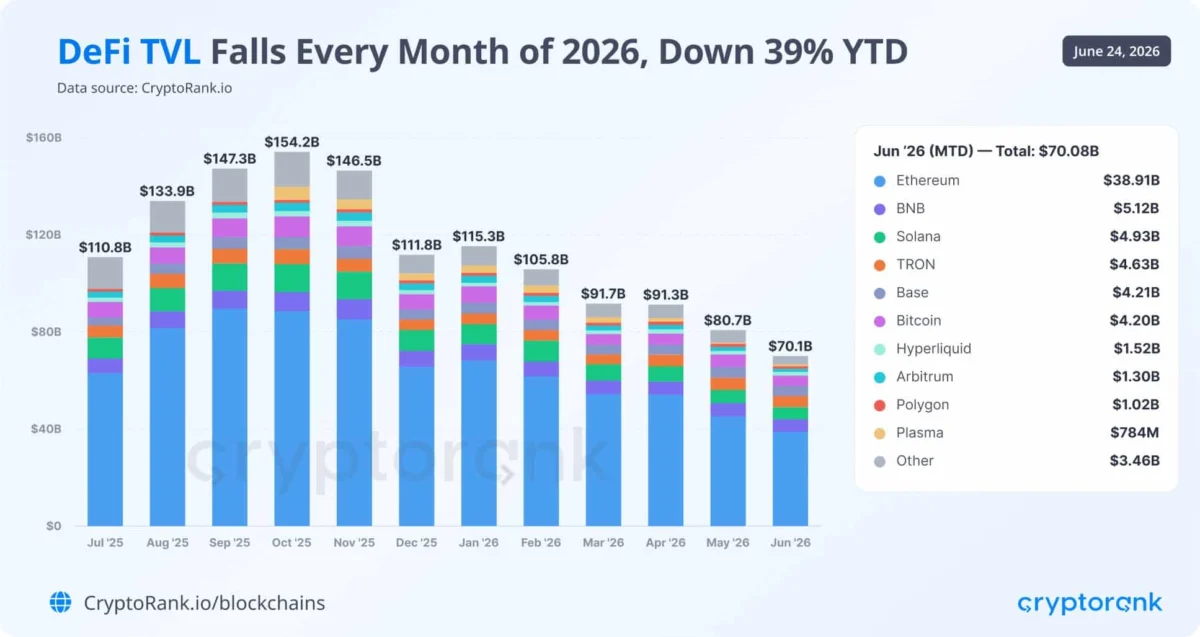
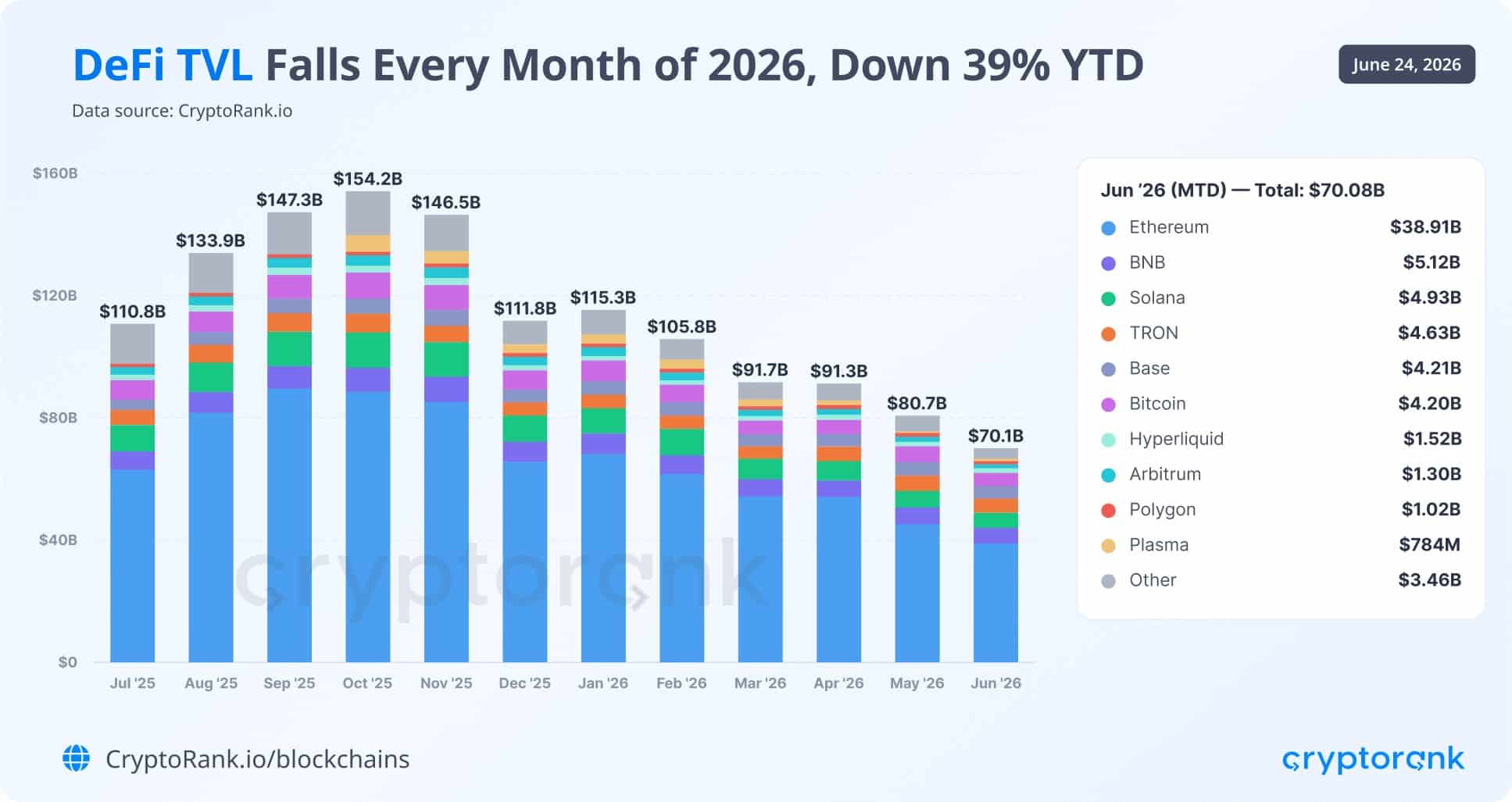
The financial architecture of DeFi has undergone a sobering transformation throughout 2026. According to comprehensive market intelligence from CryptoRank, the industry has witnessed a steady, uninterrupted decline in TVL since the dawn of the year. In January, the sector commanded a robust $115 billion; by the close of June, that figure had plummeted to approximately $70 billion.
This represents a year-to-date (YTD) decline of roughly 39%. This is not merely a transient "dip" or a momentary market correction; it is a structural shift in liquidity allocation. To put this in perspective, the industry is still reeling from the hangover of late 2025, a period of exuberance during which DeFi TVL crested above the $150 billion mark.
As the euphoria of the previous cycle has evaporated, the market has pivoted toward a more risk-averse stance. Investors are systematically withdrawing from experimental, high-yield, and inherently volatile projects, preferring to keep capital on the sidelines or migrate it toward more stable, legacy-proven assets. Even Ethereum (ETH), which maintains the largest share of the DeFi market, has been unable to stem the tide, as its dominance has failed to insulate the ecosystem from broad-based selling pressure.
While the overwhelming trend is downward, the landscape is not entirely monolithic. A few rare exceptions have defied the broader gravity: TRON (TRX) and Hyperliquid (HYPE) have reported growth figures of 5% and 7% respectively, suggesting that niche utility and specific protocol architecture may still attract liquidity even in a bear market for the wider sector.
Chronology of a Crisis: The Escalation of Exploits
The decline in TVL cannot be divorced from the parallel spike in security incidents. The chronology of 2026 paints a grim picture for those entrusted with securing user assets.
Q1 2026: The Warning Signs
The year began with a series of high-profile vulnerabilities that set the tone for the months to follow. Early in the first quarter, several bridge protocols and yield aggregators experienced "logic errors," allowing malicious actors to drain liquidity pools. While individual losses were kept under control, the cumulative impact began to weigh on the sentiment of retail and institutional participants alike.
Q2 2026: The "Quarter of Chaos"
The second quarter of 2026 is now officially designated as the busiest period for crypto exploits by incident count in the history of the industry. CryptoRank reports that Q2 alone saw a staggering 85 distinct security breaches. This unprecedented frequency of attacks has fundamentally changed the risk-reward calculation for DeFi users.
While the total dollar value of the losses has not yet breached the historic, catastrophic peaks of the 2022-2023 era, the frequency of these attacks is arguably more damaging to the industry’s long-term viability. When users are faced with the prospect of a new exploit on a near-weekly basis, the "set it and forget it" nature of passive yield farming becomes untenable. Investors are now, quite literally, "sleeping with one eye open."
Data-Driven Analysis: The Liquidity Paradox
A peculiar phenomenon has emerged in the 2026 data: the disconnect between stablecoin liquidity and DeFi participation. Despite the TVL drop from the $178 billion highs witnessed in previous cycles to the current $72.5 billion, the total stablecoin supply has remained remarkably resilient, hovering around the $315 billion mark.
This disparity offers a critical insight: Liquidity has not left the crypto ecosystem; it has simply left the DeFi protocols.
The capital is clearly present, but the appetite for deploying it into smart contracts has vanished. Investors are increasingly moving their assets into cold storage, centralized exchanges, or T-bill-backed stablecoin vaults that operate outside the traditional, high-risk DeFi smart-contract environment. This suggests that the issue is not a lack of available capital, but a profound lack of trust in the security guarantees provided by decentralized autonomous organizations (DAOs) and protocol developers.
Industry and Institutional Perspectives
The broader financial community is viewing this exodus with a mix of caution and analytical detachment. Market commentators argue that the industry is currently undergoing a "Darwinian cleansing." The protocols that survived the initial boom were often built with an emphasis on speed-to-market rather than rigorous formal verification or security auditing.
Security firms and auditing houses, often the first to comment on such trends, have noted that the complexity of modern "composable" DeFi—where protocols layer on top of one another like Lego bricks—has created an "attack surface" that is virtually impossible to fully secure.
"Every time you integrate a new protocol, you are inheriting the risk of that protocol," says one lead auditor from a prominent blockchain security firm. "In 2026, we are seeing the chickens come home to roost. The complexity has outpaced the security infrastructure."
The Implications: A New Era of "Hardened" Finance?
The implications of this 39% decline are far-reaching and touch upon several key pillars of the Web3 economy:
1. The Rise of the Security-First Mandate
Going forward, any protocol seeking to attract institutional liquidity will likely need to move beyond standard audits. We are seeing a shift toward "Insurance-as-a-Protocol," where DeFi projects must integrate on-chain insurance or escrow-based security layers to guarantee user funds. Protocols that cannot provide proof of independent security monitoring will likely see their TVL continue to shrink toward zero.
2. A Shift in Governance
The "move fast and break things" ethos is officially dead. Governance forums are already shifting their focus away from yield-optimizing strategies and toward "security-first" proposals. We expect to see a wave of governance-led initiatives that prioritize code freezes, multi-signature wallet upgrades, and the implementation of circuit-breaker mechanisms that can halt withdrawals in the event of an anomaly.
3. The Institutional Wall
Institutional investors, who were beginning to dip their toes into DeFi in 2025, are largely retreating to the sidelines. For these entities, the risk-adjusted return of DeFi currently fails to justify the potential for a 100% loss of principal due to a smart contract exploit. Until a "hardened" standard of DeFi is established, institutional capital will likely remain gated in centralized or permissioned environments.
Conclusion: The Path to Recovery
With 121 hacks recorded in the first half of 2026 alone, and nearly $1 billion in losses, the sector stands at a crossroads. The current contraction is not merely a market cycle; it is a loud, urgent signal from the user base that security is the primary bottleneck for mass adoption.
The recovery of the $45 billion lost in TVL will not be achieved through better marketing or higher APYs. It will be achieved through the slow, methodical process of rebuilding trust. Protocols must prove that they can act as resilient custodians of capital, not just as experimental sandboxes for code. Until the industry can demonstrate a sustained decrease in the frequency of exploits, the recovery of TVL will remain, at best, uneven and, at worst, stagnant.
The era of DeFi’s "wild west" growth phase is over. The era of the "hardened" protocol has begun, and only those that prioritize security over speed will survive the remainder of the year.
