

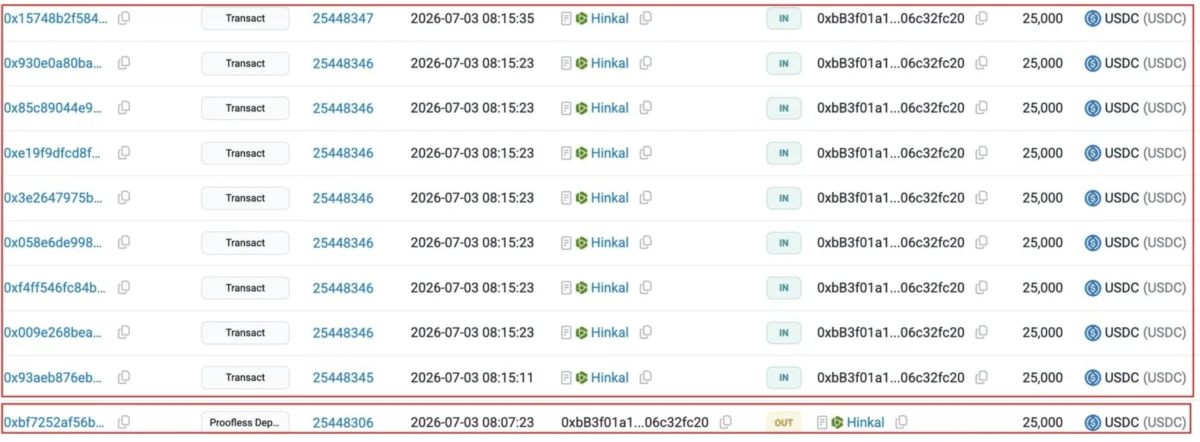
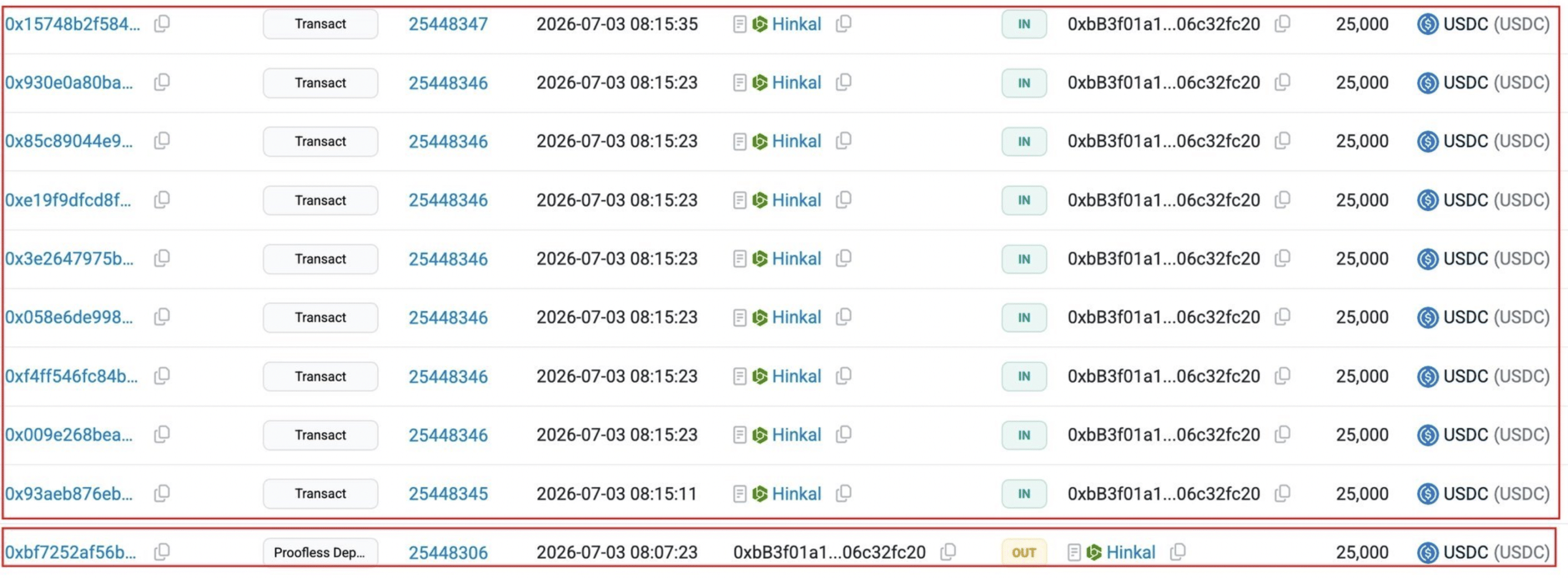
The decentralized finance (DeFi) ecosystem has once again been shaken by a sophisticated smart contract exploit, serving as a stark reminder of the fragile security foundations upon which many privacy-centric protocols are built. The Hinkal stablecoin privacy protocol, designed to offer users anonymity in their financial transactions, has reportedly been compromised, leading to the unauthorized withdrawal of approximately $820,000 in USDC. This incident, while relatively small in the broader context of multi-million dollar DeFi hacks, provides a critical case study on the dangers of implementation-level coding errors in complex smart contract architectures.
The Core Incident: A Flaw in Privacy Logic
Initial investigations into the Hinkal breach suggest that the attacker exploited a specific logical flaw within the protocol’s smart contract infrastructure. According to preliminary analysis, the vulnerability resided in the interaction between the protocol’s deposit and transaction functions.
Specifically, the attacker manipulated the prooflessDeposit() function, a mechanism intended to facilitate deposits into the privacy pool. By bypassing the expected validation layers, the bad actor was able to execute a series of unauthorized transact() calls. Under normal operating conditions, these functions are designed to verify the cryptographic proofs that underpin Hinkal’s privacy architecture—ensuring that only authorized users with legitimate balances can withdraw assets. By circumventing these checks, the attacker successfully drained $820,000 in USDC directly from the protocol’s liquidity reserves.
This breach is not indicative of a fundamental flaw in the concept of privacy-preserving DeFi, but rather a failure in the rigorous verification of code execution paths. The incident underscores the "black box" nature of complex smart contracts, where a single mismanaged function can expose an entire treasury to malicious actors.
Chronology of the Attack
While the exact timestamp of the initial breach is currently being reconciled against on-chain data, the sequence of events follows a pattern common to recent DeFi exploits:
- The Reconnaissance Phase: It is hypothesized that the attacker spent a significant amount of time auditing the Hinkal smart contract code, specifically targeting the
prooflessDeposit()function. Identifying a lack of sufficient input validation, the attacker prepared the necessary transaction sequence. - The Execution Phase: The attacker initiated the exploit by calling the
prooflessDeposit()function. By providing crafted inputs that failed to trigger the standard cryptographic verification, the attacker created an artificial state within the contract. - The Extraction Phase: Following the successful manipulation, the attacker executed a string of
transact()calls. Because the contract was tricked into recognizing the attacker as having a legitimate balance or authorization, the protocol processed the withdrawals, moving the $820,000 in USDC to an external address controlled by the exploiter. - The Post-Mortem Phase: Security researchers, including those from GoPlus Security, identified the anomalous activity on-chain. As news of the drain spread through social media and security monitoring channels, the community began to piece together the mechanics of the vulnerability.
Supporting Data: The 2026 Security Landscape
The Hinkal exploit is not an isolated event but rather a symptomatic occurrence within a turbulent 2026 for the cryptocurrency industry. Data from industry analysts suggests that while the total volume of stolen funds has decreased compared to previous years, the frequency of attacks remains alarmingly high.
A Year of Record-Breaking Frequency
According to reports from TRM Labs, the first half of 2026 witnessed 207 distinct security incidents. This represents a record-high number of individual hacks, indicating that while protocols may be becoming more resilient against massive, "billion-dollar" heists, they are becoming increasingly susceptible to smaller, highly targeted "precision" attacks.
Comparative Losses
Despite the high frequency of attacks, the total financial damage provides a more nuanced picture. DeFiLlama data indicates that total losses for the first six months of 2026 reached approximately $948.13 million. When compared to the $2.3 billion stolen during the same period in 2025, it appears that the industry is seeing a downward trend in total capital leakage. This may be attributed to improved security tooling, better audit standards, and the increased use of multi-signature wallets and time-locks.
Contextualizing Recent Breaches
The Hinkal incident follows a string of high-profile security failures:
- The Jaredfromsubway.eth Exploit: On June 20th, a notorious MEV (Maximal Extractable Value) bot known as Jaredfromsubway.eth was targeted. The exploit resulted in a staggering $7.5 million loss, highlighting that even sophisticated bots designed to profit from market inefficiencies are not immune to code-level vulnerabilities.
- The Edel Finance Incident: Shortly thereafter, Edel Finance fell victim to a flash loan attack. The attacker manipulated the wrapped xStocks exchange rate, extracting approximately $403,000. This incident served as a reminder that oracle manipulation remains a primary attack vector for lending protocols.
Official Responses and Industry Sentiment
As of the time of writing, the Hinkal team has been relatively quiet regarding a formal post-mortem, though they are expected to issue a statement once a full audit of the remaining code is completed. Security firms like GoPlus Security have been instrumental in documenting the exploit, providing the community with the necessary data to understand how the prooflessDeposit() function was weaponized.
The broader DeFi community has responded with calls for more rigorous "stress testing" of privacy-focused protocols. Because privacy protocols inherently obfuscate transaction history, they present unique challenges for forensic analysis. When these protocols fail, tracking the funds becomes significantly more difficult than in transparent protocols like Uniswap or Aave, leading to a loss of investor confidence that is harder to recover.
Implications for the Future of DeFi
The Hinkal exploit brings several critical implications to the forefront of the industry’s ongoing security debate:
1. The Complexity-Security Paradox
The drive to create more complex privacy features often leads to increased code complexity. As demonstrated by Hinkal, the more intricate the verification logic, the higher the likelihood of a logical error. Future development must prioritize "minimalist" security, where the code is as simple as possible to achieve the desired privacy outcome, thereby reducing the attack surface.
2. The Role of Continuous Auditing
The frequency of 207 hacks in six months proves that a one-time audit before a protocol launch is insufficient. Protocols must adopt "continuous security," employing automated monitoring tools that track smart contract state changes in real-time. If the Hinkal protocol had an active, AI-driven monitoring system in place, the anomalous transact() calls might have been flagged and paused before the full $820,000 was drained.
3. The Shift in Attacker Sophistication
Attackers are moving away from brute-force methods and toward "surgical" exploits. By focusing on specific functions like prooflessDeposit(), hackers are demonstrating a deep, granular understanding of how smart contracts interact with the Ethereum Virtual Machine (EVM). This necessitates that development teams hire security engineers who are not just coders, but experts in adversarial thinking.
4. Regulatory and Insurance Pressures
With nearly $1 billion lost in the first half of the year alone, the pressure for the DeFi industry to adopt insurance solutions is mounting. As regulatory bodies continue to scrutinize the sector, protocols that fail to demonstrate robust security standards will likely face increasing difficulty in attracting institutional capital.
Conclusion
The Hinkal protocol exploit is a sobering reminder that innovation in the DeFi space often comes at the cost of security. While the $820,000 loss is a fraction of the total value currently locked in DeFi, every stolen dollar erodes the trust that is essential for the industry’s long-term survival.
As we look toward the remainder of 2026, the industry must reckon with the fact that while the "big" hacks are becoming less frequent, the "silent" exploits of niche protocols are becoming a persistent drain on the ecosystem. The path forward is not found in the abandonment of privacy or the halting of innovation, but in the institutionalization of security. Only by treating smart contract code with the same rigor as traditional financial banking infrastructure can the promise of decentralized, private finance be fully realized. Investors, meanwhile, are reminded to exercise extreme caution, ensuring they understand the technical risks inherent in any protocol that manages their assets, regardless of its marketing or promises of privacy.
