

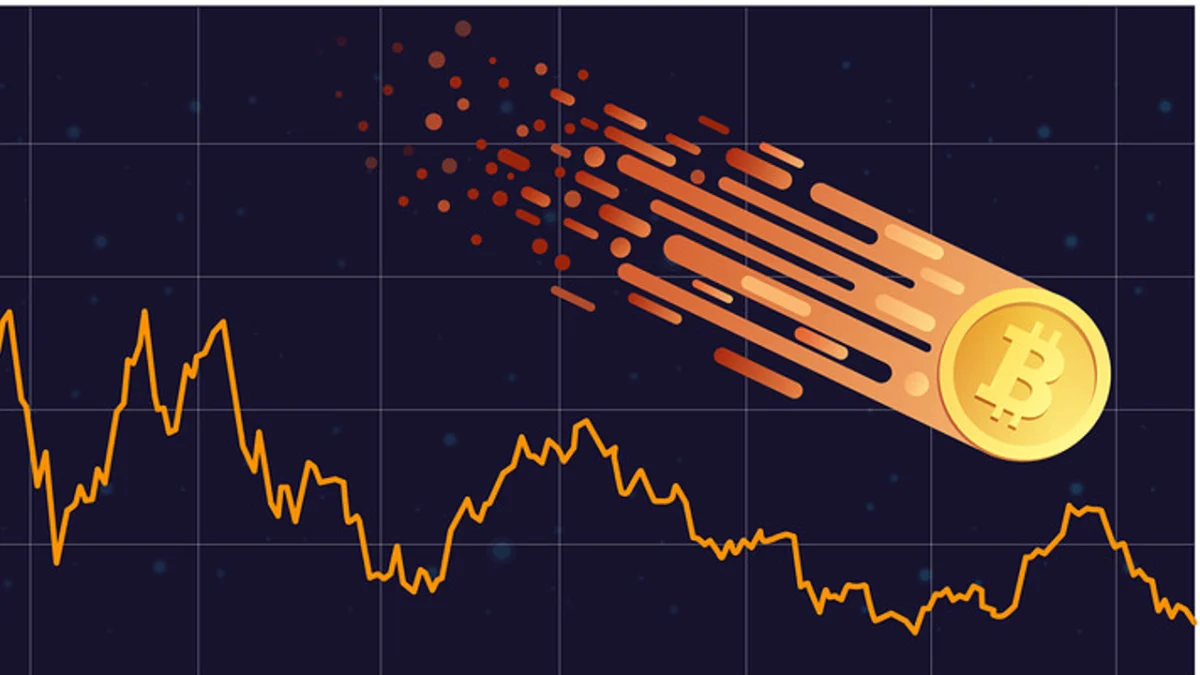
The global cryptocurrency market is currently grappling with a severe wave of volatility, as Bitcoin—the world’s premier digital asset—recorded its sixth consecutive day of losses this Tuesday. The sustained downward pressure has pushed prices significantly lower, shedding roughly 12% of their value compared to the same time last week. As institutional and retail investors alike retreat from high-risk assets, the broader market is witnessing a profound shift in sentiment, driven by a volatile mix of technical weakness and escalating geopolitical instability in Eastern Europe.
Main Facts: A Bearish Week for Digital Assets
The trading week began on a somber note for Bitcoin (BTC). After reaching a local high of $39,394.44 on Sunday, the asset saw a sharp reversal, falling to a low of $37,358.00 as market participants reacted to deteriorating macro conditions. At the time of writing, Bitcoin is fluctuating near the $37,800 mark—a level that sits approximately 44.97% below its all-time high, underscoring the severity of the ongoing correction.
The bearish trend is not exclusive to Bitcoin. Ethereum (ETH), the industry’s second-largest cryptocurrency by market capitalization, has mirrored this downward trajectory. ETH/USD hit an intraday low of $2,585.95 on Tuesday, its weakest performance since February 3. This decline has effectively stalled the momentum of a previously forming bullish cross between the 10-day and 25-day moving averages, leaving traders to grapple with a fragile support structure.
Chronology: The Timeline of the Current Slump
The descent began in earnest toward the end of last week, as technical indicators flashed clear warnings of exhaustion. By February 21, Bitcoin’s price had already flirted with the critical $37,000 support level. While a late-night rebound on Monday briefly propelled the asset to $38,607, the recovery proved fleeting.
By Tuesday, the selling pressure resumed, pushing the price toward the $37,200 long-term support zone. This consistent slide marks a significant departure from the optimism observed earlier in the month. Market observers have pointed to the "tepid" demand currently plaguing the Bitcoin network. With only 275,000 daily active entities recorded as of Tuesday, the network is operating at a level significantly lower than the highs observed during the previous bull cycle, signaling a cooling interest from new market participants.
Supporting Data: Technical Indicators and Liquidation Spikes
The technical landscape for Bitcoin is increasingly precarious. The 14-day Relative Strength Index (RSI)—a momentum oscillator used to determine whether an asset is overbought or oversold—is currently tracking at 39. This is the lowest reading in over three weeks, confirming that the asset is deep in oversold territory.
However, technical indicators are only part of the story. The market has been plagued by a series of sustained liquidations that have exacerbated the price drop. In a single hour on Tuesday, over $30 million in long positions were liquidated—a staggering figure that represents the second-highest hourly liquidation volume in four days and the third-highest in nearly a month.
When leverage is wiped out at this scale, it often triggers a cascade effect, forcing further sell-offs as traders are margin-called. This "forced selling" has made it difficult for the price to find a stable floor, even as some retail traders attempt to buy the dip. Currently, BTC faces immediate resistance near $37,800, with further hurdles at $38,200. Should the bulls fail to reclaim these levels, the price could see a retest of the $35,000 psychological support zone, as noted in recent technical analyses.
Geopolitical Implications: The "War Risk" Premium
The primary driver behind this week’s exodus from crypto assets is the rapid escalation of tensions between Russia and Ukraine. As Russian President Vladimir Putin announced the deployment of forces into two rebel-held regions of Ukraine, global financial markets reacted with a "risk-off" sentiment that has spared no asset class.
Historically, proponents of Bitcoin have argued that the cryptocurrency serves as a "digital gold" or a hedge against geopolitical instability. However, in the current economic environment, Bitcoin has behaved more like a high-growth tech stock. As investors fear the economic fallout of potential sanctions, energy price spikes, and the broader uncertainty of a military conflict, they are liquidating speculative assets to protect their portfolios and increase their cash reserves.
This environment has created a feedback loop of fear. As the crypto community observes the volatility in traditional equities and commodities, they are preemptively unloading their holdings to avoid further losses. This lack of confidence is being mirrored in the broader economic forecast, with financial analysts—such as those at Stifel—suggesting that a combination of macro factors, including interest rate hikes and geopolitical strife, could see Bitcoin prices plummet as low as $10,000 in a worst-case scenario.
Future Outlook and Market Analysis
As the market navigates this period of high uncertainty, the path forward remains clouded. The short-term price action for Bitcoin depends heavily on whether it can maintain its $37,200 support. A failure to hold this line would likely confirm a deeper bear market, potentially inviting institutional short-sellers to increase their positions.
For Ethereum, the technical outlook is similarly cautious. Should a recovery wave materialize, the market will first encounter resistance near $2,680. A sustained move above this level, followed by a break through the $2,750 threshold, would be required to signal that the selling pressure has abated and that buyers are ready to re-enter the market.
Ultimately, the cryptocurrency sector is undergoing a "stress test" that goes beyond mere market cycles. The integration of digital assets into the global financial system means that Bitcoin and Ethereum are no longer isolated from world events. The current price correction is as much about the threat of war as it is about the internal mechanics of the crypto market.
Investors are now caught in a dilemma: hold through the volatility in the hope of a long-term rebound, or exit the market to preserve capital in an increasingly unpredictable world. For now, the "tepid" demand and the prevalence of massive long liquidations suggest that the path of least resistance remains to the downside. As the world watches the unfolding situation in Ukraine, the crypto market remains a barometer for the collective anxiety of the global investor class.
Summary of Technical Levels:
- Bitcoin (BTC):
- Current Price: ~$37,792
- Immediate Resistance: $37,800
- Secondary Resistance: $38,200
- Major Support: $37,200 (Test level)
- Ethereum (ETH):
- Immediate Resistance: $2,680
- Secondary Resistance: $2,750
- Target on Recovery: $2,880
Disclaimer: This report is for informational purposes only and does not constitute financial advice. Cryptocurrency investments carry high risks; please consult with a qualified professional before making any investment decisions.
