

The financial industry is currently embroiled in a philosophical and technical tug-of-war that could define the next decade of global capital markets. At the center of this debate are two industry titans—Ark Invest and Andreessen Horowitz (a16z)—who hold diametrically opposed views on how Traditional Finance (TradFi) will integrate with blockchain technology.
The contention revolves around a singular, provocative question: Is TradFi’s interest in blockchain merely a pursuit of operational efficiency, or is it a genuine shift toward the decentralized architecture of DeFi?
Main Facts: The Clash of Perspectives
The conflict surfaced when a16z, the venture capital firm known for its deep-rooted belief in the transformative power of Web3, published a stance suggesting that TradFi’s current foray into blockchain is not an embrace of Decentralized Finance (DeFi) at all. Instead, a16z argued that institutional players are strictly interested in "blockchain" as a utility—a tool to lower costs and optimize existing legacy processes.
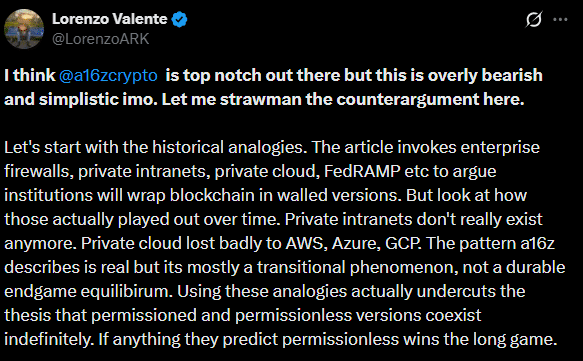
Ark Invest, led by the research insights of Director of Crypto Research Lorenzo Valente, has publicly dismissed this narrative. Valente labeled the a16z outlook as "overly bearish and simplistic." While Ark acknowledges that institutional players are indeed motivated by cost-of-goods-sold (COGS) efficiencies, they argue that a16z fails to account for the unstoppable momentum of permissionless, public networks.
The core of the disagreement lies in the "End State" of finance. For a16z, the convergence of DeFi and TradFi is a romanticized myth. For Ark, it is an inevitability, driven by the inherent market preference for open-access, global liquidity.
Chronology: How the Institutional Pivot Unfolded
To understand the current tension, one must look at the timeline of the institutional blockchain pivot:
- 2020–2022: The Experimental Phase. Major financial institutions, including JP Morgan and SWIFT, began testing distributed ledger technology (DLT) in "sandbox" environments. The goal was to modernize settlement times and reduce counterparty risk.
- 2023: The Rise of Private Permissioned Chains. Seeing the need for privacy and regulatory compliance, the industry saw a surge in the development of private, permissioned ledgers. Platforms like Canton and various proprietary enterprise ledgers were positioned as the future of institutional tokenization.
- 2024: The Stablecoin Reality Check. The global adoption of stablecoins (USDT and USDC) began to outpace expectations, forcing traditional giants like PayPal, Visa, and Mastercard to integrate blockchain-based payment rails.
- 2025–2026: The Bifurcation. As we enter the current period, the market has split. While private chains dominate the tokenized asset space (like real estate and private credit), public chains like Ethereum and Tron have secured a near-total monopoly on stablecoin liquidity and retail-facing payment rails.
Supporting Data: Where the Battle Lines Are Drawn
The data suggests that both sides of this argument possess fragments of the truth. According to current market metrics, the "DeFi vs. TradFi" debate is not a binary choice, but a nuanced divide based on asset class and functionality.
1. The Stablecoin Hegemony
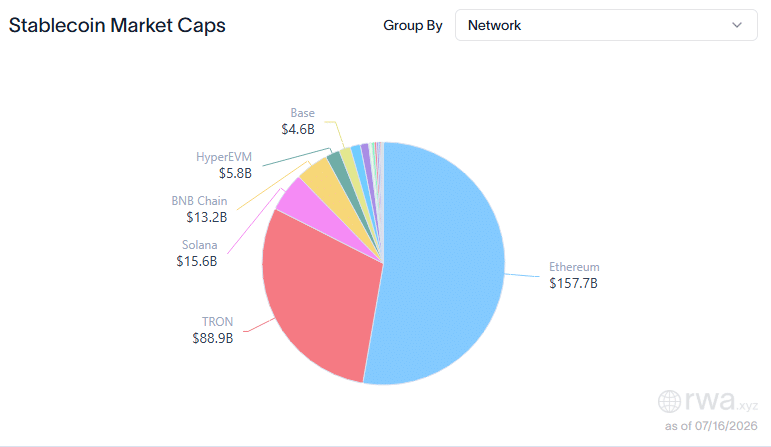
Public chains remain the undisputed kings of the stablecoin ecosystem. Ethereum and Tron currently control approximately 75% of the sector. This dominance validates the Ark Invest thesis: when it comes to money and payments, the market votes for open, permissionless, and global access. It is difficult for a private, "walled-garden" blockchain to compete with the liquidity and composability of a public network.
2. The Institutional Moat
Conversely, a16z’s argument finds significant support in the tokenized asset market. Corporate and private chains, such as Canton and Provenance, currently maintain a commanding 85% market share in the tokenization of traditional assets. Ethereum, despite its dominance in DeFi, sits at a distant 4% in this specific institutional segment. This indicates that for complex, highly regulated assets, financial institutions prioritize the control, privacy, and "permissioned" nature that corporate chains provide.
Official Responses and Strategic Interpretations
The discourse has spilled over into the public sphere, with leaders from both sides offering distinct visions for the future.
The a16z Perspective: The "COGS" Thesis
a16z posits that businesses are not ideological; they are economic. Their stance is that TradFi will adopt blockchain components only when it translates to a "compelling COGS story." They cite the development of projects like Circle’s Arc Chain and SWIFT’s ongoing blockchain pilots as evidence. According to the firm, TradFi is "selectively adopting parts that fit its model." They maintain that the vision of a fully decentralized, permissionless financial system is a "comforting story" that ignores the realities of regulatory compliance and enterprise risk management.
The Ark Invest Counter: The "Intranet" Analogy
Lorenzo Valente of Ark Invest suggests that a16z is ignoring the long-term evolution of technology. He points to the success of BlackRock’s BUIDL fund on public chains as evidence that institutions are willing to cross the bridge into the open-web if the value proposition is strong enough.
This sentiment is supported by Carlos Domingo, CEO of Securitize, who drew a compelling historical parallel: "Private chains or pseudo-ones are the intranet and private clouds of this era—a transitional step into a truly open and permissionless innovation model." In this view, private chains are merely the "walled gardens" of the late 1990s, destined to be replaced by the "public internet" of finance.
Implications: The Future of Global Markets
The implications of this standoff are profound. If Ark Invest is correct, the next decade will see a "Great Migration" of assets from private, inefficient ledgers to permissionless public networks. This would necessitate a massive overhaul of global financial regulations and a fundamental shift in how trust is programmed into financial instruments.
If a16z is correct, the industry is headed toward a fragmented "Splinternet" of finance. In this scenario, we would see a multi-tiered system:
- A "High-Street" layer of public, permissionless chains used for consumer payments and retail stablecoins.
- A "Wholesale" layer of private, permissioned chains used for institutional capital markets, tokenized securities, and cross-border settlement between central banks.
The Convergence Hypothesis
Perhaps the most likely outcome is a hybrid model. The market is already showing signs that the two worlds are not mutually exclusive. As private chains evolve, many are beginning to adopt "bridging" technologies that allow them to interact with public networks, effectively becoming "Layer 2s" or specialized execution environments for the broader decentralized ecosystem.
The emergence of corporate-led projects like the Google Cloud Universal Ledger (GCUL) and Stripe’s Tempo indicates that the infrastructure providers are hedging their bets. They are building systems that offer the speed of modern cloud computing with the settlement finality of blockchain, regardless of whether that blockchain is public or private.
Final Summary: A Convergence of Realities
The debate between Ark Invest and a16z highlights a critical juncture in financial history.
- TradFi’s Selective Adoption: Institutions are indeed cherry-picking blockchain features—smart contracts, atomic settlement, and tokenization—without necessarily adopting the ethos of decentralization.
- The Power of Public Liquidity: Public chains have already won the battle for stablecoin liquidity, proving that when assets are liquid and global, they naturally gravitate toward open-source protocols.
- The Transition Period: We are currently in a "transitional era." Much like the early days of the internet, where private intranets eventually gave way to the public web, the financial sector is testing the waters of private ledgers before inevitably moving toward a more open, interoperable, and decentralized financial standard.
While a16z views the current state of TradFi adoption as the "final destination," Ark Invest views it as the "pre-game." As stablecoins continue to eat into traditional payment volumes and tokenized treasury products gain traction on public chains, the pressure on private, siloed chains will only increase. Whether these private chains survive as permanent fixtures or eventually dissolve into the public blockchain ecosystem remains the defining question of the next decade of finance.
Ultimately, both firms are correct in their own way: TradFi is acting out of necessity and efficiency, but that efficiency is proving to be a gateway to a much larger, more transparent, and radically more efficient decentralized future.
