

In a move that has sent ripples through the decentralized finance (DeFi) ecosystem, Zapper, a prominent asset management platform that once served as a primary gateway for millions of users to navigate the complex world of Web3, has announced it will officially cease operations. After a nearly seven-year tenure as a cornerstone of the DeFi infrastructure, the company is set to shutter its platform on August 3, 2026, marking a somber milestone for a project that was once heralded as a beacon of user-friendly blockchain innovation.
This closure is not merely the end of a single startup; it represents a profound "reality check" for the entire decentralized finance sector. While Zapper enjoyed massive popularity, achieving peak transaction volumes of over $13 billion and supporting a monthly active user base exceeding 2 million, these vanity metrics ultimately proved insufficient to mask the underlying fragility of its business model.
Main Facts: The Anatomy of a Shutdown
The decision to close Zapper was not impulsive, but rather the result of a long-term struggle to reconcile rapid user growth with the harsh realities of profit margins and competitive saturation.
As of early August 2026, Zapper will effectively sunset its operations. The company has stated its commitment to assisting existing users with the transition process, ensuring that assets are not lost during the wind-down period. The core issue, as identified by leadership and industry analysts, was the inability to translate immense traffic into a sustainable revenue stream.
Despite the platform’s technological prowess and its ability to simplify complex DeFi protocols—such as yield farming, liquidity provision, and asset tracking—the market landscape shifted under its feet. Increased competition from newer, more agile, and often more specialized protocols led to severe fee compression. As the cost of maintaining the high-performance infrastructure required for a seamless user experience rose, Zapper’s margins were squeezed into non-existence.
A Chronology of Growth and Decline
To understand the trajectory of Zapper, one must look at its evolution through the various market cycles of the last seven years.
The Rise (2019–2022)
Launched during the early days of the "DeFi Summer," Zapper quickly established itself as a "dashboard for the decentralized web." It provided a crucial service: aggregating disparate DeFi protocols into a single, intuitive interface. This was a revolutionary concept at the time, as it spared users from having to manually navigate dozens of individual websites to track their positions and yield. During this period, the company successfully secured $15 million in venture capital funding from industry giants including Framework Ventures, Coinbase Ventures, and ParaFi Capital. This capital was intended to fuel rapid product iteration and widespread adoption.
The Plateau (2023–2025)
As the DeFi market matured, so did the expectations of both users and investors. The "growth at all costs" mentality began to fade as the broader crypto market faced cooling periods. Zapper continued to add features and integrations, but the overhead of supporting an increasingly complex multi-chain ecosystem began to weigh on the company’s bottom line. During these years, competitors emerged—many of which offered narrower, more specific services with lower fee structures, further eroding Zapper’s market share.
The Inevitable Conclusion (2026)
By the first half of 2026, the writing was on the wall. Profitability failed to materialize, and the external funding that had sustained the company’s burn rate during its expansion phase was no longer accessible or deemed appropriate by investors. The leadership team faced a binary choice: continue to pivot in an increasingly hostile economic environment or honorably exit the market. They chose the latter.
Supporting Data: The Economics of DeFi Infrastructure
The case of Zapper provides a rare, transparent look into the economic challenges facing middle-layer DeFi projects. The platform’s success in attracting 2 million monthly active users highlights the demand for better user experiences (UX) in blockchain. However, the $13 billion in processed volume highlights a different problem: high throughput does not necessarily equate to high profit.
The Fee Compression Trap
In the decentralized world, competition is often a race to the bottom regarding fees. As decentralized exchanges (DEXs) and aggregators refined their routing algorithms, the "middleman" fee—the small percentage Zapper might have taken for facilitating a transaction—was constantly under pressure. When a platform relies on volume-based fees, any decline in transaction activity or a decrease in the fee per transaction has a disproportionate impact on net revenue.
The Cost of Innovation
Infrastructure is expensive. Running nodes, indexing blockchain data, and maintaining security protocols for millions of users require significant human and capital resources. For Zapper, the "cost of goods sold" (COGS) in terms of server maintenance and developer salaries consistently outpaced the platform’s ability to monetize its user base.
The $15 million in VC funding, once considered a war chest, ultimately served as a bridge that could not reach the other side of profitability. Investors, initially eager to fund user acquisition, eventually shifted their focus toward "sustainable unit economics," leaving projects like Zapper vulnerable when they could not pivot quickly enough.
Official Responses: A Reflection on Mission
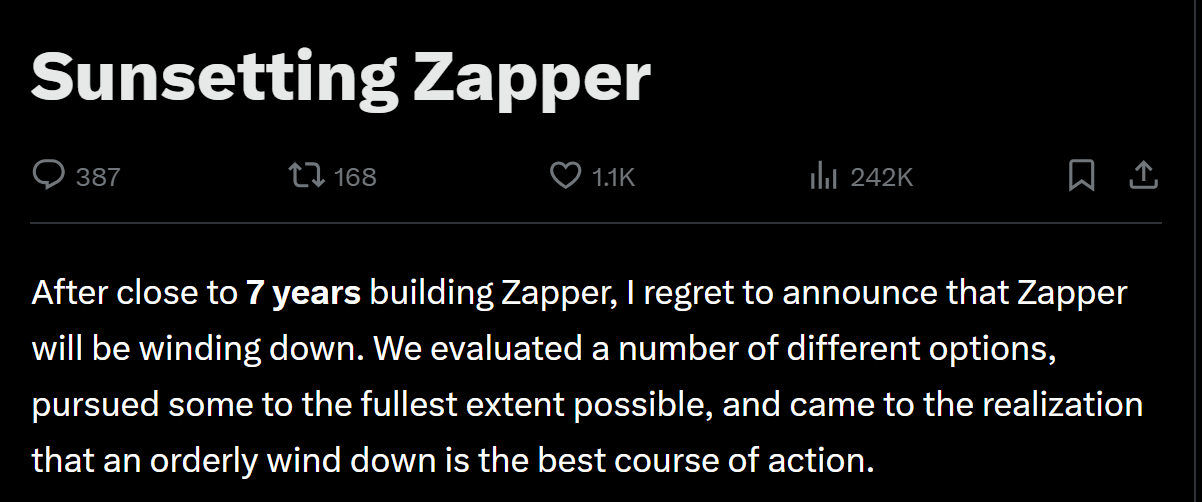
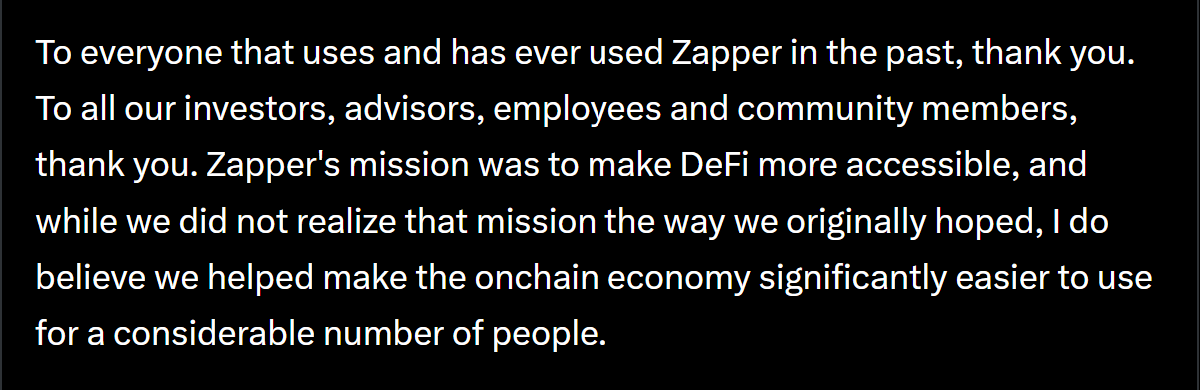
Seb Audet, the Co-Founder and CEO of Zapper, issued a statement on X (formerly Twitter) that struck a tone of somber reflection. While he did not sugarcoat the failure, he framed it within the context of the platform’s original vision.
"Zapper’s mission was to make DeFi more accessible, and while we did not realize that mission the way we originally hoped, the impact we had on the ecosystem and the lessons learned remain a testament to the hard work of our team," Audet noted.
This response highlights a recurring theme in the tech startup world: the difference between "product success" (users loved the product) and "business success" (the company could pay its bills). Audet’s words serve as a poignant reminder that in the volatile world of Web3, even the most beloved products can fail if they lack a moat or a robust monetization strategy.
Implications for the DeFi Industry
The closure of Zapper serves as a harbinger for the next phase of the DeFi industry. The era of "growth-first" startups funded by speculative venture capital is likely drawing to a close, replaced by a more disciplined, enterprise-focused approach.
1. The Death of the "Generalist" Aggregator?
Zapper’s failure suggests that generalized DeFi dashboards may struggle to survive against specialized protocols. In a market where every basis point of yield matters, users are increasingly gravitating toward platforms that provide deep, specialized utility rather than broad, surface-level tracking.
2. The Shift Toward Sustainable Revenue
The industry is moving away from token-incentivized growth models that artificially inflate usage metrics. Future DeFi projects will be judged by their ability to generate real yield or consistent transaction fee revenue that covers their operational costs without relying on inflationary tokenomics or perpetual VC funding.
3. The Maturity of the Ecosystem
Perhaps the most important implication is that DeFi is becoming "boring." By "boring," we mean that it is becoming a mature financial service industry. Projects that treat DeFi as a laboratory for experiments will be replaced by those that treat it as a financial infrastructure business. This means rigorous auditing, lean operational structures, and a laser-focus on margin management.
4. A Warning for Future Founders
For founders, the lesson is clear: build for longevity, not just for a bull market. The ease with which capital was available in previous cycles has created a false sense of security. The "Zapper model"—spending heavily to scale and hoping that revenue will follow—is no longer a viable path to success. Modern DeFi startups must prove their profitability from the ground up, ensuring that they can withstand periods of low volume and high competition.
Conclusion: A Legacy of Innovation
As Zapper prepares to shut down on August 3, 2026, the legacy it leaves behind is complicated but undeniably significant. It was one of the first platforms to truly simplify DeFi for the average user, acting as a gateway for millions of people to interact with decentralized protocols.
While its business model eventually buckled under the weight of market competition and rising infrastructure costs, the technological path it forged remains. Many of the features, UX patterns, and integration standards that Zapper pioneered are now standard across the industry.
The closure of Zapper is not the end of DeFi, but rather a maturation of it. As the sector sheds its experimental skin, it enters a more demanding, professional, and sustainable era. For those who built and used Zapper, the platform remains a symbol of an early, optimistic time in crypto—a time when the mission was to change the world, even if the math did not always support the dream.
