


Main Facts
The current market cycle has proven to be a period of profound disappointment for the stablecoin sector. In a historic shift for digital asset liquidity, more than $10 billion has exited the wider cryptocurrency ecosystem since the beginning of the year. This marks the largest absolute-value liquidity contraction on record, a development that closely mirrors a 25% drop in the total crypto market capitalization over the same timeframe.
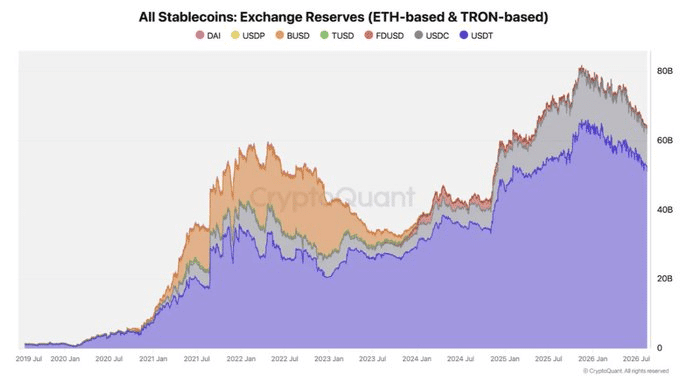
Beneath this macro contraction lies an even more pronounced structural shift: exchange-level stablecoin liquidity has plummeted from a peak of $80 billion down to $64 billion. However, this capital flight has not affected all trading platforms equally. According to recent data from on-chain analytics firm CryptoQuant, Binance has managed to buck the broader trend of capital drain, seeing its market share of stablecoin liquidity expand dramatically from 60% to 68.5%.
While traditional market analysts initially interpreted this centralization of capital as a bearish indicator—suggesting that buying power is starving across secondary platforms and threatening a broader sell-off—new on-chain data paints a more nuanced picture. Crucially, a simultaneous surge in Bitcoin spot demand has begun to challenge the narrative of unmitigated doom, hinting that capital may be rotating out of derivatives and into actual assets as the market attempts to carve out a long-term bottom.
Chronology of the 2026 Liquidity Contraction
To fully understand the gravity of the current market environment, it is necessary to trace how the liquidity landscape has evolved over the course of the year:
- Early Q1 2026: The broader crypto market enters a risk-off phase, triggered by persistent macroeconomic uncertainty, shifting regulatory headwinds, and a cascade of heightened volatility that sidelines retail investors.
- Mid-Q1 2026: Stablecoin reserves across centralized exchanges hit a cyclical peak, hovering between $80 billion. Shortly thereafter, large-scale capital withdrawals begin, signaling the start of the largest absolute-value liquidity contraction in crypto history.
- Late Q1 to Q2 2026: As capital exits the ecosystem, total crypto market capitalization sheds roughly 25%. Concurrently, an asymmetrical liquidity drain takes place across exchanges. While smaller and mid-tier platforms bleed stablecoins rapidly, Binance absorbs a significant portion of the remaining capital, driving its market share upward.
- Late Q2 to Present (2026): Total exchange-based stablecoin liquidity contracts down to $64 billion, while Binance’s dominance solidifies at 68.5%. Despite this severe reduction in overall platform liquidity, on-chain metrics capture an unexpected counter-trend: a sharp revival in spot market accumulation, culminating in a yearly high for combined spot and futures demand.
Supporting Data and On-Chain Metrics
The prevailing narrative of a liquidity crisis is heavily underscored by hard data from CryptoQuant and various exchange order books.
The $10 Billion Exodus
The absolute value of stablecoins leaving the crypto ecosystem year-to-date has eclipsed $10 billion. In past market cycles, contractions of this magnitude were almost universally followed by prolonged periods of price consolidation or severe downward corrections. Because stablecoins act as the primary "dry powder" or fiat-equivalent currency used to purchase volatile assets like Bitcoin and Ethereum, their disappearance from the ecosystem directly throttles the market’s capacity for sustained upward momentum.

Binance’s Centralization of Capital
The movement of remaining stablecoins reveals a striking concentration of wealth. As total exchange stablecoin reserves dropped from $80 billion to $64 billion, Binance emerged as the primary beneficiary of the remaining liquidity.
- Market Share Expansion: Binance’s share of exchange stablecoin liquidity grew from 60% to 68.5%.
- The Competitor Drain: Conversely, secondary and tertiary exchanges experienced an accelerated bleeding of their stablecoin reserves, effectively stripping them of local buying power.
The Divergence: Spot Demand vs. Speculative Retrenchment
While the concentration of stablecoins on a single platform is typically viewed as a technical precursor to further downside—since a failure at Binance or a sudden shift in its user base could trigger systemic liquidations—on-chain indicators reveal a compelling counter-argument regarding spot demand.
For much of the year, speculative demand dominated the market, with leveraged futures trading driving price action while organic retail participation languished. However, recent data highlights a structural reversal:
- 30-Day Sum Total Demand: Bitcoin’s combined futures and spot demand metric reached a 2026 peak of 10,883 BTC.
- De-risking in Derivatives: The growth in this metric is heavily weighted toward spot accumulation rather than speculative positioning. This suggests that actual buyers are stepping in to absorb supply, neutralizing some of the downward pressure typically caused by shrinking stablecoin pools.
Official Responses and Market Analysis
Industry analysts and market researchers have been sharply divided over the implications of these conflicting on-chain signals.
Traditional quantitative analysts view the outflow of stablecoins from the broader ecosystem—coupled with their hyper-concentration on Binance—as a classic warning sign. One prominent market observer noted that when liquidity becomes heavily siloed on a single platform while overall ecosystem reserves dry up, the structural health of the market deteriorates. "The buying power of alternative platforms is severely hindered," analysts pointed out, suggesting that smaller exchanges could face severe liquidity crunches if market makers decide to pull capital entirely out of crypto rails.
On the other hand, blockchain data scientists and decentralized finance (DeFi) researchers argue that traditional liquidity metrics fail to account for capital rotation. Several on-chain commentators have highlighted that falling exchange balances do not always equate to capital leaving crypto entirely; frequently, stablecoins migrate to self-custody wallets, decentralized exchanges (DEXs), or are directly deployed into spot assets.
Furthermore, defenders of the current market structure point out that the purging of speculative leverage—evidenced by the cooldown in derivative markets—often precedes healthier, more sustainable market recoveries. By shaking out hyper-leveraged retail traders, the market clears out systemic vulnerability, paving the way for institutional and spot-driven accumulation.
Implications for the Future of the Market
The intersection of contracting stablecoin liquidity, exchange centralization, and rising spot demand carries profound implications for the remainder of 2026 and beyond.
1. The Death (and Rebirth) of Retail Speculation
The current cycle has made it abundantly clear that the era of easy, highly leveraged retail speculation is facing a stern reality check. With $10 billion leaving the ecosystem and smaller exchanges starved of stablecoins, hyper-speculative altcoin seasons have become considerably harder to sustain. Retail investors, battered by macroeconomic uncertainty and heightened volatility, have largely retreated to the sidelines.
2. Binance as the Market’s Ultimate Pivot Point
With Binance now commanding over 68.5% of all exchange-held stablecoin liquidity, the exchange holds unprecedented influence over short-term price action. While this centralization offers deep liquidity pools for traders operating on the platform, it introduces a single point of structural vulnerability. Any regulatory pressure, operational friction, or sudden risk-off behavior originating on Binance will have an outsized, cascading effect on the entire cryptocurrency market.
3. The Green Shoots of a Market Bottom
Despite the undeniably bearish optics of a $16 billion drop in exchange stablecoin reserves from peak levels, the simultaneous rise in spot demand—highlighted by Bitcoin’s 10,883 BTC 30-day sum total peak—suggests that long-term participants are quietly accumulating.
If capital is indeed rotating out of speculative stablecoin balances and moving directly into hard spot assets, the current liquidity crunch may be misinterpreted. Rather than signaling an impending market collapse, these dynamics could represent the painful, yet necessary, final stages of market capitulation and bottom-formation. As macroeconomic fears continue to weigh on global risk assets, crypto’s ability to foster genuine spot demand in the face of a liquidity drain may ultimately determine whether the market can engineer a sustainable recovery in the quarters ahead.
