

By Financial Markets Desk
Published September 23, 2026
Main Facts
Cryptocurrency markets surged into a broad-based rally as Bitcoin decisively pierced the $86,500 threshold on Tuesday. This upward push shattered the stubborn resistance ceiling that had capped price action through the entirety of September. The leading digital asset’s breakout propelled the cumulative global cryptocurrency market capitalization above the vital $3 trillion milestone.
Market sentiment has turned decidedly bullish. The Crypto Fear & Greed Index printed a reading of 79—firmly seated in "greed" territory—while the Altcoin Season Index registered at 49. This indicates that while alternative tokens are beginning to experience aggressive capital inflows, Bitcoin maintains clear market dominance.
The digital asset rally is not occurring in a vacuum. It aligns seamlessly with a powerful, risk-on sentiment taking hold across traditional financial equities. Wall Street has experienced consecutive sessions of robust buying, driven primarily by blockbuster performances in artificial intelligence-related technology stocks and surging semiconductor chipmakers.
Simultaneously, macroeconomic crosscurrents have created a complex environment. Although the Federal Reserve enacted a 25-basis-point interest rate hike earlier in the month to combat stubborn inflation, its ongoing technical balance sheet operations continue to inject vital liquidity into the financial system, providing an unexpected tailwind for risk-on asset classes like cryptocurrencies.
Chronology
To understand how the market arrived at this crucial juncture, it is helpful to trace the sequence of macroeconomic and sector-specific events that shaped September 2026:
- Early September 2026: Rising energy costs begin to weigh heavily on global supply chains. Gasoline prices drive a significant portion of consumer price pressures, forcing economic forecasters to price in potential monetary tightening by central banks.
- September 8, 2026: Crude oil benchmarks (Brent and WTI) hover near local highs before geopolitical developments in the Middle East begin to shift expectations surrounding global energy supplies.
- September 16, 2026: In a unanimous 12-0 vote, the Federal Open Market Committee (FOMC) raises its benchmark interest rate by 25 basis points to a target range of 3.75% to 4.00%. This marks the central bank’s first rate hike since 2023, prompted by an acceleration in the Producer Price Index (PPI) to 5.4% annually.
- Monday, September 21, 2026: Wall Street records a historic session. The Nasdaq Composite closes at an all-time record high, surging 2.26% in its best single-day performance since June. AI-linked equities explode upward, with Intel rallying 12% and Advanced Micro Devices (AMD) gaining approximately 10% to breach a $1 trillion market capitalization.
- Tuesday, September 22, 2026: Bitcoin definitively breaks out above $86,500, clearing the dense historical resistance zone between $79,673 and $84,144. Meanwhile, chipmaker equities extend their winning streak—the longest consecutive run for the sector since April—while macroeconomic news regarding potential diplomatic breakthroughs in the Strait of Hormuz causes crude oil prices to drop sharply.
Supporting Data
A deep dive into on-chain metrics, technical charting indicators, and macroeconomic data paints a comprehensive picture of the current financial landscape:
Market Metrics and Sentiment Indicators
- Total Crypto Market Capitalization: Surpassed $3 trillion following Bitcoin’s push past $86,500.
- Crypto Fear & Greed Index: 79 (Greed).
- Altcoin Season Index: 49 (Indicates a balanced market where Bitcoin still leads, though altcoins are rapidly gaining momentum).
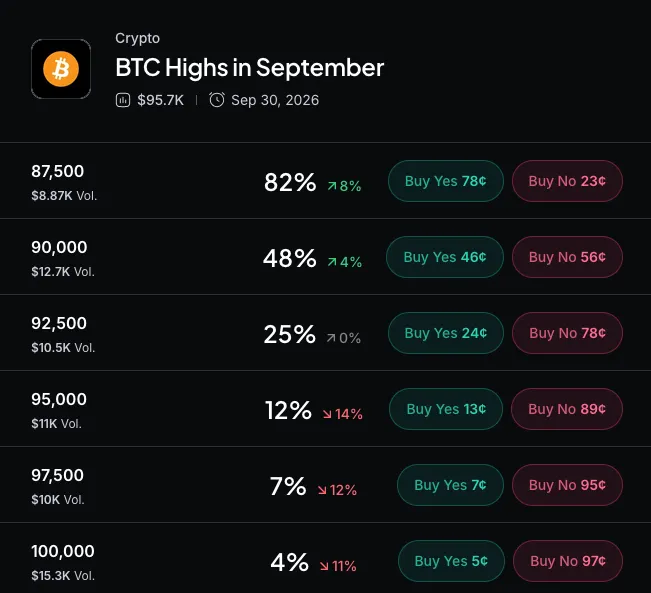
- Prediction Market Odds (Myriad): Traders on the decentralized prediction platform Dastan are pricing in a 48% probability that Bitcoin touches $90,000 by the end of September, compared to a 25% probability of reaching $92,500.
Technical Analysis: Bitcoin (BTC/USD)
- Immediate Resistance Targets (Fibonacci Extensions): $90,763 and $95,074.
- Key Support Zones: If a market correction materializes, the primary defense zone sits between $79,673 and $84,144. A breakdown below this region exposes lower supports at $75,436 and the critical summer defense floor at $73,617.
- Chart Patterns: Bitcoin has printed a classic "golden cross" on the daily timeframe—a widely watched bullish formation where the 50-day moving average crosses definitively above the 200-day moving average.
Altcoin Performance (Trailing 7-Day Metrics)
- Zcash (ZEC): Extended a multi-month rally to trade at $1,551, representing a stellar 36.7% gain over seven days.
- Solana (SOL): Climbed 18.2% across the week.
- XRP: Advanced to $1.57 amid renewed regulatory clarity discussions.
- Broad Market Breadth: Across the top 100 cryptocurrencies by market capitalization, an astounding 97 are reporting positive price performance over the past seven days.
Macroeconomic and Monetary Data
- Federal Reserve Balance Sheet: Fed bond holdings sit at approximately $6.7 trillion. While significantly down from the $9 trillion peak recorded in 2022, the balance sheet is no longer shrinking due to the Fed’s ongoing, technical purchases of short-term Treasury bills initiated in December 2025 to maintain "ample" bank reserves.
- Producer Price Index (PPI): Accelerated to an annualized rate of 5.4% in August, forcing the Fed’s hand regarding the mid-September rate hike.
- Crude Oil Correction: Brent crude briefly slipped below $98 per barrel, and WTI fell under $93 per barrel—their lowest marks since September 8.
Official Responses and Geopolitical Developments
The macroeconomic narrative was further complicated this week by high-level political statements concerning international trade, energy security, and Middle Eastern geopolitics.
Addressing the United Nations General Assembly, President Donald Trump commented on ongoing diplomatic efforts in the Middle East, stating that he anticipates a comprehensive trade and security deal with Iran "right after the election," referencing the upcoming November midterms.
This diplomatic optimism was bolstered by reports that Tehran had signaled a willingness to reopen the strategically vital Strait of Hormuz within days if Washington eases economic pressure. Simultaneously, Saudi officials confirmed that work is underway to fully restart the kingdom’s major East-West pipeline by the weekend.
These developments triggered an immediate retreat in global energy markets. Traders had spent weeks pricing in worst-case scenarios regarding maritime transit disruptions in the Persian Gulf. The sudden prospect of restored oil flows provided immediate relief to global supply chains, driving crude oil benchmarks down sharply and easing fears of a prolonged, energy-driven inflationary spiral.
Regarding monetary policy, Federal Reserve officials have maintained a guarded stance following their unanimous decision to hike rates to the 3.75%–4.00% range on September 16. Wall Street analysts are currently divided over whether the September increase was a reactive, isolated measure designed to offset the summer oil shock, or the inaugural step in a new tightening cycle. The central bank’s median projections for 2026 continue to target a federal funds rate of approximately 4.1% by year-end, with the next critical policy meeting scheduled for October 27–28.
Implications
The convergence of record-breaking equity markets, surging semiconductor valuations, a stabilizing Federal Reserve balance sheet, and a resilient cryptocurrency sector carries profound implications for institutional and retail investors alike.
1. The Paradox of Fed Policy
The most intriguing dynamic in current global finance is the apparent contradiction within Federal Reserve policy. By raising interest rates by 25 basis points in September, the central bank signaled its ongoing war against persistent inflation. However, by continuing its regular purchases of short-term Treasury bills to supply liquidity to the banking sector, the Fed is effectively injecting cash back into the financial system. This balance sheet expansion ($6.7 trillion and holding steady) directly counters the restrictive monetary stance of higher interest rates. For risk assets like Bitcoin and technology equities, this liquidity buffer acts as a powerful safety net, absorbing Treasury debt issuance and fueling speculative capital inflows.
2. Institutional Risk-On Appetite
The synchronized rally of Nasdaq tech giants—highlighted by AMD crossing the $1 trillion market cap threshold—and Bitcoin’s breakthrough past $86,500 demonstrates that institutional risk appetite remains robust. Rather than retreating from high-beta assets in the face of higher borrowing costs, institutional allocators are increasingly treating top-tier digital assets as high-growth components of a diversified risk-on portfolio.
3. Altcoin Season on the Horizon?
While Bitcoin continues to command market leadership (as reflected by the Altcoin Season Index reading of 49), the aggressive double-digit gains seen across tokens like Solana, XRP, and Zcash suggest that capital is beginning to trickle down the risk curve. If Bitcoin successfully consolidates above its current levels and makes a run toward the $90,763 resistance target, historical market cycles suggest that liquidity could rotate aggressively into mid- and small-cap altcoins, potentially triggering a broader altcoin market surge.
4. Downside Risks and Volatility Warnings
Despite the prevailing euphoria, market participants must remain cognizant of structural risks. The technical setup demands caution: failure by bulls to defend the $79,673–$84,144 support zone during any macroeconomic pullback could trigger cascading liquidations, driving prices rapidly down toward $75,436 and $73,617. Furthermore, with the next FOMC meeting looming at the end of October, any unexpected hawkish shift in central bank rhetoric—or unforeseen developments in geopolitical flashpoints—could instantly alter the prevailing risk-on narrative.
Disclaimer: The views and opinions expressed in this article are for informational and educational purposes only. They do not constitute financial, investment, legal, or trading advice. Readers should conduct their own thorough research and consult with a qualified financial advisor before making any investment decisions.
