

The global financial landscape stands at a watershed moment. As the sun rises over San Salvador, the Republic of El Salvador is poised to make history by becoming the first sovereign nation to adopt Bitcoin as legal tender. This monumental shift, codified under the "Bitcoin Law," mandates that all economic agents accept the cryptocurrency as a medium of exchange, effectively positioning the nation at the vanguard of a radical monetary experiment.
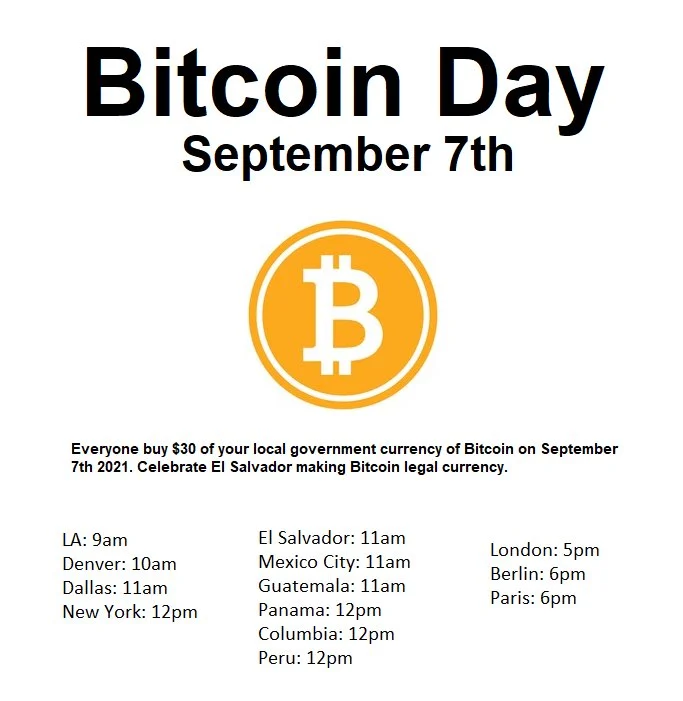
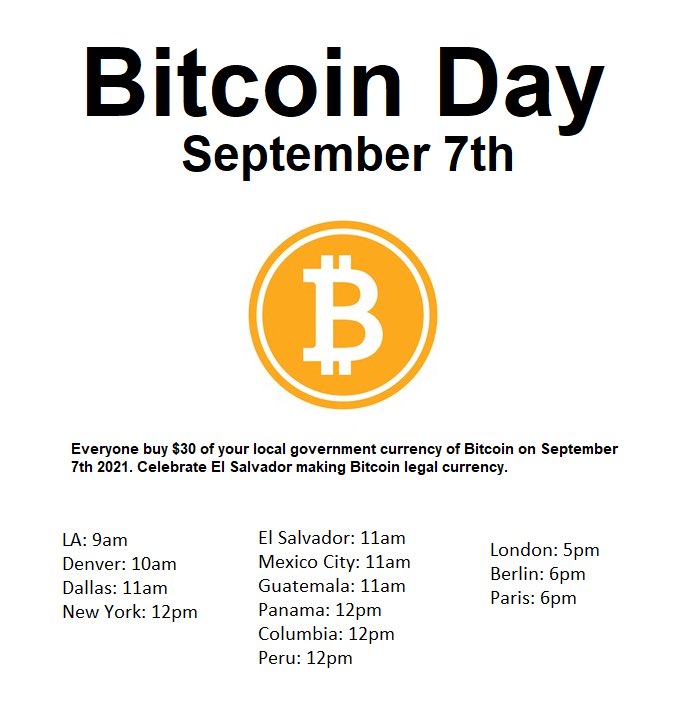
As the clock ticks down toward this transition, the global Bitcoin community—a decentralized network of investors, developers, and enthusiasts—is engaging in a coordinated, grassroots show of solidarity. The initiative is simple yet symbolic: an international "buy-in" movement, urging participants to purchase $30 worth of Bitcoin to commemorate the day and demonstrate support for the Central American nation’s bold economic pivot.
Chronology of a Grassroots Movement
The origins of this movement can be traced back to a single, unassuming thread on the /r/Bitcoin subreddit. On September 5, 2021, a user posed the question: "So… We all buying $30 worth of Bitcoin on Tuesday?" The suggestion quickly gained momentum, capturing the zeitgeist of a community that prides itself on decentralized action. Within hours, the post garnered thousands of upvotes and thousands of comments, reflecting a level of organic coordination rarely seen in traditional financial markets.
By September 6, the sentiment had migrated from Reddit to the broader crypto-sphere, most notably Twitter. Memes, hashtags, and viral infographics began to circulate, transforming the Reddit suggestion into a global campaign. Influential figures within the space, including MicroStrategy CEO Michael Saylor, amplified the message to millions of followers, further cementing the date—September 7, 2021—as a day of symbolic action.
The movement reached across borders, with communities in South Korea, Brazil, and Europe translating the initiative into local languages. Notably, in Brazil, the date held additional significance as it coincided with the country’s Independence Day, allowing the Bitcoin community to weave narratives of monetary sovereignty into the local cultural fabric.
Analyzing the $30 Symbolism and Market Dynamics
The choice of $30 is intentional. Proponents of the movement have emphasized that the goal is not to manipulate market prices or orchestrate a "pump." Rather, the amount is intentionally small, ensuring accessibility for retail participants while mitigating the risks of market volatility.
However, the campaign has not been without its detractors. Critics have raised concerns about the optics of such coordination, with some social media users labeling the movement "greasy" or an attempt to engineer a manufactured price spike. Skeptics argue that such coordinated buying could be interpreted as market manipulation, potentially leading retail investors into a trap.
"Everyone needs to be aware that this could possibly be leading the sheep to their death," one skeptical commenter noted on Reddit. "These narratives are appearing just before we hit significant technical retracement levels."
Despite these warnings, the prevailing sentiment among supporters remains one of ideological alignment. For many, the $30 purchase is not about immediate financial gain, but about participating in a historic, global event that challenges the status quo of fiat-based monetary policy.
The Role of Institutional Heavyweights
The involvement of high-profile figures like Michael Saylor has added a layer of complexity to the narrative. As the CEO of a publicly traded company with billions of dollars in Bitcoin holdings, Saylor’s support for the grassroots effort serves as a bridge between retail sentiment and institutional interest.
Saylor has consistently maintained that MicroStrategy is a long-term holder, explicitly stating that the company has no immediate plans to divest its holdings. This public stance acts as a stabilizing force for those who fear that the "buy-in" movement is a precursor to a large-scale institutional "dump." The transparency of the blockchain ensures that any movement of funds from major institutional wallets will be visible to the public, providing a level of accountability that traditional financial markets often lack.
Implications for El Salvador’s Economic Future
The implementation of the Bitcoin Law is not merely a technical upgrade; it is an economic overhaul. For El Salvador, the adoption of Bitcoin as legal tender aims to solve several structural issues, most notably the high costs associated with remittance payments, which represent a significant portion of the nation’s GDP. By bypassing traditional banking intermediaries, the government hopes to lower transaction fees and increase financial inclusion for the unbanked population.
The success of this policy will likely depend on the government’s ability to build the necessary infrastructure. From the rollout of the "Chivo" digital wallet to the deployment of physical Bitcoin ATMs across the country, the logistical challenges are immense. The international community, watching from the sidelines, is eager to see whether this "digital dollarization" can provide a viable alternative to existing financial systems.
Global Reactions and Regulatory Scrutiny
The move has drawn criticism from international financial institutions, including the International Monetary Fund (IMF) and the World Bank, both of which have voiced concerns regarding the potential impact on financial stability and consumer protection. Critics point to the inherent volatility of Bitcoin as a major risk factor for an economy that relies on a stable medium of exchange.
Conversely, proponents argue that the volatility of Bitcoin is a secondary concern compared to the systemic inflation associated with fiat currencies. For the people of El Salvador, the adoption of Bitcoin is seen as a hedge against the devaluation of the U.S. dollar, which has served as the country’s official currency since 2001.
A New Era of Decentralized Solidarity
Perhaps the most striking aspect of this event is the sense of unity it has fostered across geographic and socioeconomic divides. As Twitter user Tomer Strolight noted, the phenomenon of Bitcoin has created a sense of benevolence among strangers that is unprecedented. The ability to unite people from diverse backgrounds—all focused on a singular, technological solution to monetary problems—is a testament to the unique power of the Bitcoin network.
The "3 PM El Salvador Time" target for the coordinated buy represents a climax to this period of anticipation. It is a moment where the digital and the physical worlds collide, testing the limits of what a decentralized community can achieve when it rallies behind a single, shared purpose.
Conclusion: The Long-Term View
Whether the events of September 7 result in a price surge, a period of consolidation, or a correction, the broader impact of El Salvador’s decision will be felt for years to come. The nation has effectively become a living laboratory for cryptocurrency adoption.
The $30 buy-in, while minor in the context of global market volume, stands as a symbol of the decentralized era. It represents a collective acknowledgement that the future of money is being rewritten, not in the boardrooms of central banks, but in the open-source code and global communities that power the Bitcoin network. As the world watches, one thing is certain: the financial status quo has been permanently challenged, and the experiment in El Salvador will serve as the benchmark for every nation that considers following in its footsteps.
Data Summary Table: The September 7th Initiative
| Category | Details |
|---|---|
| Objective | Commemorate El Salvador’s Legal Tender Day |
| Action | Purchase $30 USD worth of Bitcoin |
| Primary Platforms | Reddit (/r/Bitcoin), Twitter, Telegram |
| Institutional Support | Publicized by Michael Saylor (MicroStrategy) |
| Potential Risks | Market volatility, regulatory scrutiny, "pump-and-dump" concerns |
| Long-term Goal | Promote financial inclusion and monetary sovereignty |
Disclaimer: This article is for informational purposes only and does not constitute financial advice. Readers should perform their own due diligence before participating in any market activities or cryptocurrency investments.
