

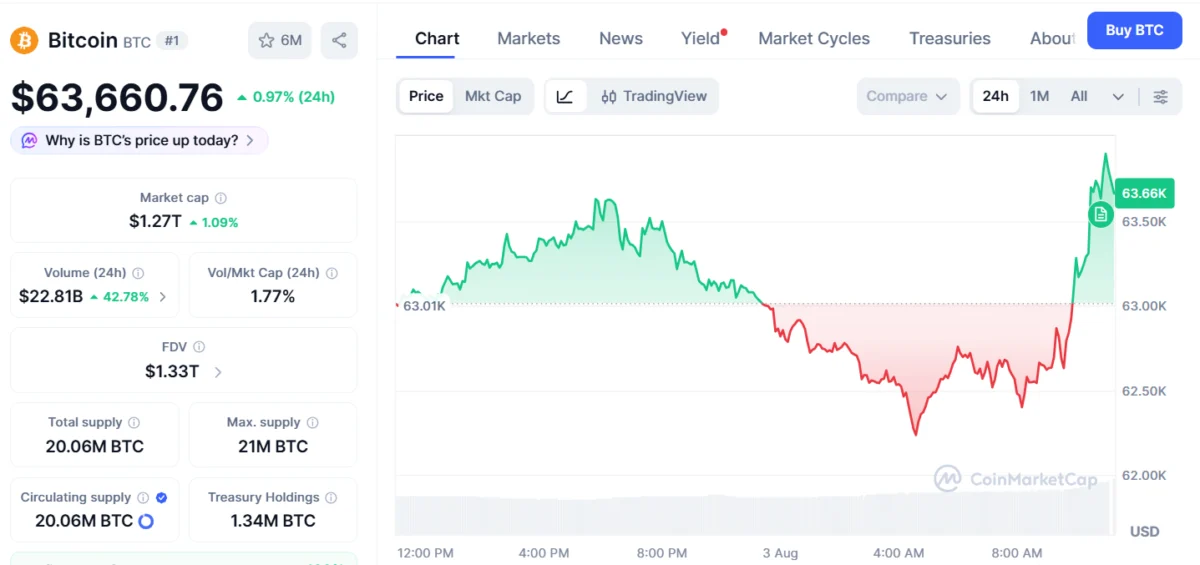
In a striking reversal of historical market norms, the global financial landscape is witnessing an unusual divergence: the "volatile" asset class of Bitcoin is currently exhibiting lower expected volatility than the bedrock of global finance—the U.S. Treasury market. While bond traders are bracing for turbulence not seen since the height of the spring banking crisis, the cryptocurrency market remains surprisingly sanguine.
This phenomenon, while counterintuitive, offers a profound look into the changing perceptions of risk in a macro environment defined by persistent inflation, geopolitical tension, and a shifting interest rate landscape.
Main Facts: A Tale of Two Volatilities
The core of this market shift lies in the measurement of implied volatility. The MOVE index, which tracks the volatility of U.S. Treasury bonds, has surged from a baseline of 80 earlier this week to roughly 104. This represents the highest reading since March 2024, signaling significant anxiety among institutional investors regarding the stability of sovereign debt.
Conversely, the Bitcoin Volatility Index (BVIV), provided by Volmex, which tracks 30-day implied volatility for Bitcoin, has been hovering near the 37 mark—remarkably close to its 2026 low of 35. Simultaneously, the Cboe VIX, the "fear gauge" for the S&P 500, is anchored near yearly lows of 14.
The divergence is clear: the bond market is currently pricing in a higher degree of uncertainty and potential for rapid price swings than the crypto market. This flips the traditional narrative on its head, where Bitcoin was universally characterized as the high-beta, high-risk outlier that would inevitably react with violent swings to any sign of macroeconomic instability.
Chronology: The Escalation of Treasury Stress
The current volatility mismatch did not happen overnight; it is the culmination of a sequence of macroeconomic developments that have forced a re-evaluation of risk.
- Early Q1 2026: Markets began the year with optimism regarding the trajectory of interest rates. However, persistent inflation data began to cast doubt on the Federal Reserve’s ability to maintain a dovish stance.
- Mid-February: The U.S. 10-year Treasury yield, a global benchmark for borrowing costs, began a steady ascent, briefly touching the 5.2% threshold. This climb acted as a shock to the bond market, which had grown accustomed to lower yield environments.
- The Current Week: As yields stabilized at elevated levels, the MOVE index experienced a sharp spike. The rapid move in bond prices forced traders to pay a premium for protective options, driving up the cost of hedging against further Treasury fluctuations.
- Bitcoin’s Response: While Bitcoin’s price rally stalled in response to the rising yields—highlighting that the asset is not entirely immune to the cost of capital—the options market failed to reflect the "panic" pricing seen in Treasuries. Traders are choosing not to hedge against extreme BTC swings, suggesting a lack of conviction in a downward breakout.
Supporting Data: Dissecting the Divergence
To understand why this shift is so significant, one must look at the correlation metrics between these asset classes. Historically, when Treasury yields rise, risk assets (like stocks and crypto) experience increased volatility as liquidity tightens and financing costs rise.
However, recent data shows that the correlation between the MOVE index and both S&P 500 and Bitcoin volatility has effectively broken down. The correlation coefficient has trended toward zero, or even turned negative in some windows. This suggests that the "fear" currently infecting the bond market is localized to interest rate policy and fiscal sustainability concerns, rather than systemic contagion.
Key Metrics Comparison:
| Index | Current Reading | Yearly Context |
|---|---|---|
| MOVE Index (Treasury Vol) | ~104 | High (Highest since March) |
| BVIV (Bitcoin Vol) | ~37 | Near 2026 Low (35) |
| Cboe VIX (S&P 500 Vol) | ~14 | Near Yearly Low |
The data indicates that the "safe haven" asset is currently the one experiencing the most stress. Investors in the bond market are reacting to the fiscal reality of U.S. debt, while Bitcoin holders are seemingly looking past short-term rate fluctuations, perhaps viewing the asset as a long-term hedge against fiat debasement regardless of immediate yield shifts.
Official Perspectives and Market Analysis
Market analysts are divided on what this divergence signals. Some argue that the calm in Bitcoin is a sign of "maturity," where the asset is increasingly held by long-term, "HODLer" institutional entities who are less prone to panic selling during macro-shocks.
"What we are seeing is a decoupling of risk perceptions," notes one senior fixed-income strategist. "Bond traders are trapped in a cycle of reacting to every Fed utterance and energy price spike. Bitcoin traders, however, have already priced in a high-inflation, high-volatility world. They are no longer surprised by the macro narrative, so they are not paying for the volatility premium that bond traders currently are."
Conversely, some traditional finance experts warn that the lack of volatility in Bitcoin could be a "calm before the storm." If the bond market stress spills over into broader financial liquidity—the so-called "plumbing" of the global economy—Bitcoin could be sold indiscriminately as institutional desks liquidate assets to meet margin calls on their bond positions.
Implications: A New Era for Crypto and Bonds?
The implications of this shift are profound for investors and policymakers alike.
1. The Redefinition of "Risk"
For years, the crypto industry has fought to be treated as a legitimate asset class. By exhibiting lower volatility than the Treasury market, Bitcoin is effectively challenging its label as a "speculative toy." If Bitcoin continues to show lower realized and implied volatility than government bonds, the case for its inclusion in institutional portfolios as a stabilizer—rather than a disruptor—gains weight.
2. The Bond Market as the New Epicenter
The spike in the MOVE index is a warning sign that the primary threat to market stability is no longer crypto-native leverage, but sovereign debt management. When the risk-free rate becomes the most volatile component of a portfolio, the entire structure of the global market is forced to recalibrate.
3. The Risk of Spillover
While correlations are currently low, they are not permanently severed. If the Treasury market experiences a "liquidity event" (a sudden inability to find buyers at prevailing yields), the resulting systemic panic would likely force a sell-off in every liquid asset, including Bitcoin. The current calm in the crypto market may be a sign of strength, but it should not be mistaken for complete immunity from global liquidity cycles.
4. Strategic Positioning
For traders, the current environment presents a unique opportunity to exploit the volatility gap. With Bitcoin options being relatively cheap compared to the elevated fear in the bond market, some sophisticated players are likely using the current lull to accumulate positions, betting that the "fear" will eventually rotate back into traditional risk assets or that Bitcoin will continue to trade based on its own internal supply/demand dynamics rather than the whims of the U.S. Treasury.
Conclusion: A Market in Transition
The current state of the financial markets is a testament to the fact that nothing remains static. Bitcoin, once the wild child of finance, is currently sitting in a state of quiet consolidation, while the bond market—the anchor of the global economy—is navigating choppy waters.
Whether this indicates a fundamental shift in Bitcoin’s role as a store of value or merely a temporary divergence caused by unique macro conditions remains to be seen. However, one thing is certain: the market is no longer following the old rulebook. As yields remain high and the bond market continues to grapple with the complexities of the current economic cycle, all eyes will be on whether Bitcoin can maintain its composure, or if the "volatile" asset is simply waiting for the right moment to reclaim its reputation.
Investors should remain vigilant. The divergence is a reminder that in modern finance, the most dangerous risks are often found where we least expect them, and the assets we label as "safe" are just as susceptible to the winds of uncertainty as the ones we label as "risky."
