


By Financial Markets Desk
Published: August 2026
Main Facts
The Bank for International Settlements (BIS)—frequently referred to as the "central bank for central banks"—has hardened its stance against privately issued, U.S. dollar-pegged stablecoins. Speaking on the sidelines of the prestigious Jackson Hole economic symposium, BIS official Pablo Hernández de Cos delivered a stark warning: dollar-denominated stablecoins are not a credible payment mechanism at scale, and more importantly, they present an existential threat to global monetary sovereignty.
While USD-backed stablecoins—led by industry giants Tether (USDT) and Circle (USDC)—currently command over 90% of the entire stablecoin market supply, their rapid expansion into emerging economies is triggering alarm bells among international policymakers. Rather than embracing decentralized or private digital assets, the BIS is aggressively championing bank-led wholesale alternatives, specifically tokenized deposits and central bank digital currencies (CBDCs).
According to the BIS, stablecoins exhibit limited commercial utility outside of crypto-native trading pairs and niche retail remittances. However, their growing footprint in developing nations suffering from high inflation or collapsing local fiat currencies—such as parts of South America, where Bolivia is actively weighing incorporating USDT into its official payment systems—threatens to induce a phenomenon known as "digital dollarization."
As traditional financial heavyweights like JPMorgan test proprietary tokenized deposit networks and the European Central Bank (ECB) explores bringing central bank money on-chain, a high-stakes battle is brewing. It is a fundamental clash of architectures: private tech-firm-backed ledgers versus state-sanctioned, bank-led tokenized money.
Chronology of Events
To understand how the global financial architecture arrived at this flashpoint, it is necessary to trace the escalation of regulatory scrutiny surrounding stablecoins over recent years:
- The 2020–2021 Pandemic Boom: Driven by decentralized finance (DeFi) mania and pandemic-era liquidity, stablecoins transcended their origins as crypto-trading instruments to become widely utilized cross-border settlement tools, with market caps multiplying exponentially.
- The 2022–2023 Regulatory Wake-Up Call: The spectacular collapse of algorithmic stablecoins and various crypto credit institutions forced international bodies, including the Financial Stability Board (FSB) and the BIS, to draft stringent global regulatory frameworks to curb systemic risk.
- The 2024–2025 Emerging Market Infiltration: As hyperinflation battered currencies in nations like Argentina, Venezuela, and parts of Africa, citizens bypassed local banking systems en masse to hold digital dollars via Tether. Concurrently, regional governments began exploring legal frameworks to accommodate these assets.
- Summer 2026 Volatility: Visa data revealed a sharp 37% contraction in stablecoin transaction volumes over the summer months, dropping from a staggering $1.8 trillion at the end of June to $1.13 trillion in August, pointing to a temporary cooling period in retail and commercial traction.
- August 2026 (Jackson Hole Symposium): BIS head Pablo Hernández de Cos officially draws a line in the sand, dismissing stablecoins as scalable payment methods while warning of widespread monetary destabilization and endorsing tokenized deposits as the superior structural alternative.
Supporting Data & Market Metrics
The debate over stablecoins is rooted in staggering numbers, massive market concentration, and recent behavioral shifts within the digital asset ecosystem:

- Market Dominance: USD-denominated stablecoins maintain an iron grip on the digital asset economy, capturing over 90% of the total stablecoin supply. Tether and Circle remain the clear duopoly dictating liquidity flows across both centralized and decentralized exchanges.
- Volume Slump: Transaction metrics compiled by payment giant Visa demonstrate the cyclical nature of stablecoin usage. Volumes experienced a notable correction during the summer of 2026, plunging 37% in roughly two months—falling from $1.8 trillion in late June down to $1.13 trillion by August. Analysts remain divided on whether this signals a structural plateau or a temporary macro-driven cool-down.
- The "Digital Dollarization" Footprint: In regions with acute macroeconomic instability, USDT has effectively replaced local fiat as the primary medium of exchange and store of value. South America represents a primary adoption hub, highlighted by Bolivia’s exploratory steps toward integrating USDT into its official national payment apparatus.
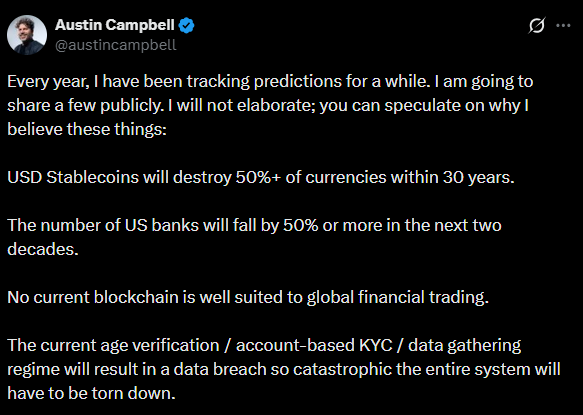
- The 30-Year Horizon: Macroeconomic forecasters and academic voices have framed the threat in severe terms. Notably, Austin Campbell, an adjunct professor at Columbia Business School, has publicly forecasted that the aggressive expansion of USD-backed stablecoins could erode and effectively destroy over 50% of sovereign national currencies globally within the next three decades.
Official Responses & Institutional Perspectives
The ideological chasm between the crypto-native financial ecosystem and traditional central banking institutions has never been wider.
The Bank for International Settlements (BIS)
The BIS views the rise of private stablecoins not as financial innovation, but as a direct challenge to the monopoly of state-backed currency issuance. Pablo Hernández de Cos articulated that while tokenization holds genuine promise for streamlining global finance, private tech firms cannot be trusted to manage the foundational plumbing of monetary policy.
"The growing adoption of dollar-pegged stablecoins has also raised concerns in some jurisdictions about monetary sovereignty and the potential for digital dollarization."
To solve this, the BIS is aggressively promoting tokenized deposits—digital representations of commercial bank money recorded on distributed ledgers. De Cos argued that tokenized deposits achieve the exact same operational efficiencies as stablecoins without breaking the continuity of the traditional financial system:
"Tokenised deposits offer a more direct path to harness tokenisation while preserving the monetary system’s foundations."
Academia and Wall Street Analysts
Independent economists and banking experts echo the BIS’s structural concerns, albeit with varying degrees of alarm. Institutional stalwarts are moving swiftly to develop proprietary alternatives. Wall Street titan JPMorgan Chase has continuously refined its multi-billion-dollar tokenization strategies, while European regulators—including the ECB—are laying the groundwork to place central bank reserves directly onto secure blockchain rails.
Conversely, stablecoin issuers and Web3 advocates maintain that private-sector innovation offers crucial utility that lethargic legacy banking systems cannot match. They argue that stablecoins provide instant, frictionless, 24/7 cross-border settlement for millions of unbanked or underbanked individuals who are poorly served by bureaucratic domestic banking infrastructures.
Global Implications
The policy pivot signaled by the BIS at Jackson Hole carries profound implications for the future of money, geopolitics, and international trade:
1. The Erosion of Domestic Monetary Control
For developing economies, the widespread adoption of U.S. dollar stablecoins effectively strips central banks of their ability to set interest rates, control domestic money supply, or manage inflation. If citizens and businesses prefer holding digital dollars over rapidly depreciating local fiat, domestic monetary policy becomes toothless, forcing emerging market governments into desperate defensive postures.
2. The Institutional Counter-Offensive
Commercial and central banks are no longer ignoring blockchain technology; they are attempting to absorb and co-opt it. By rolling out tokenized deposits and sovereign CBDCs, the traditional financial sector aims to capture the speed and programmable efficiency of tokenization while retaining total regulatory oversight and KYC/AML compliance.
3. A Bifurcated Global Financial Future
The ultimate outcome of this friction may result in a bifurcated system. On one side, a state-controlled, permissioned network of tokenized commercial bank deposits and wholesale CBDCs will service institutional trade, enterprise transactions, and regulated jurisdictions. On the other side, permissionless, decentralized dollar stablecoins will likely continue to thrive in the shadows of emerging economies, censorship-heavy regimes, and peer-to-peer retail markets.
As the BIS applies maximum diplomatic and regulatory pressure, the next few years will determine whether private stablecoins can successfully withstand the weight of global central banking opposition—or if they will be systematically regulated into extinction by a wave of sovereign-backed digital currencies.
