

Global fintech titan Revolut has officially entered the digital asset issuing arena, launching its inaugural euro-based stablecoin, EURR, on Wednesday, August 26. The move marks a significant milestone for the digital banking giant, expanding its footprint deeper into the blockchain ecosystem. However, the arrival of EURR has sparked vigorous debate across the cryptocurrency and traditional financial sectors.
While the fintech firm positions EURR as a versatile financial instrument designed to comply with Europe’s stringent new regulatory frameworks, market analysts remain sharply divided over whether euro-backed tokens can genuinely challenge the unyielding dominance of U.S. dollar-denominated stablecoins.
1. Main Facts
The core developments surrounding Revolut’s latest strategic pivot encompass regulatory pressures, market positioning, and the technical mechanics of the newly released token:
- The Launch of EURR: On August 26, Revolut debuted its proprietary euro-pegged stablecoin, EURR, marking the company’s maiden voyage into stablecoin issuance. Revolut management has confirmed that EURR is only the first step, with stablecoins pegged to other major global currencies slated for release in the near future.
- The MiCA Effect and USDT Delisting: The introduction of EURR coincides with sweeping regulatory changes in Europe. Under the European Union’s Markets in Crypto-Assets (MiCA) regulation, Tether’s market-leading U.S. dollar stablecoin, USDT, failed to secure the necessary operational licenses. Consequently, major platforms operating within the European Economic Area are scrubbing USDT from their listings, with Revolut scheduled to completely drop support for USDT by the end of August.
- Market Dominance and Competitors: Currently, USD-backed stablecoins—led by Tether’s USDT and Circle’s USDC—command over 90% of the global stablecoin market share. Within the euro-pegged niche, Circle’s EURC currently reigns supreme, boasting a supply of roughly $455 million, which accounts for over 50% of the total $772 million euro-stablecoin market.
- Explosive Non-USD Growth: Despite the overwhelming dominance of the greenback, Artemis analytics data reveals that non-USD stablecoins are experiencing explosive triple-digit adoption curves, vastly outpacing the percentage growth of their dollar-denominated predecessors.
2. Chronology of Events
To understand how Revolut arrived at the launch of EURR, it is essential to trace the timeline of regulatory milestones and corporate adjustments leading up to late August:
- Late 2023 – Mid-2024 (The Regulatory Countdown): As the European Union finalized the rollout phases of its landmark MiCA regulatory framework, crypto exchanges, fintech applications, and payment processors scrambled to audit their asset offerings. Compliance became the absolute priority for any institution wishing to service European retail and institutional clients.
- Early August 2024 (The Scramble for Compliance): With MiCA enforcement deadlines looming, major issuers that failed to adapt began losing ground in European jurisdictions. Tether’s inability to attain a compliant MiCA framework for USDT forced European-facing platforms to re-evaluate their asset listings.
- Mid-August 2024 (Revolut’s Strategic Pivot): Recognizing an impending vacuum left by the imminent departure of USDT across European user bases, Revolut fast-tracked its internal stablecoin development plans. The fintech firm announced its intention to purge USDT by the end of the month while teasing an in-house alternative.
- Wednesday, August 26 (The Official Debut of EURR): Revolut officially rolled out EURR to the public. The launch signaled the company’s evolution from a mere crypto-trading intermediary to an active on-chain asset issuer, framing EURR as a compliant, native bridge for European traders and businesses.
3. Supporting Data and Market Metrics
While headlines often fixate on the absolute market capitalization of dollar-pegged giants, underlying transaction metrics tell a more nuanced story about the global and regional distribution of digital assets.
Regional Stablecoin Transaction Breakdown
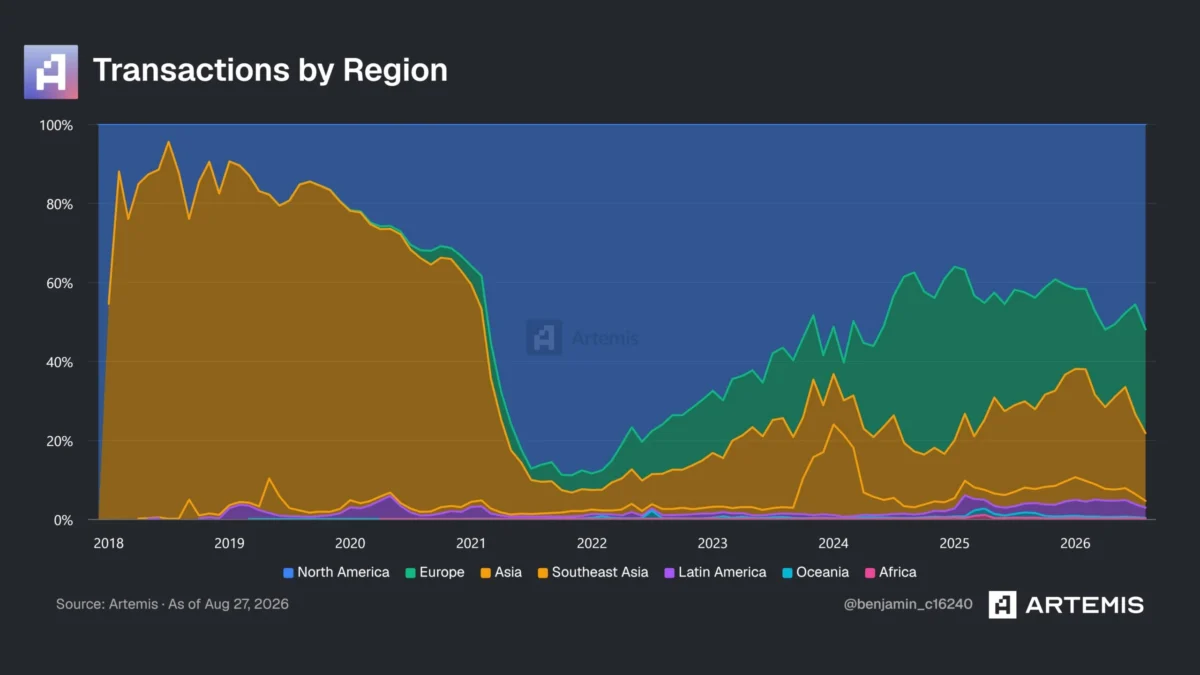
Geographically, the adoption of stablecoin settlement systems is heavily concentrated in North America, but Europe holds a formidable runner-up position:
- North America: Dominates global volume, holding the primary share of total stablecoin activity.
- Europe: Securely holds 26% of the global stablecoin transaction market share, ranking second globally and underscoring the continent’s heavy appetite for digital settlement tools.
- Asia: Ranks third globally in transactional volume.
Volume Growth: USD vs. Non-USD Alternatives
Data compiled by Artemis highlights a fascinating divergence in growth rates between established dollar assets and emerging multi-currency alternatives:

- USD-Based Stablecoins: Generated nearly $7 trillion in 30-day transaction volume, reflecting a solid 22% increase period-over-period.
- Non-USD Stablecoins: Registered a lower absolute volume of $15 billion over the same timeframe, but achieved a staggering triple-digit growth rate of 137%.
This explosive 137% surge in non-USD volume—spurred largely by euro-denominated products—signals that while the dollar still rules absolute liquidity, market participants are actively seeking local-currency settlement rails for FX operations, regional collateral management, and local regulatory compliance.
4. Official Responses and Industry Analysis
The reaction from industry analysts, macroeconomic commentators, and fintech leaders to Revolut’s EURR launch has exposed a deep ideological split regarding the utility of non-dollar stablecoins.
Skepticism from Market Critics
Prominent crypto analyst and commentator Scott Melker voiced deep skepticism regarding the long-term viability and global competitiveness of euro-backed stablecoins. Pointing to the inherent global hegemony of the U.S. dollar, Melker argued that Revolut’s product is merely a localized band-aid engineered to capture residual traffic from the forced exit of USDT, rather than a globally disruptive financial product.
"Nobody wants euros anywhere outside of Europe, and they don’t really want them there either; they’re just forced to use them. So, it’s not like this is going to compete with dollar-backed stablecoins," Melker remarked.
Optimism for Tokenized Financial Systems
Conversely, institutional advocates view regional stablecoins as foundational building blocks for a broader, multi-currency tokenized economy. Zach Abrams, former CEO of institutional stablecoin transfer network Bridge, offered a much more bullish long-term perspective on the evolution of global liquidity:
"Our financial system will be increasingly tokenized over the next 5 years. First currencies, then treasuries, next stocks, and so on. Non-USD stablecoins will play a critical role in local settlement, collateral, FX, and more."
Abrams’ perspective emphasizes that as traditional financial assets—ranging from sovereign bonds to equities—move onto public and private ledgers, institutional treasuries will require native non-USD digital tokens to manage foreign exchange risk and execute localized settlement without incurring constant currency-conversion friction.
5. Strategic Implications for the Future
Revolut’s entry into the stablecoin market and the broader European push toward compliant digital assets carry far-reaching implications for banks, regulators, and crypto users alike.
The Death of USDT in Europe and the Rise of Private Alternatives
The strict enforcement of MiCA is effectively redrawing the map for stablecoins in Europe. By pushing out non-compliant issuers like Tether, European regulators have inadvertently created a vacuum. Private entities—such as Circle with its EURC and now Revolut with EURR—are rushing in to fill this void. Because European retail and institutional users still require stable digital currency rails to trade, lend, and settle transactions, native euro stablecoins are experiencing unprecedented traction.
The Looming Shadow of the Digital Euro
Even as private firms race to capture market share through products like EURR and EURC, a massive regulatory counterweight looms on the horizon. The European Union is actively pushing forward with plans to launch an official Central Bank Digital Currency (CBDC)—the digital euro—targeted for release by 2029.
The European Central Bank (ECB) has made little secret of its motivation: protecting commercial banks and the broader Eurozone economy from the potential systemic encroachment of private, foreign, or commercial digital stablecoins. Whether the eventual rollout of a state-backed digital euro will cannibalize the traction currently being built by private euro stablecoins, or whether private tokens will serve as the gateway adoption layer for the digital euro, remains one of the most critical questions facing European fintech over the next five years.
Conclusion
Revolut’s launch of EURR is more than just a corporate product expansion; it is a tactical adaptation to a radically changing European regulatory climate. While skepticism regarding the global appeal of the euro relative to the almighty U.S. dollar remains valid, the triple-digit growth metrics of non-USD tokens prove that localized on-chain utility is expanding rapidly. As Europe transitions deeper into the MiCA era, EURR will serve as an essential test case for whether private fintech giants can successfully carve out a permanent home for the euro in the tokenized economy.
