


British Virgin Islands – September 28, 2026 – In a move that signals a significant maturation of the decentralized finance (DeFi) ecosystem, Jumper, the premier consumer-facing aggregator for cross-chain activity, has officially announced its transition into an independent entity. Previously incubated under the umbrella of the cross-chain infrastructure provider LI.FI, Jumper is now pivoting toward a standalone future, backed by a strategic shift toward a "token-first" ownership model.
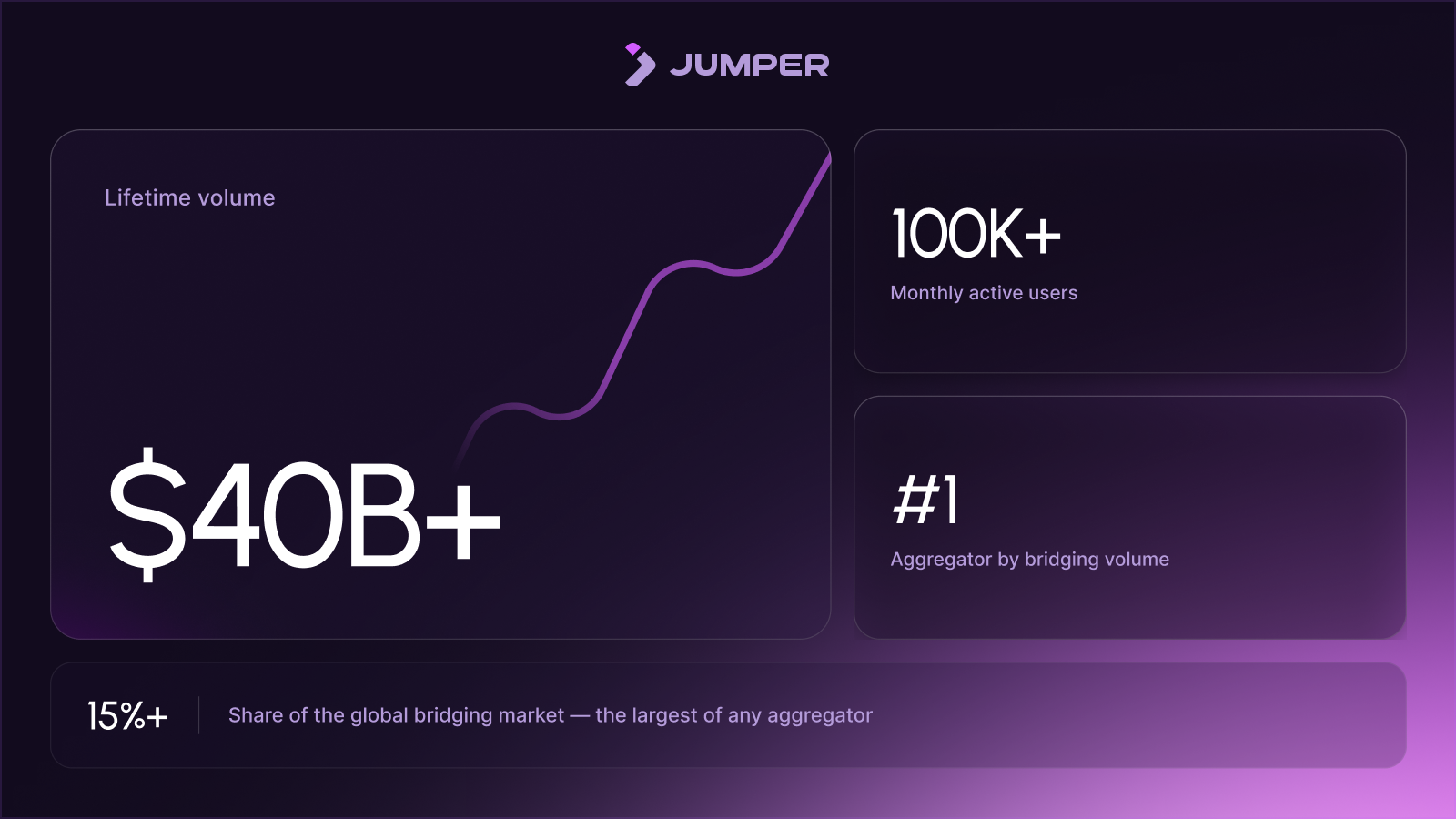
This transition marks a pivotal moment for a platform that has already processed more than $40 billion in lifetime volume and currently sustains a robust community of over 100,000 monthly active users. As Jumper separates its operations from its parent, it is simultaneously preparing for its first-ever capital raise via a JUMP token sale on the Legion platform.
Main Facts: The Evolution of an Industry Leader
Jumper’s evolution from a niche bridging tool to a comprehensive on-chain financial hub represents one of the most successful scaling stories in the blockchain space. The platform, which has established itself as the #1 aggregator by bridging volume—commanding a 15% market share—is now positioning itself to become the "super-app" of the Web3 world.
The transition involves more than just a change in corporate structure; it represents a fundamental change in the platform’s product philosophy. By breaking away from LI.FI, Jumper is shedding its "infrastructure-first" identity to focus entirely on the end-user experience. While LI.FI continues to manage the complex, backend orchestration of cross-chain liquidity, Jumper will serve as the consumer-facing interface, streamlining the fragmented experience of modern on-chain finance.
Key pillars of this new phase include:
- Operational Independence: Establishing a dedicated management team, capital reserves, and a roadmap distinct from its parent organization.
- The JUMP Token Sale: A strategic funding mechanism on Legion intended to fuel user acquisition and product development.
- The "Token-First" Philosophy: A commitment to a unified ownership structure where users, contributors, and investors share the same asset, eliminating the traditional divide between equity holders and token holders.
Chronology: From Incubation to Independence
To understand the scale of this move, one must look at the timeline of Jumper’s rapid ascent.
- 2023: The Formative Years: Jumper began as an experimental project under the LI.FI umbrella, designed to solve the growing problem of fragmented liquidity across various blockchain networks. Its initial goal was simple: provide a seamless bridging experience.
- 2024–2025: Scaling and Dominance: Through consistent innovation and aggressive integration of new liquidity sources, Jumper rapidly climbed the ranks to become the industry leader in bridge volume. The platform successfully onboarded over 100,000 monthly active users, proving that simplicity is the ultimate driver of adoption in a complex DeFi landscape.
- Early 2026: The Strategic Pivot: Recognizing that bridging was merely a "starting point," leadership began drafting plans to expand into perpetual futures, yield generation, and real-world asset (RWA) trading.
- September 2026: The Formal Breakout: The company officially announces its independence from LI.FI, signaling a transition from an internal product to a standalone venture, underscored by the announcement of the JUMP token sale.
Supporting Data: Why Jumper Matters
The numbers behind Jumper’s growth are not merely impressive—they are indicative of a larger trend toward institutional-grade retail tools.
- Volume Metrics: With over $40 billion in lifetime volume, Jumper has cemented itself as a vital artery of the DeFi ecosystem.
- Market Share: Holding a 15% share of the bridging aggregator market, the platform has successfully fended off competitors by prioritizing reliability and user interface (UI) clarity.
- User Retention: Sustaining 100,000 active users in a high-churn industry like crypto is a testament to the platform’s stickiness.
- Product Expansion: The upcoming launch of Jumper Perps is expected to be a major catalyst. By aggregating various perpetual futures venues into a single, cohesive dashboard, Jumper intends to capture the segment of traders who are currently forced to bounce between multiple decentralized exchanges (DEXs) to manage their portfolios.
Official Responses: The Philosophy of Ownership
In an exclusive statement regarding the company’s new direction, CEO Marko Jurina emphasized the need to challenge legacy financial structures.
"Bridging was the starting point for Jumper," Jurina stated. "As more financial assets move on-chain, the opportunity gets much bigger than bridging. We want Jumper to become the application users open whenever they want to trade, invest, or move value on-chain."
Perhaps the most radical aspect of the announcement is the refusal to conduct a traditional equity round. Jurina argues that the separation of equity and tokens creates a conflict of interest that is antithetical to the ethos of blockchain technology.
"We believe the token should be the only way to have ownership and exposure to the value being created by Jumper," Jurina added. "There shouldn’t be one group holding equity and another group holding a token. If crypto is serious about creating new forms of ownership, the people who use, support, and build these businesses should be able to participate directly in the value they help create."
Implications: A New Standard for DeFi
The implications of this move extend far beyond Jumper itself. By setting a precedent where the token represents the sole vehicle for value accrual, Jumper is effectively "voting with its wallet" against the dual-asset models that have dominated the last cycle of venture capital-backed crypto projects.

1. The Super-App Paradigm
Jumper’s pivot towards becoming a "super-app" mirrors the evolution of fintech giants like Alipay or Grab. By providing a "one-stop shop" for swapping, bridging, perps, and RWAs, Jumper is reducing the friction that prevents mass adoption. If successful, this model could force other DeFi protocols to consolidate, leading to a "winner-takes-most" environment for consumer-facing apps.
2. The Death of the "Equity vs. Token" Divide
If the industry adopts Jumper’s "token-first" approach, we may see a decline in traditional Series A/B equity rounds for crypto startups. This shift would empower retail users and early adopters, allowing them to participate in the growth of the platform on equal footing with professional venture firms. It is a bold, if risky, bet on the maturity of decentralized governance and community-led value creation.
3. Strengthening the Ecosystem
By separating from LI.FI, the ecosystem gains two distinct entities that can focus on their core competencies. LI.FI remains the "plumbing" of the industry—the indispensable infrastructure—while Jumper becomes the "interface." This specialization allows both companies to iterate faster and pursue distinct strategic goals without the internal friction of a multi-product firm.
Conclusion: The Path Ahead
As Jumper prepares for its JUMP token launch and the subsequent rollout of its perpetual futures trading engine, all eyes are on whether this independent entity can maintain its current momentum. The company’s focus on abstraction—hiding the technical complexity of blockchain protocols from the user—has already won over 100,000 users. If they can successfully execute their vision of an all-encompassing, token-owned super-app, Jumper may very well set the blueprint for how decentralized finance applications are built, funded, and managed in the years to come.
For those watching the evolution of Web3, Jumper’s transition is more than just a corporate restructuring; it is a declaration of intent. It is a signal that the era of fragmented, utility-less protocols is coming to an end, and the era of the integrated, community-aligned, on-chain financial hub has arrived.
Disclaimer: This article is for informational purposes only and does not constitute financial advice. Investors should conduct their own research before participating in any token sales or decentralized finance activities.
