

TL;DR
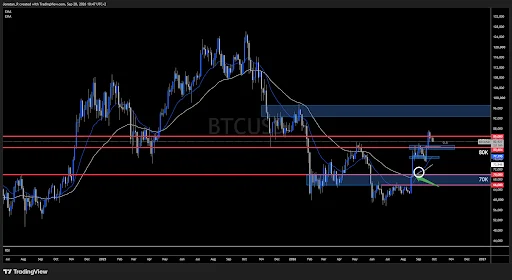
On October 2, the cryptocurrency market experienced a violent, condensed period of volatility that saw approximately $110 million in short positions liquidated within a ten-minute window. As Bitcoin and Ethereum surged, the sudden upward price pressure triggered a classic "short squeeze," forcing bearish traders to cover their positions by buying back assets, which in turn propelled prices even higher. This event serves as a stark reminder of the inherent risks of leveraged trading in the digital asset ecosystem, where positioning, rather than fundamental news, can often dictate the immediate trajectory of price candles.
The Anatomy of a Market Liquidation
Crypto traders were given another brutal reminder this week of how quickly leverage can transform a standard price fluctuation into a high-velocity market event. On October 2, the digital asset landscape witnessed a sharp, rapid ascent that caught a significant portion of the derivatives market off-guard.
In the span of just ten minutes, roughly $110 million in short positions were liquidated across major cryptocurrency exchanges. The overwhelming majority of these forced closures were on the bearish side of the ledger, meaning traders who had bet on a decline in the value of Bitcoin, Ethereum, and other major altcoins were suddenly pushed to the exit.
In the world of perpetual futures and high-leverage trading, a liquidation is an automated safety mechanism. When a trader’s collateral falls below a specific threshold due to adverse price movement, the exchange automatically closes the position to prevent further losses. However, the mechanism of closing a short position is inherently bullish: it requires the trader to "buy back" the asset they previously borrowed and sold. When thousands of traders are forced to perform this buy-back simultaneously, it creates a feedback loop that accelerates the rally, often pushing prices far beyond their initial resistance levels.
Chronology of the October 2 Squeeze
The event unfolded with clinical precision. Market data providers began tracking a sudden influx of buying pressure during the early hours of October 2. As Bitcoin broke through key psychological price barriers, the delta between the spot price and the funding rates of perpetual futures began to widen.
- The Trigger: A marginal, initial uptick in Bitcoin’s price began to test the liquidation thresholds of traders who had built up substantial short exposure in the preceding days.
- The Cascade (T+0 to T+5 minutes): As the price climbed, the first wave of retail and small-to-medium institutional short positions hit their liquidation prices. These automatic buy orders injected liquidity into the order books, further pushing the price upward.
- The Feedback Loop (T+5 to T+10 minutes): The rapid increase in price reached the "stop-loss" thresholds of even larger short positions. The resulting wave of market buy orders acted as a catalyst, creating a self-reinforcing surge that liquidated $110 million in positions within this compressed ten-minute window.
- Stabilization: By the end of the ten-minute burst, the market had reached a new, higher plateau. The frantic pace of liquidations subsided, leaving behind a market landscape that had been significantly "de-leveraged" of bearish sentiment.
Supporting Data: Why Positioning Matters
One of the most persistent myths in crypto journalism is the instinct to immediately search for a macroeconomic or regulatory catalyst to explain every major price move. Often, the temptation to link a price spike to a specific headline—such as a central bank comment or a regulatory filing—is merely an attempt to impose a narrative on what is essentially a technical phenomenon.
In this instance, there was no singular "news" catalyst. Instead, the move was a function of market positioning. Perpetual futures allow traders to command massive exposure with relatively small amounts of collateral. When a market becomes "crowded"—meaning a large concentration of participants are all betting in the same direction—the environment becomes primed for a squeeze.
Recent observations by NewsBTC have highlighted the increasing transparency of these large-scale positions. For example, the recent monitoring of a $67 million Ethereum short position on the decentralized exchange Hyperliquid demonstrated how institutional-grade risk is now migrating to venues where order flow is more visible. These large, "whale-sized" shorts act as fuel for the market; when they are forced to cover, the price impact is amplified significantly compared to thousands of smaller, retail-sized positions.
The Intersection of Derivatives and Spot ETF Flows
While the October 2 squeeze was primarily a derivative-market event, it occurred against the backdrop of renewed interest in US-based spot Bitcoin ETFs. This creates an interesting, multi-layered picture of market liquidity.
Spot ETFs operate on a fundamentally different mechanism than perpetual futures. ETF issuers must purchase actual Bitcoin to back their shares, which creates direct, long-term demand for the underlying asset. When ETF inflows turn positive—as they did recently—it provides a structural "floor" for the price.
However, the interplay between these two worlds is critical. While ETFs provide stable, long-term demand, the derivatives market provides the short-term volatility. The squeeze was likely exacerbated by the fact that the spot market was already showing signs of renewed strength. When traders are caught in a short position during a period of genuine, institutional-grade demand, the resulting "liquidation cascade" is far more violent than it would be in a vacuum. As noted in recent NewsBTC coverage, even on aggregate positive days for ETFs, large issuer-level swings are common, meaning the headline price candle rarely reflects the complexity of the underlying flow.
Implications for Market Participants
What are the lasting implications of a $110 million liquidation event? First and foremost, it serves as a recalibration of market leverage. The "wipeout" effectively cleared out a large portion of the bearish overhang that had been building up in the derivatives markets.
However, it is crucial to understand that this does not mean leverage has been eliminated from the system. In the fast-paced world of cryptocurrency, the "reset" is often temporary. Traders who were liquidated may look to re-enter positions, or new traders may step in to bet on a reversal, effectively restarting the cycle of leverage.
For institutional and retail observers alike, the event highlights three key takeaways:
- Transparency is rising: With the growth of on-chain derivatives and transparent venues, observers can now better track where the "crowded trades" are located before they happen.
- Liquidity fragmentation: The gap between the spot market and the derivatives market remains a primary source of volatility. Understanding the difference between a price move driven by institutional accumulation (ETFs) versus a price move driven by liquidation cascades (futures) is essential for risk management.
- The "News-Free" Rally: Market participants must accept that in the digital asset space, internal positioning is often a stronger driver of price than external news. A market that is over-leveraged to the downside is inherently unstable, and the "spark" to trigger a rally can come from the traders themselves, not from a press release.
Conclusion: The Persistence of Risk
The October 2 liquidation event was a classic demonstration of the "feedback loop" in action. A minor price correction turned into a massive short squeeze simply because the market was positioned for a decline that failed to materialize. As Bitcoin and Ethereum continue to attract both institutional interest and speculative capital, the potential for these rapid, high-impact liquidation events will likely persist.
For the prudent investor, the lesson is clear: while macro trends and ETF flows provide the long-term context for Bitcoin’s value, the short-term price action is frequently dictated by the mechanics of the derivatives market. A $110 million wipeout may have cleared the air for a moment, but in an environment fueled by high leverage and perpetual innovation, the next squeeze is likely already in the making.
This article was written by the News Desk and edited by Samuel Rae.
