

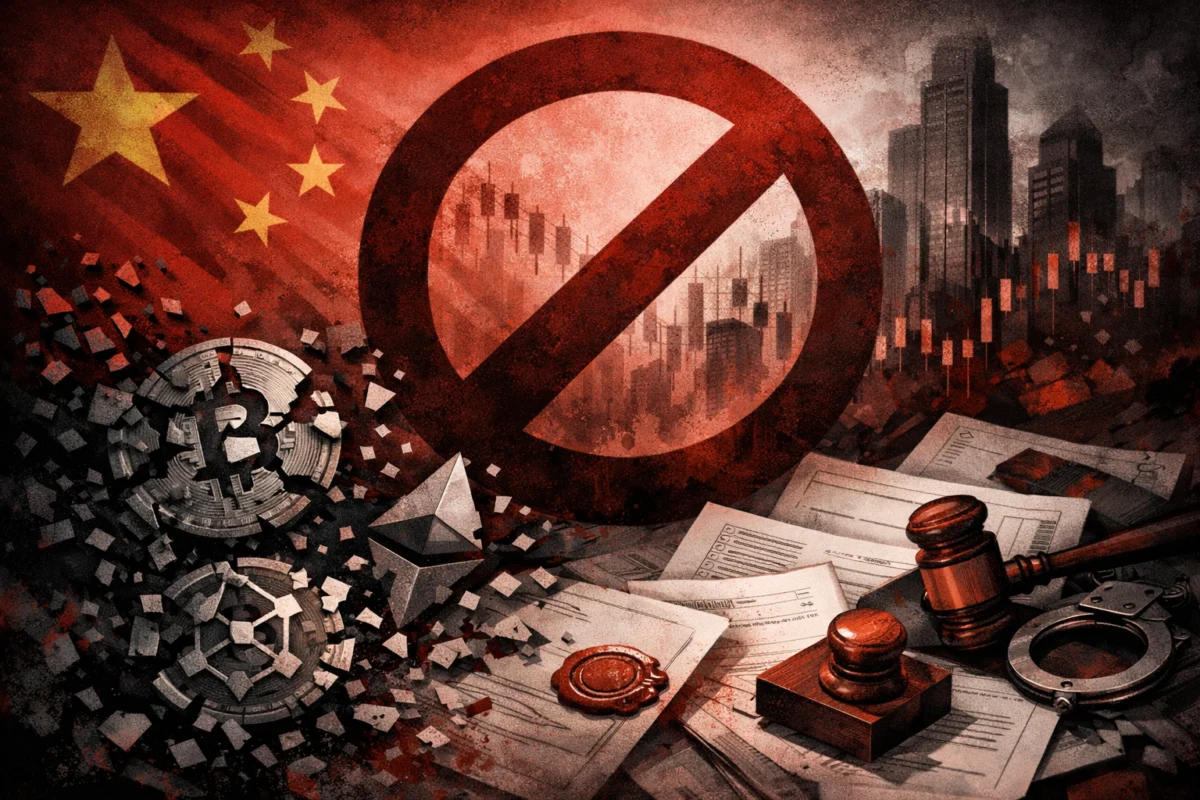
BEIJING — In one of the most comprehensive and definitive regulatory interventions in the history of digital finance, the People’s Republic of China has officially classified Real-World Asset (RWA) tokenization as an illegal financial activity.
A coordinated joint directive, issued simultaneously by seven of the nation’s most powerful financial and industrial associations, has definitively closed the door on any speculation that tokenized assets might find a legal loophole or a future sandbox environment within mainland jurisdiction. By lumping RWA tokenization into the exact same prohibited category as stablecoins, decentralized cryptocurrencies, and crypto-mining operations, Beijing has sent an unequivocal message: the digitization and blockchain-based fractionalization of physical assets will not be tolerated under any guise.
The policy shift is notable not merely for its prohibition of a burgeoning global fintech sector, but for its expansive legal reach. The crackdown targets project issuers, technology providers, marketing firms, payment processors, and even individual operational employees. Furthermore, the directive effectively bridges the regulatory firewall between the Chinese mainland and offshore jurisdictions, specifically curbing the involvement of domestic brokerages and personnel in RWA operations linked to Hong Kong.
Main Facts: Deconstructing Beijing’s Comprehensive RWA Ban
The prohibition was formalised via a coordinated notice released by a rare alliance of seven national industry bodies: the China Internet Finance Association, the China Banking Association, the China Securities Association, the China Asset Management Association, the China Futures Association, the China Association of Listed Companies, and the China Payment and Clearing Association.
This unprecedented display of regulatory alignment underscores the gravity with which Beijing views the perceived threat of tokenized assets. Key elements of the new directive include:
- Total Prohibition: RWA tokenization—defined as the process of issuing digital tokens or token-like debt and equity rights that claim to represent physical or financial assets—has no legal basis under existing Chinese law.
- No Regulatory Grace Period: Authorities explicitly stated that no Chinese financial regulator has ever approved any form of RWA tokenization project. This dismisses claims made by various startups that their operations were part of authorized "pilot programs," "sandbox trials," or pending registrations.
- Broad Legal Classifications: The notice maps RWA activities directly to severe violations of China’s Criminal Law and Securities Law. Issuing tokens to the public is categorized as illegal fundraising; facilitating unapproved distributions equates to unauthorized public securities offerings; and employing speculative leverage or betting models constitutes illegal futures trading.
- Extraterritorial Reach and the "Operations" Trap: The policy targets offshore and Hong Kong-linked structures. Crucially, any entity or individual utilizing mainland-based staff—even a single operational employee—faces severe legal liability if they support virtual currency or RWA-related businesses, dismantling the popular Web3 model of "offshore incorporation with mainland development teams."
Chronology of Events: The Evolution of China’s Crypto and RWA Restrictions
To understand how China arrived at this total prohibition on real-world asset tokenization, it is necessary to examine the systematic escalation of Beijing’s anti-crypto policies over the past decade.
2013–2017: The Initial Salvo Against Cryptocurrencies
- December 2013: The People’s Bank of China (PBOC), alongside other ministries, issues a notice prohibiting financial institutions and payment companies from handling Bitcoin transactions, warning that the cryptocurrency lacks legal tender status.
- September 2017: Regulators issue a sweeping ban on Initial Coin Offerings (ICOs), classifying them as unauthorized illegal public financing. Exchanges are forced to shut down operations within mainland China, prompting a mass exodus of crypto platforms to overseas hubs like Hong Kong, Singapore, and Japan.
2021: The Total Ban on Mining and Transactions
- May 2021: The State Council’s Financial Stability and Development Committee calls for a strict crackdown on Bitcoin mining and trading activities, citing systemic financial risk prevention.
- September 2021: Ten government agencies—including the PBOC, Cyberspace Administration of China, and the Supreme People’s Procuratorate—release a joint directive declaring all cryptocurrency-related activities illegal. Foreign virtual currency exchanges are explicitly barred from providing services to mainland residents via the internet.
2022–2024: The Rise of Web3, Hong Kong Divergence, and RWA Gray Areas
- Late 2022 to 2023: As global financial markets embrace RWA tokenization—tokenizing everything from US Treasury bills to real estate and private credit—some fintech startups attempt to navigate Chinese regulatory boundaries. Hong Kong emerges as a virtual asset hub, opening its doors to licensed crypto exchanges and security token offerings (STOs).
- Mid-2024: Mainland-linked firms and tech entrepreneurs increasingly test the waters by establishing offshore entities in Hong Kong while keeping technical and operational teams based in Shenzhen, Shanghai, or Beijing, operating under the assumption that tokenizing real-world assets (backed by tangible collateral) might be viewed more favorably than speculative meme coins.
Late 2025 – January 2026: The Final Closure
- January 2026: The seven major Chinese financial associations issue their coordinated notice, formally classifying RWA tokenization alongside stablecoins and crypto mining as illegal financial activities. The directive explicitly targets Hong Kong-linked operations and closes the operational loopholes exploited by mainland-based Web3 service providers.
Supporting Data and Risk Analysis: Why Beijing Rejected Tokenization
While Western financial institutions and global asset managers—such as BlackRock and Franklin Templeton—have championed tokenization as the future of capital markets for its ability to lower transaction costs, enhance liquidity, and provide 24/7 settlement, Chinese regulators view the technology through a lens of existential systemic risk.
The Illusion of Collateral and Systemic Spillovers
Regulators specifically rejected the foundational premise that token structures can guarantee the secure ownership, transparent management, or frictionless liquidation of underlying physical assets. According to the official assessment:
- Fictitious Asset Risks: Authorities argue that many RWA projects rely on difficult-to-verify collateral, creating vulnerabilities akin to shadow banking ponzi schemes.
- Contagion and Leverage: Even when teams claim genuine collateralization, the integration of blockchain tokens with speculative trading models, lending, and leverage introduces uncontrollable risk spillovers into the broader financial system.
- Fraud Prevention: The crackdown explicitly links RWA tokenization to a surge in financial fraud, where scammers utilize sophisticated blockchain terminology ("tokenized real estate," "commodity-backed stablecoins," or "green energy mining credits") to dupe retail investors into illegal fundraising and multi-level marketing (MLM) schemes.
Protecting the Digital Yuan Ecosystem
The timing of the RWA ban aligns strategically with China’s macroeconomic objectives. Beijing is currently pushing for the internationalization of its central bank digital currency (CBDC), the digital yuan (e-CNY).
To preserve absolute state control over monetary policy, cross-border payments, and capital flows, the government cannot allow private stablecoins or decentralized tokenized assets to act as alternative mediums of exchange or stores of value. The establishment of a new Shanghai centre for cross-border payments and blockchain services further illustrates that Beijing prefers state-monopolized, permissioned digital infrastructure over permissionless, tokenized public chains.
Official Responses and Cross-Industry Mobilization
The unprecedented unity displayed by the seven financial associations highlights the seriousness of the policy. Legal observers and compliance experts have noted that this type of cross-sectoral coordination is typically reserved for moments of acute financial crisis management.
In official statements accompanying the directive, association representatives emphasized that ignorance of the law will not serve as a defense for Web3 service providers.
"Institutions and individuals who knew or should have known that they were supporting virtual currency or RWA-related business operations will be held legally accountable," the joint notice warns.
Legal scholars point out that this "knew or should have known" standard places an immense burden of proof on legal, technological, and marketing service providers. Under China’s Criminal Law, aiding and abetting illegal financial operations can carry severe prison sentences and corporate asset seizures.
Global and Domestic Implications for the Web3 Ecosystem
The repercussions of this directive extend far beyond China’s borders, reshaping corporate strategies across Asia and forcing international fintech startups to sever ties with the mainland.
1. The Death of the "Offshore/Onshore" Hybrid Model
For years, many Chinese tech entrepreneurs operated under a pragmatic compromise: incorporate the legal entity in the British Virgin Islands, Singapore, or Hong Kong, but maintain a cost-effective development, engineering, or operations team in mainland tech hubs like Shenzhen or Hangzhou.
The new directive completely shatters this model. Because the decree explicitly penalizes entities for employing even a single operational worker on the mainland to support an RWA or crypto project, offshore Web3 startups are now forced to choose between completely relocating their staff outside of China or shutting down their operations entirely.
2. Impact on Hong Kong’s Virtual Asset Hub Ambitions
The directive also exerts downward pressure on the boundary between mainland China and Hong Kong. By urging domestic Chinese brokerages to halt their involvement in RWA tokenization activities in Hong Kong, Beijing has signaled that Hong Kong’s regulatory autonomy over digital assets has strict limits when mainland capital or personnel are involved. While Hong Kong continues to position itself as a regulated virtual asset center, mainland institutions and citizens are now facing an impenetrable legal wall preventing them from participating.
3. Service Provider Liability
The liability net has widened to capture non-financial actors. The Web3 service chain—including technology outsourcing firms, marketing agencies, social media influencers promoting token projects, payment interface providers, and independent legal advisors—now faces direct legal exposure. Marketing a foreign RWA platform to Chinese audiences, providing smart contract auditing services from a mainland office, or offering localized customer support can now be prosecuted as complicity in illegal financial operations.
Conclusion
China’s definitive ban on real-world asset tokenization marks the end of an era where fintech innovators hoped that attaching blockchain tokens to tangible, physical assets might bypass the sweeping crypto bans of 2017 and 2021.
By unifying seven major financial regulators, establishing strict criminal liabilities for the entire Web3 service chain, and extending its reach to offshore and Hong Kong-linked structures, Beijing has demonstrated its unwavering commitment to absolute financial sovereignty. As global markets race toward tokenized equities, real estate, and government debt, China’s financial ecosystem remains locked behind a state-controlled digital firewall, prioritizing centralized monetary control and risk elimination above all else.
