

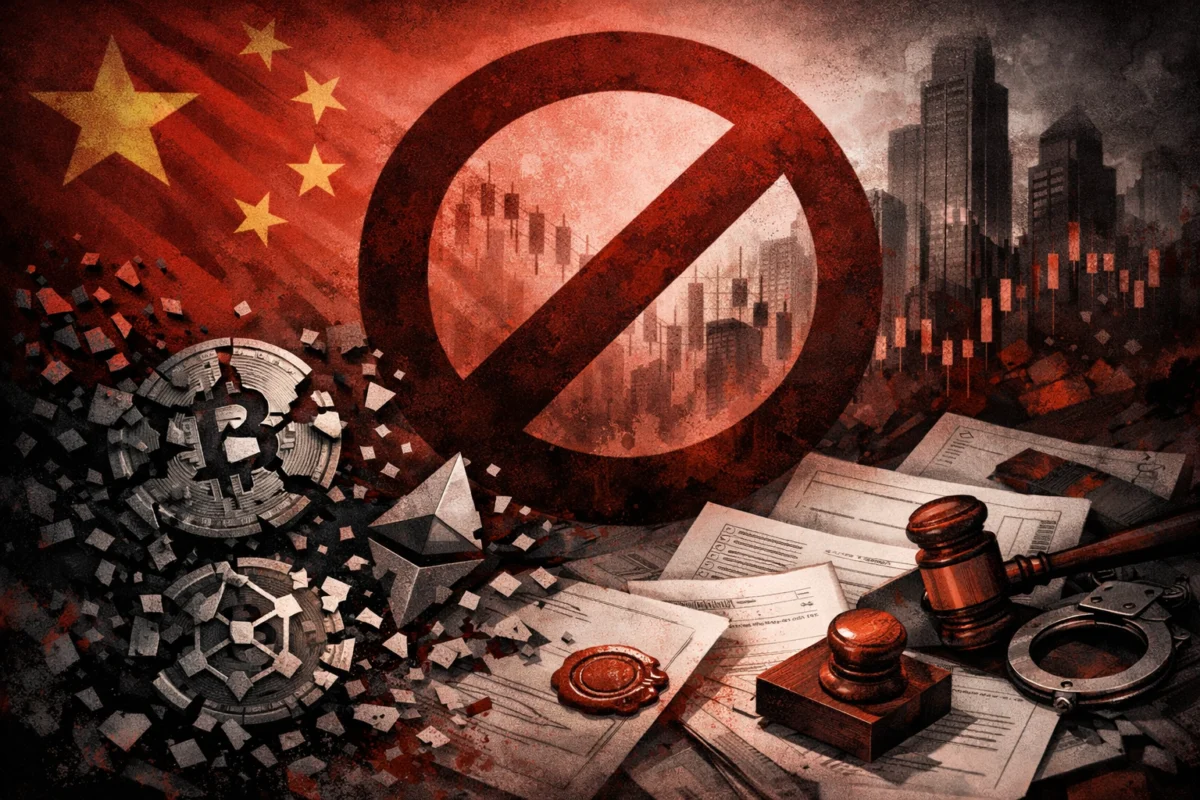
In a move that effectively shutters one of the most promising yet speculative corners of the digital asset industry, China has delivered its most definitive regulatory strike to date. Seven of the country’s top financial industry associations have issued a joint, coordinated notice formally classifying the tokenization of Real-World Assets (RWA) as an illegal financial activity. This decision leaves no room for interpretation, placing RWA projects firmly alongside the prohibited categories of cryptocurrencies, stablecoins, and crypto mining.
By targeting the very infrastructure that allowed these digital entities to operate, Beijing has effectively severed the lifeline for Web3 startups attempting to bridge the gap between traditional finance and blockchain technology. The mandate acts as a comprehensive "hard line," extending its reach far beyond the project founders to include the entire service chain—from marketing agencies and payment processors to the individual employees working from within mainland China.
The Coordinated Regulatory Front
The scale of this intervention is underscored by the unprecedented level of cross-industry cooperation. The declaration was signed by seven of China’s most powerful regulatory bodies:
- The China Internet Finance Association
- The China Banking Association
- The China Securities Association
- The China Asset Management Association
- The China Futures Association
- The China Association of Listed Companies
- The China Payment and Clearing Association
This unified front signifies that the ban is not merely a localized suggestion but a systemic policy directive aimed at containing what the state perceives as uncontrollable financial risk. By consolidating the power of these seven associations, Beijing has ensured that there is no regulatory "gray area" left to exploit.
Chronology of the Crackdown
To understand the gravity of this latest directive, one must view it as the culmination of a multi-year effort to consolidate state control over digital finance.
- 2017 – The Initial Pivot: China began its tightening of the digital asset sector by banning Initial Coin Offerings (ICOs) and closing domestic crypto exchanges.
- 2021 – The Mining Ban: A comprehensive prohibition on crypto mining and trading was enforced, signaling a shift toward state-sanctioned blockchain technology (such as the BSN) while discarding decentralized assets.
- 2023–2024 – The Rise of RWA: As the global market saw a surge in interest regarding the tokenization of stocks, real estate, and government bonds, many offshore projects sought to capitalize on Chinese liquidity, often masking their activities as "tech innovation" or "pilot programs."
- January 2026 – The Final Clause: The latest joint notice effectively closes the "innovation loophole." By explicitly stating that no regulator has ever approved any form of RWA tokenization, the state has neutralized any claims of projects operating under "trial" or "sandbox" status.
Defining the Breach: Why RWA is Under Fire
Regulators have defined RWA tokenization—the process of creating digital tokens that represent fractional ownership of physical assets—as a mechanism for illicit financing. According to the notice, these structures are fundamentally flawed because they introduce risks tied to "fictitious assets, operational failure, and speculative volatility."
From a legal standpoint, the authorities have mapped RWA activity directly onto existing statutes:
- Illegal Fundraising: Issuing tokens to the public that promise future returns is classified under the Criminal Law as unauthorized fundraising.
- Unlicensed Securities Offerings: Facilitating the trade of these tokens without a formal license is deemed an illegal public offering of securities.
- Unauthorized Futures Trading: Any model involving leverage, betting mechanisms, or derivatives is categorized as an illegal futures business.
Crucially, the government has rejected the "offshore narrative." Many projects previously argued that by holding assets in secure jurisdictions and using smart contracts for transparency, they were exempt from mainland jurisdiction. Beijing has explicitly rejected this, arguing that if the target market is the Chinese public, or if the operational team is located within China, the activity is subject to Chinese criminal prosecution regardless of where the server or the company is registered.
The "Objective Liability" Standard
Perhaps the most alarming aspect for the Web3 industry is the new, rigid standard of liability. The notice establishes that institutions and individuals who "knew or should have known" they were supporting RWA-related business can be held legally accountable.
This standard effectively criminalizes the entire professional support system for these projects. It is no longer just the CEO who faces risk; it is the:
- Technology Outsourcers: Software developers writing the code for RWA platforms.
- Marketing Agencies: Firms responsible for promoting these tokens to Chinese investors.
- Influencers: Individuals who market these assets on social media platforms like WeChat or Weibo.
- Payment Processors: Banks and fintech firms that facilitate the flow of capital between fiat and these tokenized assets.
By threatening the entire supply chain, Beijing has created a "chilling effect" that makes it nearly impossible for offshore projects to find reliable partners within the mainland.
Implications for Hong Kong and Beyond
A significant portion of the regulatory ire is directed at the "offshore-to-mainland" pipeline. For years, projects have used Hong Kong as a bridge to reach mainland capital. The China Securities Regulatory Commission (CSRC) is now explicitly urging domestic brokerages to sever ties with any Hong Kong-linked RWA activities.
This creates a massive compliance headache for firms operating in the Special Administrative Region. If a Hong Kong-based project has even a single operational employee residing in Shanghai or Beijing, the entire project is now legally vulnerable under this new directive. This is a direct strike at the "Web3 hub" ambitions that Hong Kong has been cultivating, as the mainland authorities have made it clear that they will not tolerate a secondary market for digital assets that circumvents national controls.
The Strategic Context: The Digital Yuan
Why now? Analysts point to the timing of this crackdown as a strategic maneuver to protect the state’s monopoly on currency issuance. China is currently in the midst of an aggressive push to internationalize the e-CNY (the digital yuan) through new cross-border payment centers in Shanghai.
Private stablecoins and tokenized RWA platforms represent a competing form of value transfer that the state cannot control. By eliminating the competition, the government ensures that the only authorized digital currency for cross-border trade and asset management remains the state-controlled digital yuan. The crackdown on "valueless tokens" and "pyramid-style" RWA schemes provides the perfect moral and legal pretext to consolidate this control.
Conclusion: The End of the "Grey Market" Era
For the global Web3 community, the message from Beijing is unambiguous: the era of the "grey market" is over. The days of using offshore structures to reach Chinese users while claiming a "tech-first" compliance posture are gone.
For domestic players, the risk-to-reward ratio has tilted decisively toward ruin. With the threat of criminal prosecution hanging over not just founders, but also developers, marketers, and payment providers, the ecosystem for RWA in China is set to evaporate. While global markets continue to experiment with the tokenization of everything from real estate to treasury bills, China has opted for total exclusion, choosing the stability of the state-controlled financial system over the volatility and potential systemic risk of decentralized, tokenized finance.
This move reinforces China’s position as a global outlier in digital finance, prioritizing strict regulatory adherence and capital controls over the adoption of borderless, decentralized technologies. For any startup still operating in this space, the new directive is a clear signal to relocate or cease operations entirely.
