

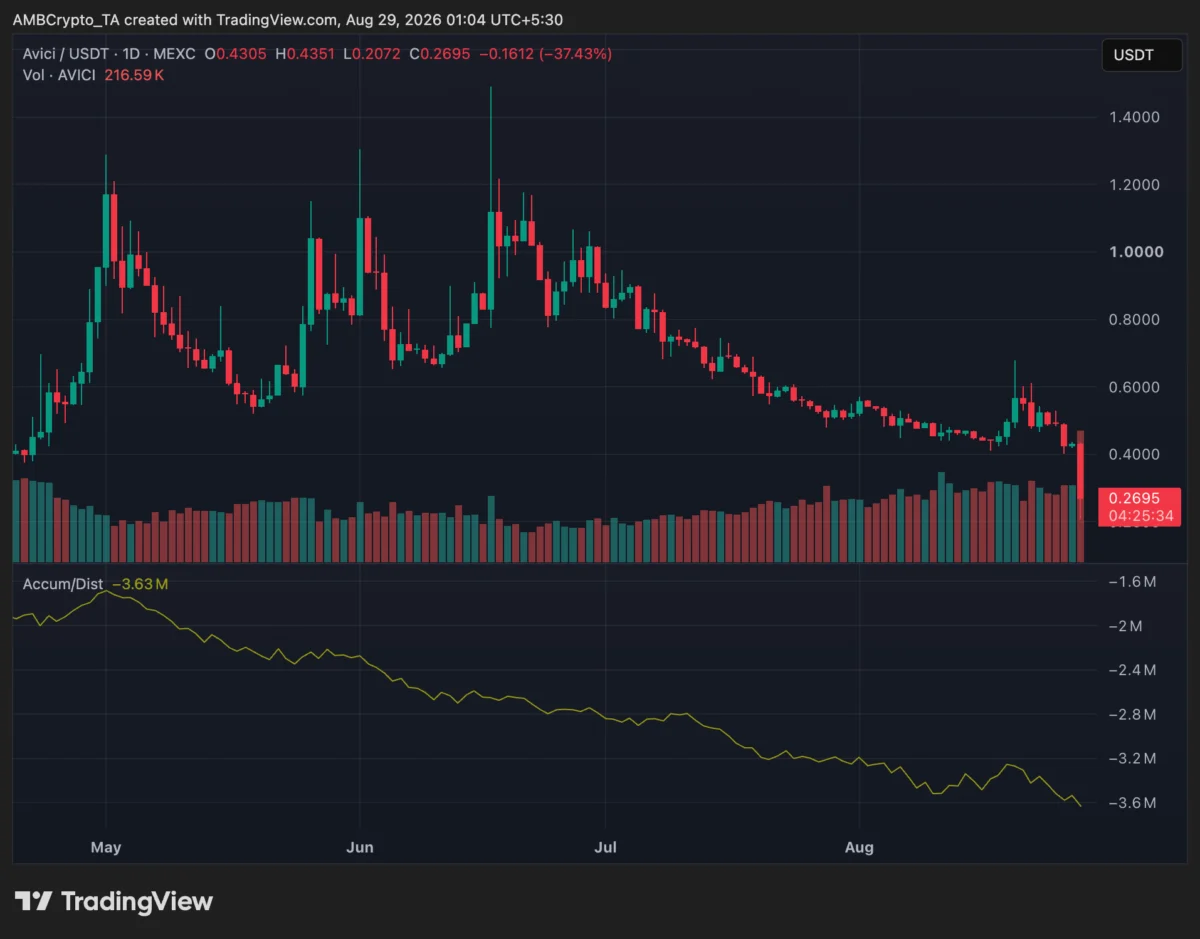
The digital asset ecosystem was thrown into a state of heightened anxiety this week as the AVICI network grappled with a significant technical failure that effectively froze customer withdrawals. The incident, which has led to a sharp, double-digit decline in the AVICI token’s market valuation, has raised pressing questions regarding the security infrastructure of decentralized platforms and the transparency of their incident response protocols.
As of Friday, the AVICI token suffered a staggering 37% decline, compounding an already difficult multi-month downward trend. On-chain data has provided a grim window into the mechanics of the event, with analysts tracking an associated Solana wallet that held over $600,000 in assets—funds that appear to have been siphoned from the platform before being dispersed across the network.
The Chronology of the Crisis
The unfolding situation began with mounting user complaints regarding failed transaction attempts on the AVICI platform. Specifically, users attempting to withdraw funds from their card balances found themselves unable to access their assets.
As social media channels and community forums began to fill with reports of "stuck" transactions, the technical nature of the problem became apparent. On-chain analysis tools, including Solscan, eventually linked the surge in failed transactions to a specific Solana address. The timeline of the activity is as follows:
- The Detection Phase: Users began reporting systemic withdrawal failures, prompting an immediate influx of queries to the AVICI support team.
- The On-Chain Identification: Blockchain sleuths identified an address that had accumulated a substantial balance of USDC, USDT, and SOL, totaling approximately $604,818.97.
- The Capital Flight: Following the initial detection, the funds within the implicated wallet were rapidly moved. The address’s balance of stablecoins (USDC and USDT) was drained to zero, while the remaining 886.94 SOL was transferred to an external, secondary address, effectively laundering the trail of the capital.
- The Market Reaction: News of the withdrawal issues permeated the market, causing a sharp sell-off of AVICI tokens. The token, which opened at $0.4305, plummeted to an intraday low of $0.2072, representing a value loss of over 50% at its nadir before a partial recovery.
Technical Deep Dive: The Data Behind the Breach
The scale of the incident is underscored by the granular data provided by blockchain explorers. The Solana address in question—7XigoEaHxpoHp819fnajGqsz329Lve9c2SXSq8KaFRVf—serves as the focal point of the investigation.
Breakdown of Seized Assets
According to the transaction history verified on Solscan, the wallet held the following at the time of its capture:
- USDC: $570,410
- USDT: $34,188
- SOL: Approximately $221
- Scope of Impact: The address is linked to approximately 2,500 individual user accounts, suggesting a highly targeted or systemic compromise of the platform’s withdrawal logic.
While the total sum matches the reports of a $600,000 drain, it is important to note that definitive proof linking the entirety of these funds to specific AVICI customers is still being validated by independent forensic experts. The speed at which the funds were moved post-capture indicates a sophisticated actor, likely leveraging automated scripts to obscure the flow of assets through the Solana ecosystem.
Official Responses and Corporate Transparency
The AVICI team issued a brief statement acknowledging the difficulties, confirming that they were "aware of an issue affecting card-balance withdrawals" and were actively "working with partners to resolve it."
However, the tone of the communication has drawn criticism from the community. AVICI has notably refrained from characterizing the incident as a "hack" or a "security breach," preferring instead to frame it as a technical operational issue. By declining to provide an estimate of the number of affected users or the precise monetary value involved, the platform has inadvertently fueled rumors and exacerbated the panic among its remaining user base.

Critics argue that in the fast-paced world of decentralized finance (DeFi), ambiguity is the enemy of trust. Without a comprehensive post-mortem or a clear roadmap for remediation, investors are left in the dark, wondering whether their assets are truly secure or if the protocol’s underlying smart contracts have been fundamentally compromised.
Market Implications: A Fragile Recovery
The price action following the event highlights the fragility of smaller-cap tokens. AVICI’s market structure is thin, meaning that even moderate sell pressure can lead to exponential volatility.
The Macro Context
While the withdrawal issue acted as the immediate catalyst for the 37% price crash, analysts point out that AVICI has been on a downward trajectory for several months. The incident did not necessarily "cause" the decline so much as it "crystallized" the existing negative sentiment surrounding the project.
The token’s inability to maintain its support level at $0.40—a critical psychological threshold—suggests that the market is currently viewing AVICI with extreme skepticism. While it recovered slightly to $0.2695, the rally remains weak, and the token faces significant resistance in its attempt to return to pre-incident levels.
The Liquidity Risk
Because of the project’s limited liquidity, the "price discovery" process is currently distorted. Large holders (whales) seeking to exit their positions are finding it difficult to do so without further depressing the price, creating a feedback loop of volatility. For retail investors, the takeaway is clear: assets on platforms with low liquidity and unproven security architectures carry a disproportionate amount of tail risk.
Broader Implications for the Ecosystem
The AVICI incident serves as a poignant reminder of the inherent risks in modern crypto-banking and DeFi integrations. The integration of traditional "card balances" with blockchain-based assets is a double-edged sword. While it provides user-friendly convenience, it introduces complex intermediary dependencies—if the "partner" mentioned by AVICI fails, or if the API bridge between the card provider and the blockchain is compromised, the end user is often left with no recourse.
Security Best Practices and Future Outlook
For investors, the AVICI situation underscores three vital lessons:
- Custodial Risk: Keeping large amounts of capital on a single platform, especially one that has shown signs of operational instability, is a significant risk.
- On-Chain Vigilance: Tools like Solscan are no longer just for developers; they are essential for the average investor to track the movement of their assets in real-time.
- Communication as a Metric: A platform’s ability to communicate clearly during a crisis is a primary indicator of its long-term viability. Platforms that obfuscate details often see a much slower recovery in user trust.
As the situation develops, the community awaits a full technical audit from the AVICI team. Until a concrete explanation is provided and the security of the withdrawal mechanism is verified, the market is likely to remain in a "wait-and-see" mode. Whether AVICI can regain the $0.40 handle depends not only on market forces but on the team’s ability to demonstrate that the underlying vulnerability has been permanently patched.
For now, the events of this week stand as a cautionary tale for the industry: in the digital asset space, infrastructure reliability is the bedrock upon which all value is built. When that foundation cracks, the consequences are immediate, severe, and difficult to reverse. As trading continues, the focus will remain on the $0.20 support level, which currently acts as the final line of defense against a deeper, more protracted collapse for the AVICI token.
