
A bond that used to take three days to settle now clears in two seconds. An invoice that once sat in a bank queue for weeks gets funded in hours. A gold bar locked in a Zurich vault can be owned in fractions by investors in Jakarta and São Paulo. The assets have not changed. The infrastructure underneath them has, and in 2026, the volume of capital moving through that infrastructure has made the shift hard to overlook.
Real-world assets, bonds, invoices, commodities, real estate, and private credit, sit at the centre of global finance and have for centuries. They have also always been slow to move, expensive to transfer, and accessible only to a narrow band of institutional participants. Tokenization places ownership of these assets on a blockchain, compressing settlement from days to seconds, enabling fractional ownership, and stripping out the intermediary layers that have historically added friction and cost.
According to RWA.xyz, which tracks tokenized asset activity across blockchain networks, the total distributed value of tokenized real-world assets was almost $31 billion at press time, with a growth of 15% in the last 30 days alone. Treasuries anchor the market as the largest single category. Gold-backed tokens have also driven a surge in commodities. Tokenized equities, a segment that barely existed two years ago, are posting quarterly volumes that already exceed the whole of 2025.
Private credit does not make headlines the way Bitcoin does, but with over $14 billion now active on-chain against a traditional market worth $3 trillion, it is quietly becoming one of tokenization’s most consequential use cases. Direct lending to companies outside the banking system has always delivered strong returns, typically 8 to 15% annually, but participation was built for a small group of large allocators.
That is changing though, and the capital following it on-chain is the largest non-treasury segment in the tokenized asset market.
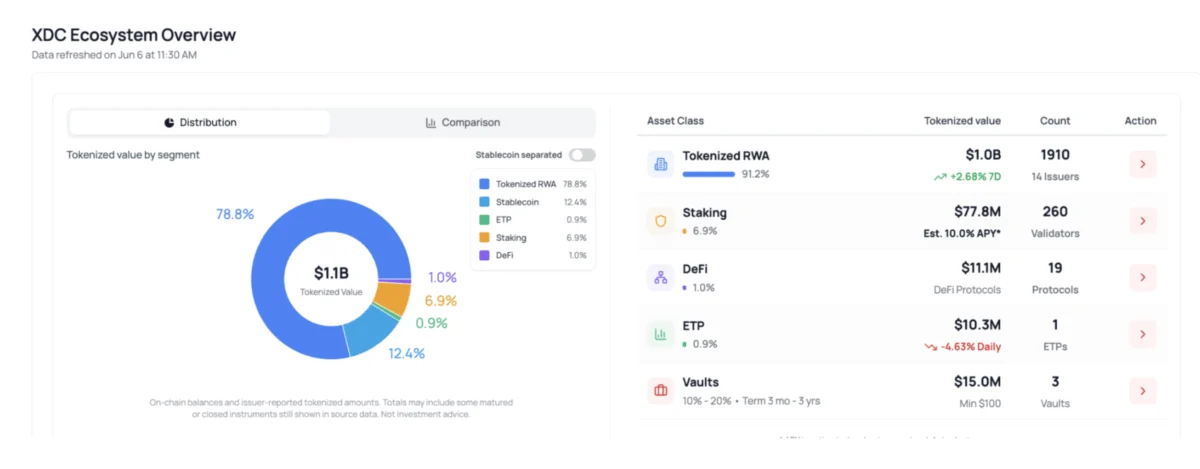
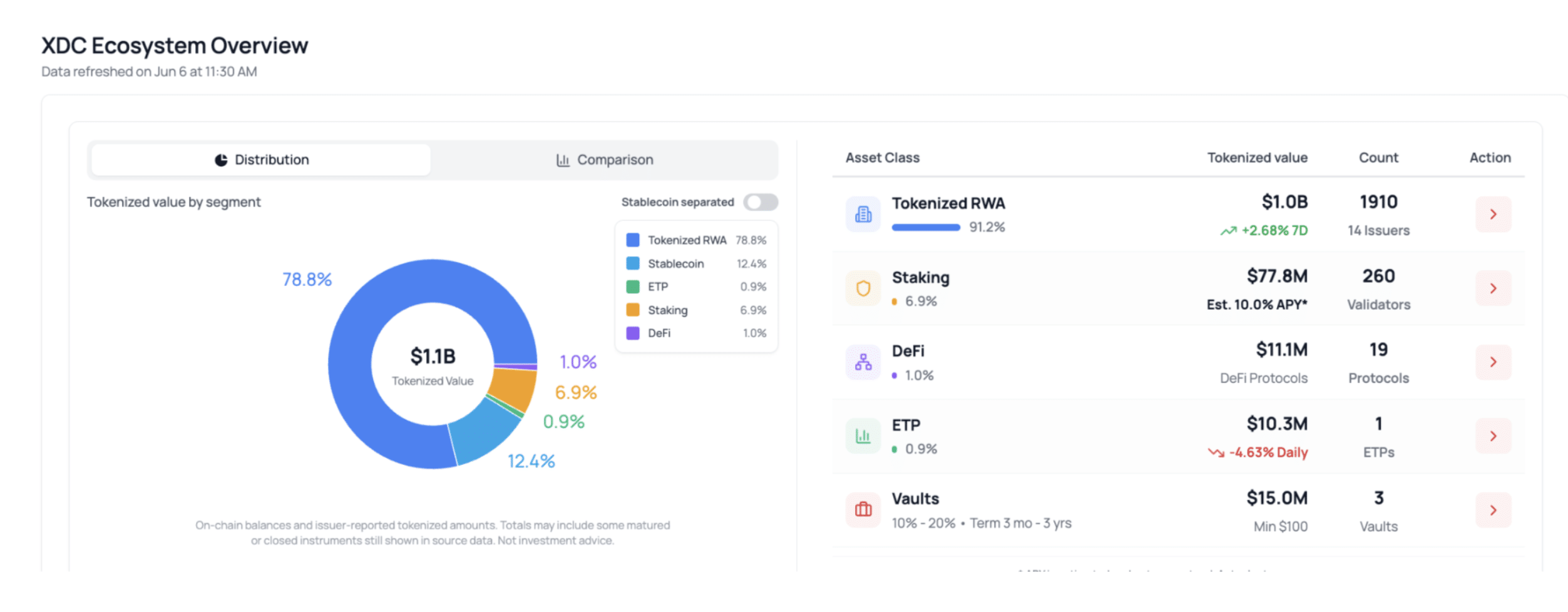
The trend shows up at the network level too. XDC, which has oriented its infrastructure around trade finance and institutional asset issuance since inception, crossed $1.1 billion in tokenized value in early June 2026, with 80% in structured real-world assets.
For context, most blockchain networks still derive the bulk of their on-chain value from speculative activity. XDC’s composition seemed to point in a different direction though.
The Asian Development Bank puts the global trade finance gap at $2.5 trillion. Behind that number are businesses that cannot ship, exporters that cannot get paid, and manufacturers that cannot grow, Not because they are bad credits but because the traditional system was never built to evaluate them. XDC has built its infrastructure around this gap, supporting tokenized invoices, letters of credit, and receivables that compress financing timelines from weeks to hours.
XDC’s position in the tokenized asset market is defined less by the volume it holds and more by what its infrastructure was built to handle. Two-second settlement, near-zero transaction costs, and compatibility with ISO 20022 financial messaging standards make it one of the few public blockchains designed from the ground up for cross-border trade finance. Regulated institutions have specific reasons to care about that distinction.
The numbers at $31 billion are significant too. What is more significant, however, is the direction. 96% percent of Asian fund managers plan to tokenize assets within three years. Regulatory clarity is building across the U.S, Europe, and Singapore. The capital entering these markets is not speculative. Instead, it is structural, and structural capital does not leave.
For the institutions still watching from the sidelines, the calculus is straightforward. The market is not waiting. The infrastructure is being built with or without them. The only real question is whether they are part of the first chapter or the one that comes after.