

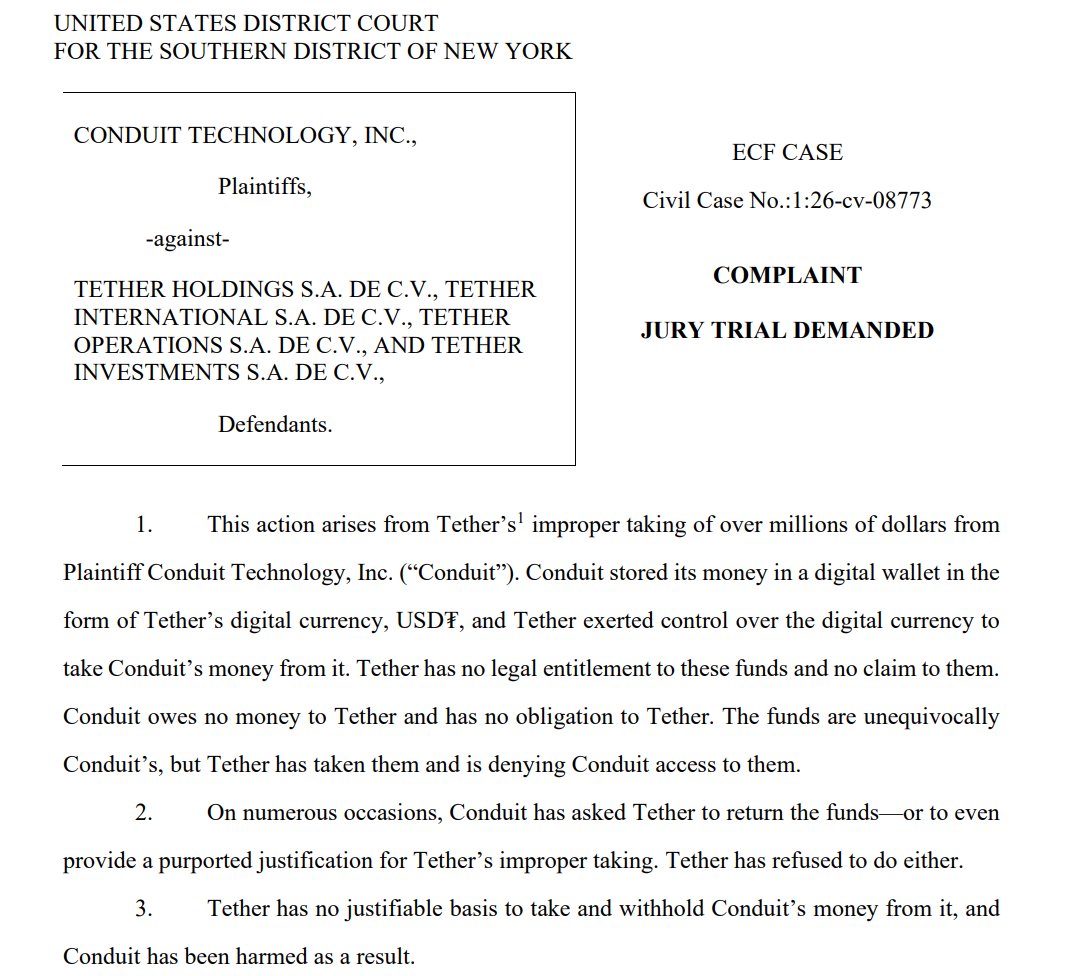
NEW YORK — Stablecoin giant Tether is facing mounting legal and regulatory headwinds after U.S.-based payment firm Conduit filed a federal lawsuit against the company in the Southern District of New York (SDNY). The legal action centers on the freezing of $2.7 million in Tether (USDT), an enforcement action Conduit argues was executed with "no justifiable basis" and has left the company financially harmed while Tether continues to profit from the underlying reserves.
The case highlights the complex, high-stakes intersection of decentralized finance (DeFi), cross-border law enforcement, and the centralized powers wielded by stablecoin issuers. As Tether navigates escalating scrutiny from U.S. lawmakers and a string of parallel lawsuits from asset holders, the industry is closely watching how these legal battles might reshape the operational boundaries of digital asset freezing.
Main Facts: The Core Dispute
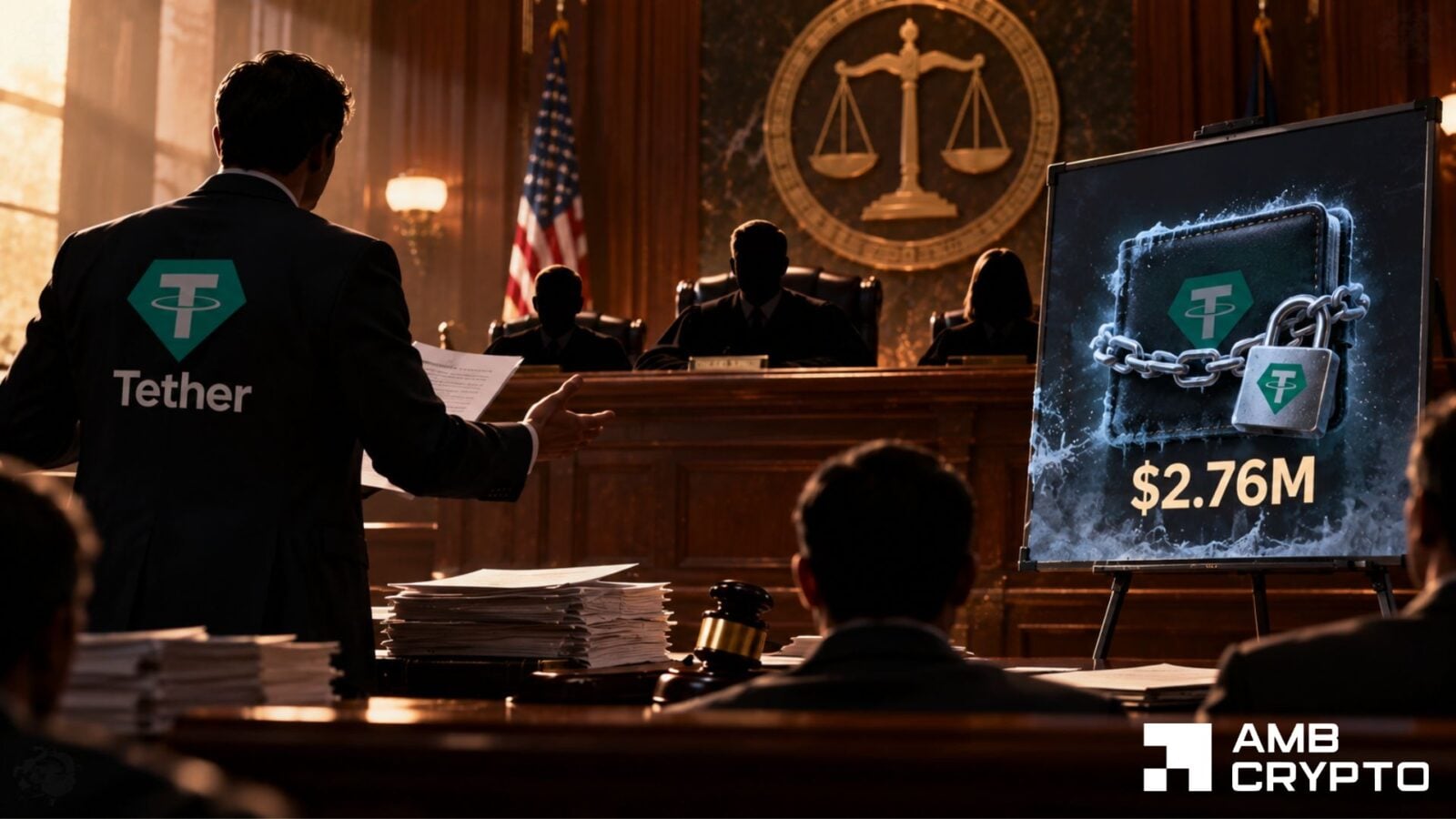
At the heart of the litigation is a freezing order executed by Tether on September 24, 2025, which targeted 23 Tron-based blockchain addresses. Among them was a wallet managed by Conduit, containing approximately $2.7 million in USDT.
According to the complaint filed in the SDNY, Conduit has repeatedly demanded that Tether either return the funds or provide a clear, legally backed justification for withholding them. Conduit alleges that Tether has stonewalled both requests, refusing to return the capital or explain its actions.
Furthermore, the lawsuit introduces a compelling financial argument: Conduit claims that Tether continues to derive financial benefit from the frozen assets. By holding the reserve assets that back the $2.76 million USDT, Tether allegedly continues to earn interest income—effectively profiting from what the payment firm terms an "unjustifiable freeze."
Chronology of Events: From Investigation to Litigation
To understand how a routine compliance freeze escalated into a federal lawsuit, a clear timeline of events is required:
- Mid-2025 (and prior): Conduit operates its payment platform, processing various digital asset transactions. An investigation is launched by Brazilian authorities into suspicious transfers involving "Onix" routed through the Conduit platform.
- September 24, 2025: Tether executes a mass freeze of 23 Tron addresses, including Conduit’s $2.7 million treasury wallet.
- Post-Freeze Inquiries: Conduit reaches out to Tether for clarification. Tether allegedly directs the payment firm to the Brazilian Federal Police for details regarding the seizure.
- Late September 2025: Conduit contacts Brazilian authorities. According to the payment firm, Brazilian officials deny ever issuing an order to Tether to freeze Conduit’s specific treasury wallet.
- The Defense of the Wallet: Conduit publicly and legally defends the targeted address, emphasizing that it was established as a treasury wallet a full month after Onix’s final transaction on their platform took place.
- October 2026: Conduit formally files its lawsuit in the Southern District of New York, seeking the return of its funds, accrued interest, and legal remedies for damages suffered.
Supporting Data and Technical Perspectives
The dispute sits at a fascinating crossroads between on-chain transparency and off-chain legal ambiguity. On-chain analysts confirmed that 23 Tron addresses were indeed flagged and locked on September 24, and Conduit’s wallet remains frozen to this day with no indication of reinstatement.
However, industry experts are divided on the true nature of the breakdown in communication. Prominent security and blockchain analyst Taylor Monahan offered two distinct hypotheses regarding the situation:
"I think Brazilian authorities have their wires crossed on what they demanded be frozen and/or isn’t communicating with Conduit well. Or Conduit is choosing to be selective with their portrayal of the situation to US courts in order to try to get their address unfrozen without dealing with the Brazilian situation head-on."
Monahan’s commentary underscores the classic blind spots in stablecoin enforcement. While issuers like Tether possess the ultimate technical kill-switch—the ability to freeze tokens on-chain at a moment’s notice—the audit trail connecting law enforcement requests to specific wallet addresses is often murky, leaving innocent intermediaries or unrelated corporate treasuries caught in the crossfire.
Official Responses and Regulatory Pressure
Tether has not been a stranger to controversy regarding its freezing mechanisms. This new lawsuit represents the second time in less than two months that the stablecoin issuer has been dragged into court by entities whose funds were locked due to ongoing investigations. Last month, another duo filed a lawsuit demanding $42.4 million in frozen USDT, alongside all interest income generated during the freeze.
These legal battles coincide with a broader, systemic assault on Tether’s regulatory standing in the United States. In late September, the U.S. Senate released a damning investigative report branding Tether’s USDT as a primary vehicle for facilitating illicit financial flows, specifically pointing to Iran-connected crypto operations.
Tether has robustly defended its compliance record against these political attacks. The company noted that it has actively cooperated with global law enforcement agencies, freezing over half a billion dollars ($550 million) tied directly to the Iranian regime and other illicit actors. Tether maintains that its blacklisting capabilities are a vital security feature necessary to protect the broader financial ecosystem from bad actors.
Broader Implications for the Stablecoin Market
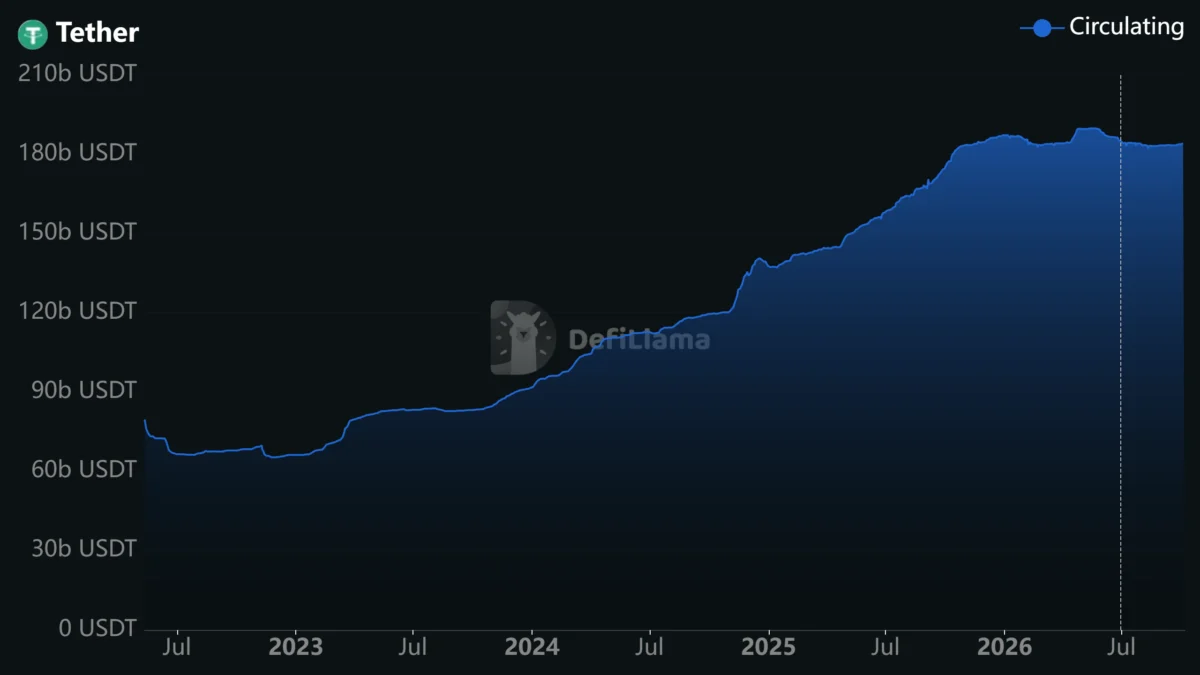
Despite mounting legal challenges, political pressure, and regulatory scrutiny, Tether remains the undisputed heavyweight of the stablecoin sector. With a staggering market supply of $184 billion, USDT anchors a massive portion of global cryptocurrency liquidity, trade volume, and decentralized finance protocols.
However, the Conduit lawsuit—and similar legal actions—pose profound questions about the future governance of stablecoins:
- The Due Process Dilemma: As centralized issuers act as de facto global financial police, courts will increasingly have to decide where the boundaries of corporate freezing power lie. Can an issuer freeze funds indefinitely without explicit, transparent legal documentation from a competent domestic court?
- The Question of Yield on Frozen Assets: Conduit’s claim regarding the interest earned on reserve assets backing frozen funds is a novel legal frontier. If courts rule that issuers cannot profit from frozen tokens, it could force a radical overhaul of how stablecoin reserves are managed during enforcement actions.
- Jurisdictional Clashes: The Conduit case demonstrates the friction that occurs when U.S. companies, international law enforcement (such as Brazilian police), and offshore issuers (like Tether) interact. Mismatched communications between foreign agencies and crypto compliance desks are likely to spark more multi-jurisdictional litigation.
As the Southern District of New York prepares to hear arguments in the Conduit case, the outcome could establish a critical precedent. Whether Tether’s unilateral risk-mitigation measures will withstand judicial scrutiny remains to be seen, but the ruling will undoubtedly shape how stablecoin issuers balance regulatory compliance with user property rights for years to come.
