

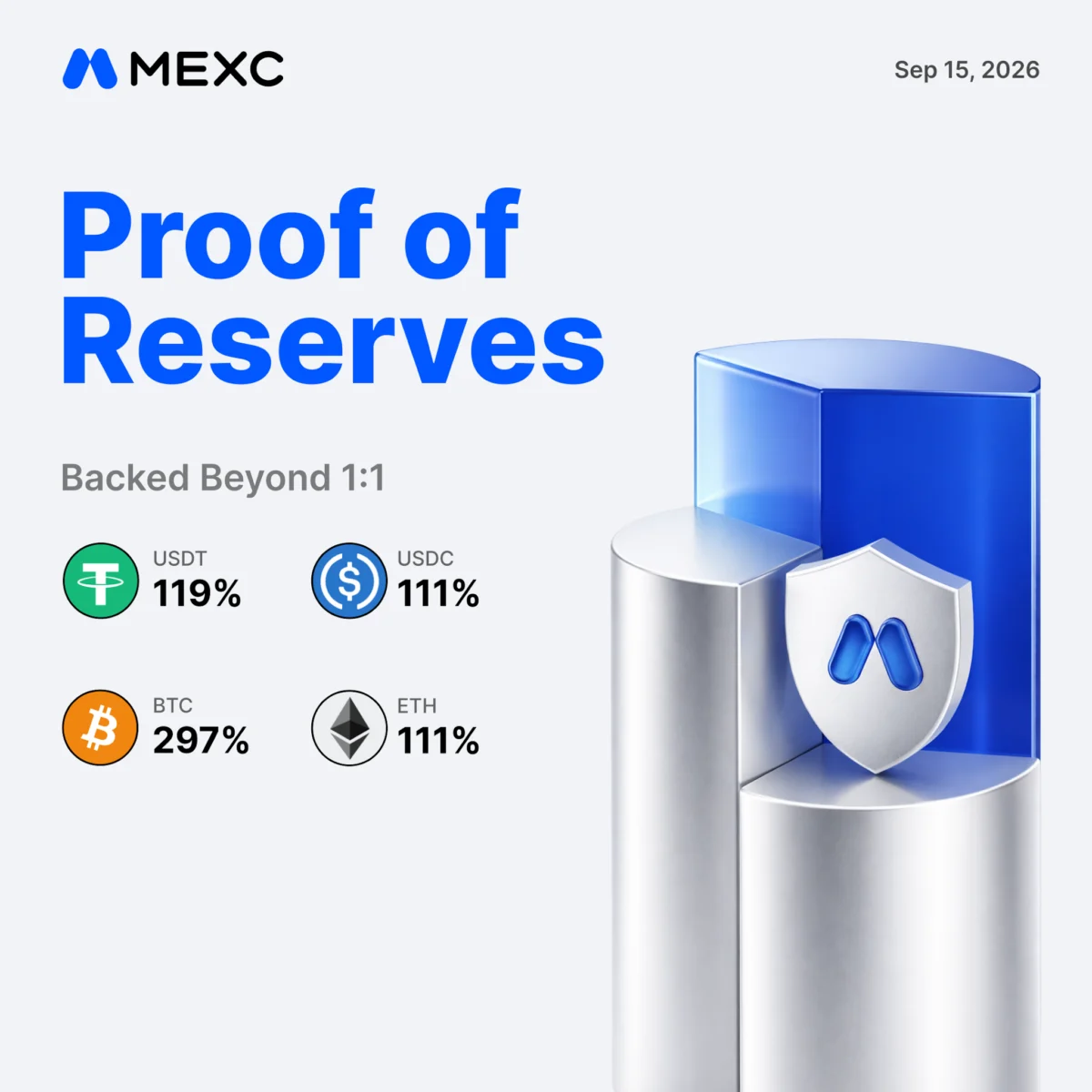
MUTSAMUDU, COMOROS — September 15, 2026 — In an era where digital asset transparency remains paramount to the maturation of the global cryptocurrency economy, prominent zero-fee digital asset exchange MEXC has officially released its Proof of Reserves (PoR) report for September 2026. Audited and independently verified by blockchain security firm Hacken, the comprehensive assessment confirms that user assets across the platform are fully backed at ratios exceeding 100% for all major reserve assets. Most notably, the exchange’s Bitcoin (BTC) reserve ratio experienced a measurable climb, rising from 288% in August to an impressive 297% for the mid-September snapshot.
The latest disclosures underscore MEXC’s ongoing dedication to rigorous financial transparency, verifiable user safety, and institutional-grade accountability. By regularly publishing month-over-month reserve data backed by cryptographic proofs, the multi-asset trading platform continues to cement its position as a trusted gateway for millions of retail and professional traders across more than 170 global markets.
Main Facts
The September 2026 Proof of Reserves report is anchored by a cryptographic snapshot taken on September 10, 2026. Conducted in collaboration with industry-leading cybersecurity and auditing firm Hacken, the assessment evaluates MEXC’s reserve health through four critical checkpoints: Proof of Liabilities, Proof of Ownership, Reserves Calculation, and an overall PoR Assessment.
According to the audited metrics, MEXC maintains substantial over-collateralization across its core digital asset holdings, comfortably exceeding the standard 1:1 backing requirement:
- Bitcoin (BTC): Boasting a reserve ratio of 297%, MEXC holds 12,202.13 BTC in reserves against total user liabilities and holdings of 4,106.57 BTC.
- Tether (USDT): Operating at a 119% reserve ratio, total reserves of 1,818,202,910.24 USDT safely cover the 1,526,526,878.38 USDT in user balances.
- USD Coin (USDC): Maintained at a 111% reserve ratio, reserves totaling 299,925,929.77 USDC fully cover user holdings of 269,894,125.25 USDC.
- Ethereum (ETH): Recorded at a 111% reserve ratio, 58,917.60 ETH in reserves cover the 53,243.98 ETH held by platform users.
To achieve this level of transparency without compromising user privacy, MEXC leverages advanced Merkle Tree cryptographic verification technology. This system allows individual account holders to independently verify that their personal asset balances are accurately accounted for within the global reserve calculation tree, ensuring complete verification capabilities without exposing sensitive user data to external parties.
Beyond its core reserves, MEXC maintains structural financial buffers designed to protect users from systemic shocks and market volatility. As of press time, the platform’s Futures Insurance Fund—engineered to absorb sudden losses resulting from extreme market liquidation events—held a balance of approximately 798 million USDT. Additionally, the exchange operates The Guardian Fund, a dual-reserve safety structure combining USDT and BTC designed to provide comprehensive compensation coverage for platform-related contingencies. The Guardian Fund held a balance of $101 million at press time, with a strategic roadmap in place to scale the fund to $500 million over the next two years.
Chronology of Transparency: The Evolution of MEXC’s Solvency Reporting
The publication of the September 2026 report is part of a broader, long-term operational timeline focused on institutional accountability within the digital asset sector. Understanding the chronological evolution of these reporting standards offers vital context regarding the exchange’s trajectory:
- Foundation and Early Growth (2018–2021): Founded in 2018, MEXC initially established its market footprint by offering deep liquidity and low-barrier trading structures, rapidly expanding across international jurisdictions to serve a growing retail base.
- The Shift Toward Zero-Fee Architecture (2022–2023): As market dynamics shifted following widespread industry turbulence and high-profile centralized exchange failures, MEXC pioneered a 0-fee spot trading model. Concurrently, leadership recognized that removing trading costs had to be matched by an aggressive ramp-up in financial transparency and security assurances.
- Adoption of Cryptographic Audits (2024): MEXC integrated Merkle Tree-based Proof of Reserves reporting on a recurring monthly schedule. Collaborating with top-tier third-party auditors like Hacken, the exchange institutionalized regular third-party solvency verifications to build an immutable record of trust.
- Fund Expansion and Scaling (2025–September 2026): Throughout 2025 and into 2026, the exchange systematically bolstered its risk mitigation structures. This included growing the Futures Insurance Fund toward the 800-million-USDT threshold and initiating the multi-year expansion plan for The Guardian Fund. The journey culminated in the September 10, 2026 snapshot, which recorded an all-time high Bitcoin reserve ratio of 297%, demonstrating robust and expanding financial health.
Supporting Data & Cryptographic Verification Methodology
In the contemporary financial landscape, self-reported exchange metrics are no longer sufficient to satisfy discerning traders and institutional participants. Independent validation is essential. The collaboration between MEXC and Hacken for the September 2026 audit establishes a rigorous framework based on cryptographic certainty.
Understanding the Merkle Tree Architecture
A Merkle Tree is a cryptographic data structure used to verify large sets of data efficiently and securely. In the context of exchange solvency:
- Data Hashing: Every individual user account balance is converted into a cryptographic "hash" (a unique alphanumeric string).
- Branching: These individual hashes are paired and hashed together repeatedly up the tree until they form a single "root hash."
- Root Verification: The root hash represents the sum total of all user liabilities on the exchange. Hacken can then compare this cryptographic liability total against the verifiable on-chain wallet addresses controlled by MEXC (Proof of Ownership).
- User Verification: Users are provided with a unique cryptographic "proof" (a Merkle path) that allows them to check their individual leaf node within the tree. This enables absolute verification that their funds are included in the solvency calculation without revealing any other user’s balance or identity.
Comparative Asset Health Breakdown
| Asset Class | MEXC Total Reserves | User Holdings / Liabilities | Audit Reserve Ratio (%) | August 2026 Ratio (%) | Status |
|---|---|---|---|---|---|
| Bitcoin (BTC) | 12,202.13 BTC | 4,106.57 BTC | 297% | 288% | Fully Backed & Over-Collateralized |
| Tether (USDT) | 1,818,202,910.24 USDT | 1,526,526,878.38 USDT | 119% | 118% | Fully Backed & Over-Collateralized |
| USD Coin (USDC) | 299,925,929.77 USDC | 269,894,125.25 USDC | 111% | 110% | Fully Backed & Over-Collateralized |
| Ethereum (ETH) | 58,917.60 ETH | 53,243.98 ETH | 111% | 111% | Fully Backed & Over-Collateralized |
The data clearly illustrates that MEXC maintains a significant surplus across all major assets. For instance, the platform holds nearly three times the amount of Bitcoin required to service all user withdrawals, providing an immense buffer against market downturns, liquidity crunches, or sudden volatility spikes.
Official Responses and Leadership Perspective
Leadership at MEXC has continually emphasized that transparency is not merely a marketing tool, but an existential prerequisite for the future of digital finance. Vugar Usi, Chief Executive Officer of MEXC, provided a definitive statement regarding the release of the September 2026 report:
"Protecting user assets and earning their trust are fundamental responsibilities, not optional commitments. In an industry where confidence has been tested time and again, transparency must be demonstrated through actions that users can independently verify. That is why we publish verifiable Proof of Reserves every month, giving users the ability to validate their asset data at any time rather than simply relying on our assurances. Our commitment is to continue raising the standard for transparency, accountability, and asset protection, and to build the kind of trust that is earned consistently over time."
Third-party auditors like Hacken have echoed the importance of these continuous disclosures. By submitting to regular, unannounced or scheduled audits, MEXC allows security professionals to scrutinize the platform’s infrastructural integrity, ensuring that user liabilities are perpetually matched or exceeded by verifiable on-chain assets.
Implications for Traders, Markets, and the Broader Crypto Ecosystem
The release of the September 2026 Proof of Reserves report carries wide-ranging implications for the digital asset landscape, touching upon regulatory compliance, retail confidence, and the ongoing convergence between traditional finance (TradFi) and decentralized digital markets.
1. Setting a New Benchmark for Retail Exchanges
Historically, proof of reserves initiatives were viewed as temporary band-aids applied during periods of systemic panic. By institutionalizing monthly audits and pushing reserve ratios well above the 100% threshold—such as BTC resting safely near 300%—MEXC establishes a new gold standard for centralized exchange operations. Retail users operating in more than 170 markets can execute trades with the comforting knowledge that their capital is backed by verifiable, liquid reserves.
2. Mitigating Counterparty Risk
Counterparty risk remains one of the greatest psychological barriers preventing broader institutional and retail adoption of digital assets. When exchanges implement dual-reserve safety nets like The Guardian Fund ($101 million scaling to $500 million) alongside massive liquidation buffers like the Futures Insurance Fund (798 million USDT), they effectively insulate everyday participants from systemic contagion. This structural resilience is vital as global markets experience macroeconomic shifts.

3. Bridging TradFi and Crypto Through Infrastructure
As MEXC continues to evolve from a crypto-native platform into a multi-asset gateway providing access to digital assets, tokenized instruments, stocks, and derivatives, the importance of robust reserve accounting multiplies. Traditional financial institutions evaluating tokenized real-world assets (RWAs) and hybrid trading environments demand the same—if not higher—levels of cryptographic accountability that MEXC demonstrates through its Hacken audits.
4. Empowering Self-Sovereignty Through Verification
True decentralization philosophy emphasizes “don’t trust, verify.” While centralized exchanges inherently require a degree of custodial trust, tools like Merkle Tree verification bridge the gap by allowing users to exercise mathematical verification over their individual accounts. This empowers users to take an active role in their own financial security.
About MEXC
Founded in 2018, MEXC has evolved into a leading global multi-asset trading platform built to serve as a zero-fee gateway to infinite financial opportunities. Operating across more than 170 markets worldwide, the exchange provides simple, efficient, and low-barrier access to a diverse ecosystem spanning cryptocurrencies, equities, tokenized assets, derivatives, and a growing suite of TradFi-linked financial instruments—all accessible through a single unified account.
Characterized by zero trading fees, deep liquidity pools, broad asset coverage, and a high-performance execution engine, MEXC is intentionally engineered for modern retail users who seek to discover market opportunities earlier, act faster, and trade with fewer structural friction points. As the boundaries between traditional finance and digital assets continue to dissolve, MEXC remains deeply committed to democratizing global financial access and helping users navigate the markets securely.
Connect with MEXC:
- Official Website: mexc.com
- X (formerly Twitter): @MEXC
- Telegram: MEXCEnglish
- New User Guide: How to Sign Up on MEXC
- Media & PR Inquiries: [email protected]
Risk Disclaimer
This content is provided for informational purposes only and does not constitute financial, investment, or legal advice. Given the inherent volatility of financial markets—including digital assets, tokenized instruments, and traditional financial products—investors should carefully evaluate current market conditions, assess underlying asset fundamentals, and consult with a qualified financial advisor before making any trading or investment decisions.
