

In a landmark development for the generative artificial intelligence sector, Black Forest Labs (BFL) has officially unveiled FLUX 3. This release marks a critical inflection point for the German AI powerhouse, transitioning from a specialist in high-fidelity still imagery to a pioneer in true multimodal intelligence. For the first time, BFL’s flagship model architecture is capable of generating synchronized video and audio, effectively moving the needle from static pixels to dynamic, world-aware content.
The debut of FLUX 3 is not merely an incremental update; it represents a fundamental shift in how the company approaches machine learning. By training a single, unified system on images, video, and audio simultaneously—rather than stitching together disparate tools—BFL has achieved a level of cohesion that sets a new industry standard.
The Core Innovation: Multimodal Integration
The headline feature of the FLUX 3 release is its advanced video generation capability. Users can now generate clips up to 20 seconds in length, characterized by high-fidelity visuals accompanied by audio that is natively synced to on-screen events. Whether it is the subtle ambient noise of a forest, the complex sound of environmental effects, or crisp, reactive dialogue, the audio and visual components are generated as a single, coherent stream.
This is the essence of true multimodality. In previous generations, AI models often functioned like a collection of specialized modules; a text-to-image engine might be paired with a separate audio-processing tool, often resulting in "uncanny valley" artifacts or synchronization errors. By learning these data types within a single shared system, FLUX 3 achieves a structural understanding of timing, physics, and causal relationships that were previously beyond the reach of generative models.
Chronology: The Rise of Black Forest Labs
The meteoric rise of Black Forest Labs is a story of veteran expertise meeting bold execution. Founded in August 2024 by the very researchers who architected the original, revolutionary Stable Diffusion models at Stability AI, BFL was born with a clear mission: to reclaim the throne of open-source generative art.
- August 2024: Black Forest Labs is founded, immediately signaling intent to challenge the stagnating state of image generation.
- Late 2024: The launch of the original FLUX models sent shockwaves through the community. By outperforming MidJourney and effectively rendering Stability AI’s own Stable Diffusion 3 obsolete, BFL captured the "best open-source image generator" title.
- October 2024: The company releases FLUX 1.1 Pro. While moving away from a strictly open-source model, the iteration topped the Artificial Analysis image arena, solidifying BFL’s reputation for technical excellence.
- November 2025: BFL releases FLUX.2. Despite the anticipation, the model faced a more lukewarm reception compared to its predecessor. During this period, competition intensified, and in late 2025, Alibaba’s "Z-Image Turbo" dethroned FLUX as the preferred tool for many, particularly those running hardware-constrained consumer graphics cards.
- July 2026: The release of FLUX 3. This marks the company’s strategic "comeback" and its pivot toward professional-grade video and robotic integration.
Supporting Data: Testing the New Standard
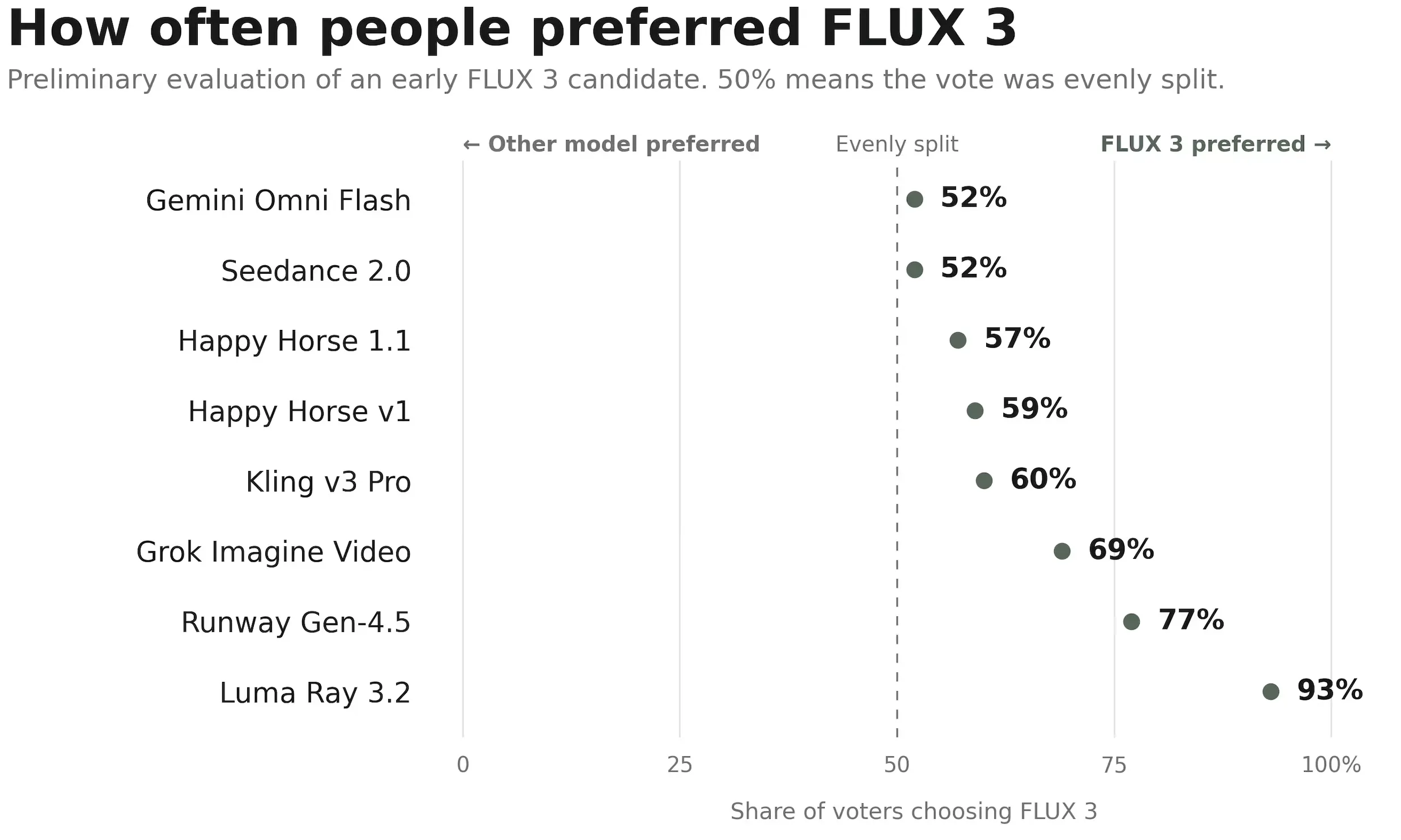
To quantify the performance of FLUX 3, Black Forest Labs employed human preference evaluations—the industry gold standard for assessing subjective quality. In these blind "head-to-head" comparisons, human reviewers were asked to choose the clip that felt more authentic, visually sharp, and audio-synchronized.
The results underscore a significant leap in capability:
- FLUX 3 vs. Runway Gen-4.5: FLUX 3 was preferred in 77% of evaluations.
- FLUX 3 vs. Luma Ray 3.2: The dominance was even more pronounced, with FLUX 3 winning 93% of head-to-head comparisons.
- FLUX 3 vs. Industry Leaders (Gemini Omni/Seedance): FLUX 3 demonstrated a competitive edge, beating these top-tier models in 52% of evaluations, suggesting that it has firmly entered the top tier of global AI models.
While BFL emphasizes that these are preference tests rather than rigid, automated scoring rubrics, the consistency of the results indicates that the model possesses a superior understanding of cinematic lighting, motion consistency, and temporal audio alignment.
The "FLUX-mimic" Breakthrough: From Screens to Factories
Perhaps the most ambitious aspect of the FLUX 3 launch is not the video generation itself, but the underlying "world model" that powers it. CEO Robin Rombach has been vocal about the company’s philosophy: "A model that only learns images can only generate images."
BFL posits that by training a model to predict the next frames of a video, the system is inadvertently learning the physics of the world—concepts like weight, contact, and timing. This internal understanding is what the company is now leveraging for its "FLUX-mimic" project.
In partnership with Zurich-based mimic robotics, BFL has developed a lightweight "decoder" that translates this latent sense of movement into actionable robotic commands. This has immediate, high-value industrial applications. German automaker Audi is currently piloting the technology to automate tasks that have long frustrated traditional industrial robots—specifically, the installation of flexible, soft-body door seals.
"Audi represents the kind of manufacturing partner we built FLUX-mimic for," says mimic co-founder Stephan-Daniel Gravert. Christoph Schneider of Audi noted that the system is now successfully handling "complex soft-body manipulation" tasks that previously required human intervention. With a latency of roughly 101 milliseconds, the system operates at a speed comparable to human visual reflexes, representing a massive jump in robotic dexterity.
Implications: The Future of Generative AI
The transition from content generation to physical world-modeling places Black Forest Labs at a unique crossroads. For creative professionals, the forthcoming release of FLUX 3’s image-generation capabilities promises a new standard in versatility, moving well beyond the photorealistic "look" that dominated the previous generation.
However, the implications for the wider tech landscape are arguably larger. By betting that video generation is the precursor to general-purpose robotics, BFL is aligning itself with the "Embodied AI" movement. If a model can predict how a soft object deforms in a video, it can theoretically learn to grasp that object in reality.
The Road Ahead
Despite the excitement, the rollout of FLUX 3 is measured. Currently, the video and robotic-action features are available only via APIs and through select, high-level industry partnerships. For the creative community, the company has announced that the image generation components will follow "in the coming weeks."
The open-weight "Dev" version—the iteration most anticipated by the local-hardware community and the open-source movement—is not expected until later in 2026. This staggered release reflects BFL’s desire to maintain a balance between commercial stability and its open-source roots.
As the AI industry watches, the question remains: Can BFL reclaim the absolute crown of open-source artificial intelligence? Given the performance of FLUX 3 and its integration into industrial robotics, the company has successfully reframed itself not just as a toolmaker for artists, but as a primary architect of the next generation of physical intelligence. The "Stable Diffusion" era may have been the starting gun, but the "FLUX" era is clearly the current race to watch.
