

The landscape of decentralized finance (DeFi) in Europe stands at a pivotal crossroads. As the European Union moves to solidify its position as a global leader in digital asset oversight, the European Banking Authority (EBA) has signaled a decisive shift: crypto lending and borrowing, previously operating in a decentralized gray area, are now firmly in the regulatory crosshairs.
By proposing the integration of DeFi lending into the Markets in Crypto-Assets (MiCA) framework, the EBA aims to address systemic vulnerabilities that have long troubled traditional financial watchdogs. This move represents an ambitious effort to harmonize the rapidly evolving crypto-asset market with the stringent standards of the traditional banking sector.
Main Facts: Bringing DeFi Under the Regulatory Umbrella
The EBA’s recent policy review is clear: the current "wild west" era of crypto lending must come to an end. The Authority, which serves as the primary architect of EU-wide banking regulation, is concerned that DeFi protocols—and the intermediaries that grant users access to them—operate in a manner that creates dangerous regulatory arbitrage.
At the core of the issue is the practice of yield generation. While MiCA explicitly banned stablecoin yield mechanisms to protect investors, several prominent stablecoins, including Circle’s USDC and EURC, continue to generate yield through complex DeFi strategies. Regulators argue that this loophole undermines the spirit of the MiCA legislation and exposes consumers to risks that the existing framework was designed to eliminate.
The EBA has explicitly identified several "red flag" risks, including:
- Systemic Contagion: The interconnected nature of DeFi protocols means that a failure in one liquidity pool could ripple across the entire ecosystem.
- Over-leverage: The ease with which users can borrow against volatile assets creates a ticking time bomb for liquidations.
- Cyber Vulnerabilities: Exploits, smart contract bugs, and "flash loan" attacks remain a constant threat to user funds.
- Market Manipulation: The lack of transparency in some lending protocols leaves room for predatory practices.
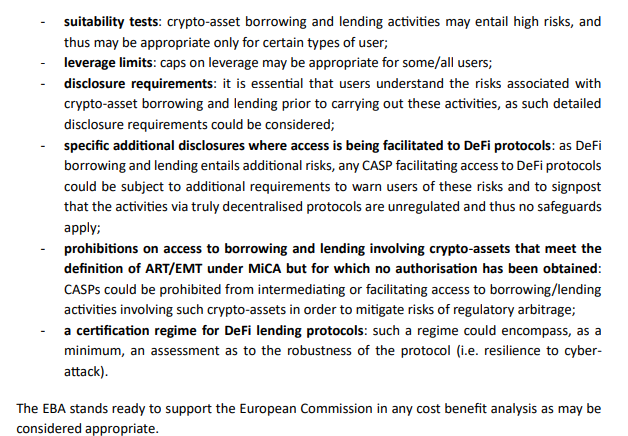
To counter these risks, the EBA is considering a suite of measures, including mandatory leverage caps, strict disclosure requirements, and a new certification standard based on "cyber resilience" for all DeFi protocols operating within the bloc.
Chronology of the Shift
The regulatory trajectory toward this announcement has been building for years:
- 2022-2023: The EU finalized the MiCA framework, establishing clear rules for crypto-asset service providers (CASPs) and stablecoin issuers. However, the framework left "truly decentralized" protocols largely untouched.
- Early 2024: As the Total Value Locked (TVL) in DeFi lending markets surged past $50 billion, European regulators observed an uptick in institutional-grade DeFi services, blurring the lines between traditional banking and on-chain protocols.
- Late 2024: The EBA and the European Securities and Markets Authority (ESMA) began a joint assessment of the risks posed by DeFi lending, specifically focusing on the intermediaries that make these protocols accessible to retail investors.
- September 2026 (Current): The EBA officially published its priorities, explicitly calling for the inclusion of crypto lending under MiCA. The proposal suggests that any platform—centralized or decentralized—that facilitates the borrowing and lending of crypto-assets should be subject to licensing and oversight.
Supporting Data: The Scale of the Market
The urgency of this regulatory push is underscored by the sheer size of the DeFi lending market. As of the most recent data, the sector boasts roughly $54 billion in total value locked. Within this, the "vault" segment—where user assets are pooled and deployed across various lending strategies—accounts for approximately $10 billion across more than 4,000 distinct vaults.
These vaults range from simple, algorithmically governed liquidity pools to complex, curator-managed funds where a human "manager" decides the optimal allocation of assets. It is this latter category that has drawn the most intense scrutiny from both the EBA and the U.S. Securities and Exchange Commission (SEC), as they bear a striking resemblance to traditional investment funds.
Official Responses and Industry Conflict
The industry’s reaction to the EBA’s proposal has been one of deep division. While the goal of increasing safety is widely accepted, the mechanism of classification remains a flashpoint for debate.
The Morpho vs. Aave Debate
The tension is perhaps best exemplified by the ongoing discourse between Morpho, a decentralized lending protocol, and Aave, one of the largest players in the space.
Morpho’s Stance: Paul Frambot, CEO of Morpho, has proposed a bifurcated regulatory model. He suggests that the industry should distinguish between "non-custodial" vaults, where the curator’s role is strictly limited by code, and "discretionary" vaults, where a human manager makes active investment decisions. Under this framework, discretionary vaults would naturally fall under securities regulation, while non-custodial vaults might enjoy a lighter, more permissive regulatory touch.
Aave’s Rebuttal: Stani Kulechov, founder of Aave, has publicly challenged this categorization. Kulechov argued that Frambot’s proposal is "self-serving" and fails to address the underlying reality of how these vaults operate. According to Kulechov, a vault is either decentralized or it is not; introducing a middle-ground category for "non-custodial" management creates a dangerous loophole that could be exploited by bad actors. He contends that there is nothing inherently wrong with discretionary vaults, provided that the industry and regulators work together to create a viable path for compliance.
Global Implications: EU vs. SEC
The EU’s approach is noticeably distinct from that of the United States. While the SEC has primarily relied on "regulation by enforcement," suggesting that almost any vault where a curator exercises discretion constitutes an unregistered security, the EU is attempting to build a comprehensive, ex-ante regulatory framework.
The implications for international firms are significant:
- Barring Unlicensed Stablecoins: The proposed rules could effectively bar stablecoins like USDT from being used in European-facing DeFi lending platforms if they do not meet MiCA’s specific reserve and governance requirements. This would force a massive shift in liquidity toward Euro-denominated or MiCA-compliant assets.
- Intermediation Focus: The EBA is focusing on the "interface." Any platform that provides a user-friendly front-end for DeFi protocols—essentially any centralized entity that simplifies the user experience—will likely be required to obtain a CASP license.
- The "Frontier" Problem: For protocols that are truly non-custodial and operate without a central entity, the regulatory path remains murky. If these protocols cannot be "licensed," will they be geofenced, or will regulators attempt to hold the developers themselves liable?
Conclusion: A New Era of Financial Engineering
The EBA’s proposal is a watershed moment for the crypto industry. By seeking to integrate DeFi into the MiCA framework, the EU is effectively telling the industry that decentralized finance is no longer an experimental subculture, but a core component of the future financial infrastructure that must adhere to the rules of the road.
While the debate between industry leaders like Aave and Morpho highlights the complexity of defining "decentralization," the regulatory direction is clear. The transition will likely force a consolidation in the market, favoring protocols that prioritize transparency, security, and regulatory compliance.
As the EU moves toward formalizing these rules, the rest of the world will be watching closely. Whether this creates a "Brussels effect," where global standards are set by the EU, or results in a fragmentation of the global crypto market, remains to be seen. What is certain, however, is that the era of unregulated, high-yield DeFi lending is reaching its natural conclusion, giving way to a more regulated—and perhaps more stable—financial ecosystem.
