

For years, traditional finance (TradFi)—characterized by legacy mainframes, multi-day settlement cycles, and a deeply entrenched skepticism toward decentralized ledgers—refused to acknowledge cryptocurrency as anything more than a speculative asset class. Today, the institutional walls are not just crumbling; they are actively being rebuilt to accommodate digital assets at scale. In what marks a watershed moment for both sectors, Citigroup, one of the world’s most globally connected financial institutions, has officially joined forces with Coinbase, a leading digital asset exchange, to overhaul global digital asset payment capabilities.
This strategic alignment signals more than just a fleeting corporate collaboration. It represents a profound structural convergence between traditional banking infrastructure and Decentralized Finance (DeFi), setting the stage for a new era of 24/7, borderless capital movement.
Main Facts: Unpacking the Citi-Coinbase Alliance
At its core, the newly announced partnership between Citi and Coinbase is designed to bridge the chasm between traditional fiat currency and the burgeoning digital asset economy.
- The Core Objective: The primary goal of the collaboration is to streamline digital asset payments for global institutional clients, bridging the gap between legacy bank-grade compliance and crypto-native liquidity.
- Initial Rollout: Phase one of the partnership focuses on liquidity access—specifically, moving traditional capital in and out of the crypto ecosystem. Citi will connect its extensive corporate client network to Coinbase’s established infrastructure, which securely converts fiat currency into digital assets and vice versa.
- The Speed Advantage: Unlike conventional cross-border bank transfers that remain bottlenecked by traditional clearinghouses and are routinely paused over weekends, the envisioned architecture aims to provide frictionless, round-the-clock liquidity management.
- The Stablecoin Frontier: Both institutions are actively engineering a mechanism that allows clients to seamlessly send traditional fiat currency from one end of a transaction and have it instantly materialize as stablecoins on the receiving end.
- Global Footprint: Citi already possesses immense reach, moving U.S. dollars on a 24/7 basis, operating proprietary token services for institutional players, and providing banking services to an estimated 90% of the world’s top eCommerce giants. Coinbase acts as the critical gateway, granting this colossal volume of legacy capital a compliant, highly secure on-ramp into the crypto economy.
Chronology: From Skepticism to Strategic Integration
To fully understand the gravity of the Citi-Coinbase partnership, it is essential to trace the evolutionary timeline of how traditional banking giants shifted from outright rejection to active integration of digital assets.
Era 1: The Great Divide (2010–2018)
During the early and mid-2010s, Wall Street viewed cryptocurrencies primarily through a lens of regulatory risk. Major commercial banks, including Citigroup, actively restricted customers from using traditional credit and debit cards to purchase digital assets. Compliance departments flagged crypto transactions as high-risk, leading to closed accounts and institutional ostracization. Blockchain was praised, but Bitcoin and other native tokens were largely dismissed.
Era 2: Institutional Exploration and Private Ledgers (2019–2022)
As decentralized finance began to demonstrate real utility, major financial institutions realized they could not simply ignore the underlying technology. Banks began exploring permissioned blockchains and private tokenization platforms. Citi, recognizing the need for modernization, developed proprietary token services to handle institutional dollar movements more efficiently, though these systems remained strictly walled off from public blockchains like Ethereum or Solana.

Era 3: The Stablecoin Awakening (2023–2025)
The explosive growth of stablecoins—digital tokens pegged 1:1 to fiat currencies—proved that blockchain rails were vastly superior for settling transactions compared to legacy SWIFT networks. Financial institutions watched as billions of dollars in daily volume bypassed traditional banking channels entirely in favor of digital dollars. Regulators began providing clearer frameworks, paving the way for institutional-grade compliance solutions.
Era 4: The Convergence (Late 2025–2026)
The announcement of the Citi-Coinbase partnership marks the culmination of this evolution. Rather than attempting to build competing consumer-facing crypto rails from scratch, a premier global bank is directly partnering with a crypto-native infrastructure provider. This cooperative model represents a new paradigm where TradFi and DeFi cease to be adversaries and instead become deeply interconnected layers of the global financial stack.
Supporting Data: The Trillion-Dollar Stablecoin Reality
Citi’s decision to integrate with Coinbase is far from a speculative gamble; it is a calculated response to irrefutable market data demonstrating that stablecoins have evolved into a dominant force in global finance.
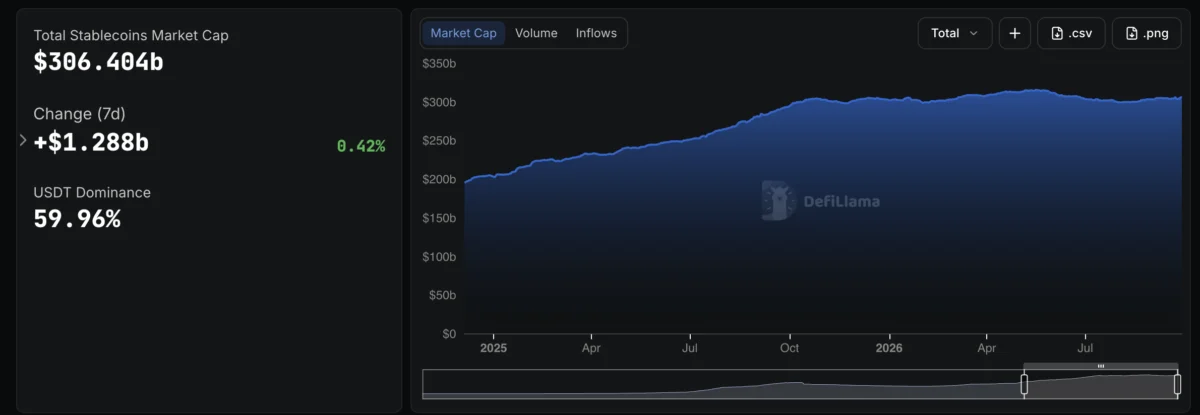
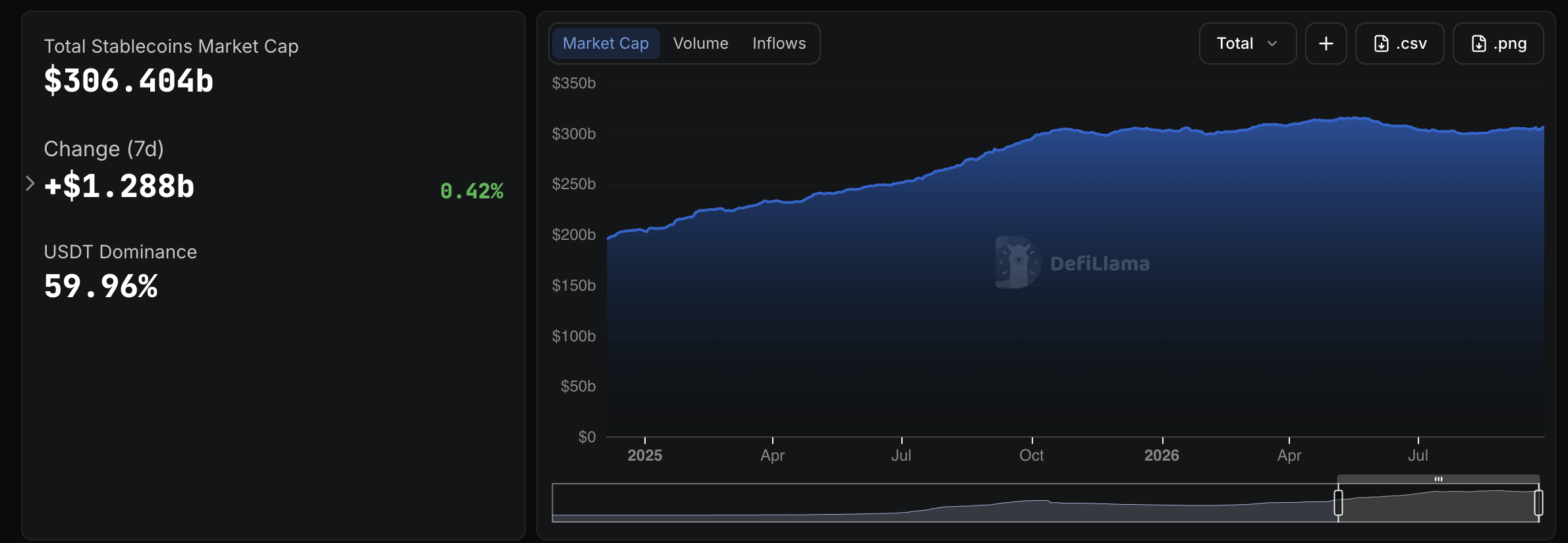
According to data compiled by DeFiLlama, the total market capitalization of stablecoins has surged past $306 billion. More importantly, this capital is not sitting idle in digital wallets; it is moving at velocities that rival, and in some cases surpass, legacy payment networks.
+------------------------------------------------------------+
|        Annual Transaction Volume Comparison (USD)          |
+------------------------------------------------------------+
| Stablecoins (Recent Annual Figures):    $11.2 Trillion     |
| Mastercard (Comparative Annual Volume): $10.6 Trillion     |
| Stablecoins (H1 2026 Alone):            $8.5 Trillion      |
+------------------------------------------------------------+
Data revealed by financial titan BlackRock underscored the staggering scale of this activity, showing that stablecoins handled an astonishing $11.2 trillion in transactions over a recent twelve-month period. To put that figure into perspective, it eclipses the annual transaction volume processed by legacy financial heavyweight Mastercard, which stood at $10.6 trillion.
The momentum has only accelerated. The first half of 2026 alone added another $8.5 trillion in stablecoin transaction volume. While market analysts readily acknowledge that these figures are not a direct "apples-to-apples" comparison—as stablecoin metrics capture a diverse blend of peer-to-peer transfers, speculative trading, and decentralized finance (DeFi) yield generation—the upward trajectory is undeniable. Legacy financial institutions like Citi are rushing to capture a slice of this massive, rapidly expanding digital liquidity pool.

Official Responses and Stakeholder Perspectives
While detailed technical specifications of the Citi-Coinbase partnership are slated for release over the coming months, executives from both organizations have framed the collaboration as a monumental step forward for international commerce.
Representatives from Citigroup have emphasized the bank’s ongoing commitment to meeting the evolving needs of its institutional clientele. By leveraging Citi’s unmatched presence in global eCommerce and institutional foreign exchange, the bank aims to reduce friction in cross-border payments. The integration is viewed as a natural extension of Citi’s existing 24/7 dollar-clearing capabilities, ensuring that corporate clients can manage liquidity dynamically without being restricted by geographic borders or traditional banking hours.
Coinbase leadership has echoed these sentiments, highlighting the significance of bringing bank-grade fiat and stablecoin rails to businesses on a global scale. For Coinbase, securing a partnership with a global systematically important bank (G-SIB) like Citi validates years of regulatory compliance, security enhancements, and institutional-grade product development. It transforms the exchange from a consumer-facing retail platform into an indispensable foundational utility for the entire global financial system.
Industry analysts have widely praised the move, noting that traditional financial institutions can no longer afford to maintain insulated ecosystems. As corporate treasuries increasingly demand instant settlement and multi-currency flexibility via digital assets, banks that fail to integrate risk losing vital institutional clients to more agile, crypto-native competitors.
Implications: What This Means for the Future of Global Finance
The convergence of Citi and Coinbase carries profound implications for the future of banking, international trade, and regulatory policy.
1. The Death of the Multi-Day Settlement
For decades, international wire transfers have been plagued by frustrating delays, intermediary bank fees, and arbitrary cut-off times. By coupling Citi’s institutional liquidity with Coinbase’s digital asset payment rails, the financial industry moves one step closer to instantaneous, 365-day-a-year settlement. Corporate treasurers will soon be able to reallocate capital across global subsidiaries in seconds rather than days.
2. Mainstream Acceptance of Stablecoins
When a top-tier global bank begins engineering infrastructure to seamlessly convert fiat currency into stablecoins, the debate over the legitimacy of stablecoins is effectively over. This partnership normalizes stablecoin usage for multinational corporations, paving the way for widespread adoption in supply chain finance, B2B invoicing, and eCommerce payouts.
3. Increased Pressure on Competitors
Citi’s proactive embrace of crypto infrastructure places immense pressure on rival Wall Street institutions. Competitor banks that have lagged in digital asset adoption now face the very real threat of client attrition as corporate treasurers gravitate toward financial partners that offer integrated fiat-crypto liquidity solutions. Expect a wave of similar partnerships and acquisitions as traditional banking boardrooms race to keep pace.
4. Regulatory Harmonization
As traditional financial giants intertwine their infrastructure with public blockchain networks, regulatory scrutiny will inevitably intensify—but it will also mature. Policymakers will be forced to establish clear, constructive frameworks that accommodate digital asset payments without compromising anti-money laundering (AML) and know-your-customer (KYC) standards. The Citi-Coinbase alliance serves as a blueprint for how compliant, regulated crypto integration can successfully operate at a global scale.
Conclusion
The partnership between Citigroup and Coinbase is much more than a routine corporate press release; it is a defining milestone in financial history. It marks the formal handshake between the old guard of Wall Street and the vanguard of decentralized finance. As both institutions roll out further details of their integrated payment and stablecoin infrastructure in the months ahead, one thing remains abundantly clear: the barrier separating traditional finance from the digital asset economy has been permanently breached.
