

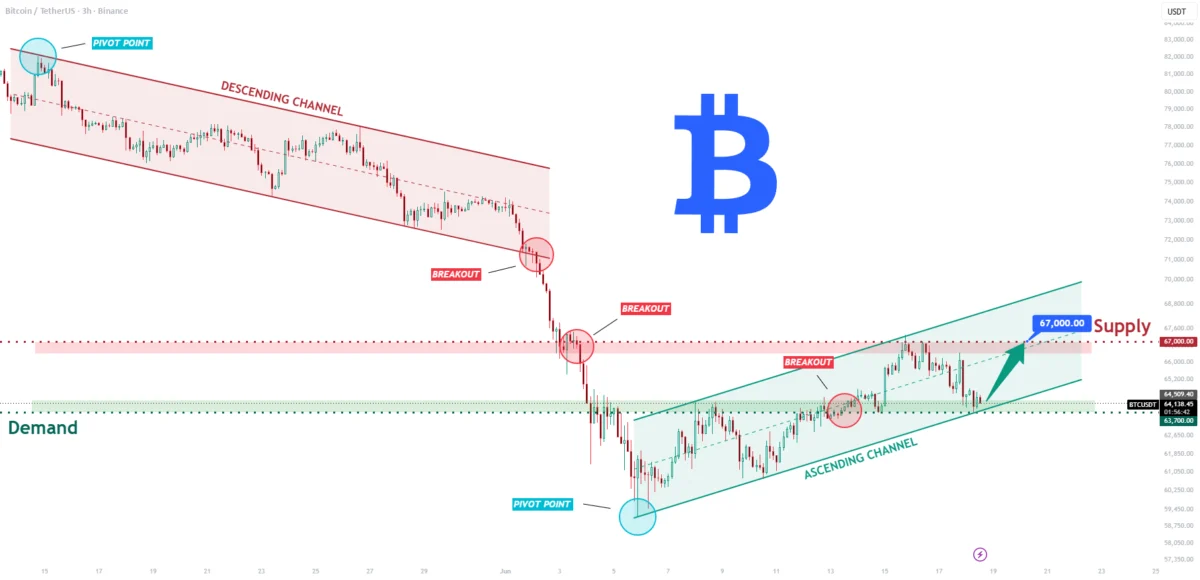
As Bitcoin enters the weekend, the digital asset market finds itself in a state of heightened tension. Investors and traders are currently locked in a tug-of-war, with technical analysts divided over whether the cryptocurrency’s recent price action represents the foundation of a robust recovery or merely a temporary reprieve before a more significant leg lower. As of June 20, Bitcoin continues to consolidate around the low-$60,000 region—a zone that has become the focal point of market sentiment and the primary determinant of the asset’s near-term trajectory.
The State of Play: A Market Divided
The current market environment is characterized by a "wait-and-see" approach. Technical analysts across platforms like TradingView have converged on a singular consensus: the $60,000 to $67,000 corridor is the most critical battlefield for Bitcoin in the second half of June.
On one side of the aisle, bulls are pointing to localized bounces from channel support, suggesting that the recent sell-off has been exhausted and that demand is accumulating at current levels. On the other side, bears argue that the lack of momentum following these bounces is indicative of a "dead cat bounce," warning that the structural integrity of the long-term trend is at risk if buyers cannot reclaim higher supply zones.
Chronology of the Current Consolidation
To understand the current impasse, one must look at the recent sequence of events that brought Bitcoin to this precarious position.
Following a period of relative volatility, Bitcoin’s price retreated from its recent highs, testing the patience of institutional and retail investors alike. Throughout the week of June 17–20, the price action became increasingly compressed.
- Mid-Week Testing: Bitcoin struggled to maintain momentum above the $65,000 mark, leading to a series of tests on the $63,000 support level.
- The June 20th Inflection: By the morning of June 20, analysts began reporting that the price had formed a distinct channel, with the lower boundary sitting near $63,700 and a significant supply wall looming at $67,000.
- The Weekend Pivot: As the traditional financial markets closed for the weekend, the crypto market—which operates 24/7—began to see a contraction in volume. This lack of liquidity often amplifies price swings, making the current $60,000 floor even more volatile.
Technical Analysis: The Bullish and Bearish Arguments
The debate currently circulating among market participants can be categorized into two distinct technical frameworks.
The Case for Recovery: The Bullish Objective
Analysts such as heniitrading have provided a more optimistic outlook, mapping the current price action as a healthy bounce from channel support. According to this model, the market is successfully holding above a critical $63,700 demand zone.
The bullish thesis hinges on the ability of buyers to push Bitcoin back into the $67,000 supply zone. If this can be achieved, it would effectively invalidate the recent bearish sentiment and prove that the current buying pressure is not merely a weak relief rally but a genuine accumulation phase. For these analysts, the objective is simple: reclaim the $67,000 level to set the stage for a retest of previous highs.
The $60,000 "Line in the Sand"
Conversely, more cautious analysts, such as weslad, view the market through a lens of risk management. The argument here is that while the market is currently respecting the demand zone, $60,000 acts as the ultimate "line in the sand."

The logic is straightforward: as long as the market respects this area, the possibility of a recovery remains on the table. However, a decisive daily close below $60,000 would signal a breakdown in market structure. Such a move would likely trigger a cascade of stop-loss orders, exposing the market to significant downside pressure.
The 4-Hour Wave Structure
Behdark’s analysis provides a granular look at the 4-hour timeframe, highlighting the $61,000 zone as the pivot point. In this setup, a strong response from buyers in the green support zone could propel Bitcoin toward the $72,000 psychological barrier. Failure to hold this zone, however, would confirm a bearish wave structure, significantly increasing the probability of a slide toward the $56,000 support level, a major area of historical interest.
Supporting Data and Market Dynamics
The current market behavior is not occurring in a vacuum. Several factors contribute to the gravity of the $60,000 test:
- Liquidity Pools: As noted by various market commentators, large liquidity pools exist just below the $60,000 mark. Market makers are often drawn to these areas to fill orders, meaning that a drop below this level could be sudden and aggressive as these pools are "swept."
- Volume Profiles: Trading volume has been inconsistent during the latest recovery attempt. High-conviction moves are usually accompanied by a surge in buying volume; the current "grinding" movement suggests a lack of institutional conviction at the present price point.
- The Correlation with Macro Factors: While Bitcoin has recently attempted to decouple from traditional equities, the sensitivity to interest rate speculation and inflationary data remains high. Investors are closely monitoring how the broader economic climate influences risk-on assets, which in turn dictates the appetite for Bitcoin.
Institutional and Expert Perspectives
While retail traders are focusing on the immediate charts, institutional players are maintaining a more long-term perspective. There has been no significant movement in the major spot ETFs, suggesting that institutional demand is currently in a holding pattern. Many analysts suggest that large-scale investors are waiting for a clear directional signal—a break above $67,000 or a capitulation event near $58,000—before deploying significant capital.
The consensus among market observers is that the lack of clear direction is intentional. Market consolidation often serves as a "spring-loading" mechanism, where the energy stored during a period of low volatility is eventually released in a sharp, decisive move.
Implications for Traders and Investors
What does this mean for the average participant? The most important takeaway is that the market has presented a "clean" decision zone. Traders are effectively being given a roadmap by the market itself.
Strategic Considerations:
- The "Wait-and-See" Strategy: For many, the safest approach is to refrain from aggressive positioning until the $60,000–$67,000 range is broken. Entering the market in the middle of this range often leads to "whipsawing," where traders are stopped out by volatility on both sides.
- The Breakout Play: For those looking to go long, a confirmed daily close above $67,000 is the primary trigger. This would suggest that the bulls have successfully overcome the supply wall and that the path of least resistance is upward.
- The Breakdown Protection: For those concerned about the downside, a close below $60,000 is the signal to prioritize capital preservation. This breakdown would likely invalidate the short-term bullish case and necessitate a reassessment of portfolio exposure.
Conclusion: The Weekend Tension
As the weekend progresses, the market will likely experience reduced liquidity, which can lead to "wicking"—price movements that briefly pierce support or resistance levels before reversing. Traders should exercise caution, as these wicks can be deceptive.
Bitcoin remains trapped in a high-tension range where both bulls and bears have technically credible cases. Whether the asset breaks toward $72,000 or slides toward $56,000 will be determined by the collective behavior of market participants in the coming days. For now, the $60,000 level stands as the silent sentinel of the market, holding the key to whether the current recovery is the start of a new chapter or the final act of a downward trend.
Investors are advised to keep a close eye on daily candle closes and volume spikes, as these will be the first indicators of which way the balance of power will ultimately tilt. In this environment, patience is not just a virtue—it is the most important tool in a trader’s arsenal.
