

The Polygon ecosystem stands at a precarious crossroads. As the entity behind one of Ethereum’s most prominent Layer-2 scaling solutions, Polygon Labs, aggressively pivots toward a for-profit payments model, the community that serves as the network’s lifeblood is voicing profound concerns. At the heart of the friction lies a fundamental disconnect between the centralized corporate objectives of Polygon Labs and the decentralized aspirations of POL token holders.
With the native token, POL, languishing significantly below its all-time high, investors are no longer satisfied with vague promises of technological progress. They are demanding transparency, fiscal accountability, and, most importantly, a clear explanation of how the transition into a commercial enterprise will generate tangible value for those who hold the ecosystem’s governance assets.
The Core Conflict: Equity vs. Governance
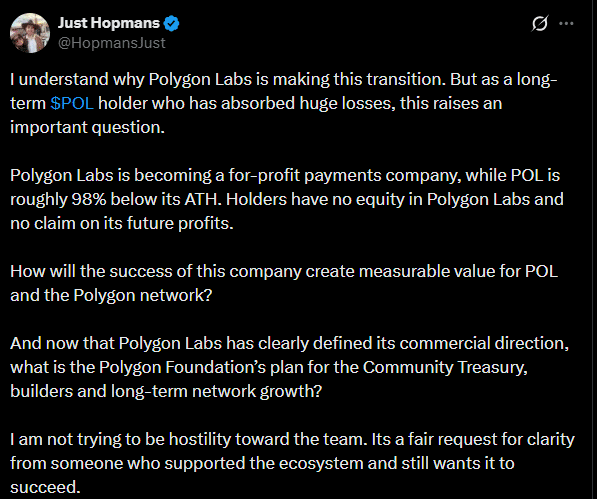
The current tension is best summarized by Just Hopmans, a vocal member of the Polygon community, who recently laid bare the grievances of the token holder base. In a candid assessment, Hopmans highlighted the existential dilemma facing POL holders:
"Polygon Labs is becoming a for-profit payments company, while POL is roughly 98% below its ATH. Holders have no equity in Polygon Labs and no claim on its future profits. How will the success of this company create measurable value for POL and the Polygon network?"
This statement strikes at the core of the “governance token” model. While POL holders possess the right to participate in network decisions, they hold no claim to the revenue generated by the underlying technology firm. As Polygon Labs transitions to prioritize profitability by 2027—a strategy underscored by recent rounds of staff layoffs—the gap between the corporation’s balance sheet and the token’s market performance has widened into a chasm.
A Chronology of Decline and Distrust
To understand the current malaise, one must look at the historical trajectory of the asset formerly known as MATIC.
- Late 2024: The highly anticipated rebranding from MATIC to POL occurs. The rollout is accompanied by significant fanfare and speculative optimism, pushing the price to the $1.00 threshold.
- 2025: Despite high transaction volumes and consistent developer activity, the token fails to maintain its momentum, beginning a protracted slide as market sentiment shifts toward newer, faster L1 competitors.
- H1 2026: Polygon Labs announces a strategic shift, pivoting toward the lucrative blockchain payments sector. Simultaneously, the Polygon Foundation reportedly moves over 50 million POL tokens. This movement occurs without sufficient communication to the community, fueling allegations of opacity.
- July 2026: POL reaches a local nadir, trading at approximately $0.06—a staggering 93% collapse from its debut year and a 98% decline from its historic peak.
Despite this carnage, user adoption has ironically increased. The number of unique POL holders has surged by 78% in the past month alone, crossing the 245,000 mark. This paradox—a plummeting price paired with a growing user base—suggests that while the network is finding utility, the token itself is failing to capture that value for its holders.
Supporting Data: The Competitive Landscape
While Polygon Labs focuses on the "payments" narrative, the cold, hard data suggests that the network is losing ground in the very arena it seeks to dominate: stablecoin settlement.
The Stablecoin Settlement Reality
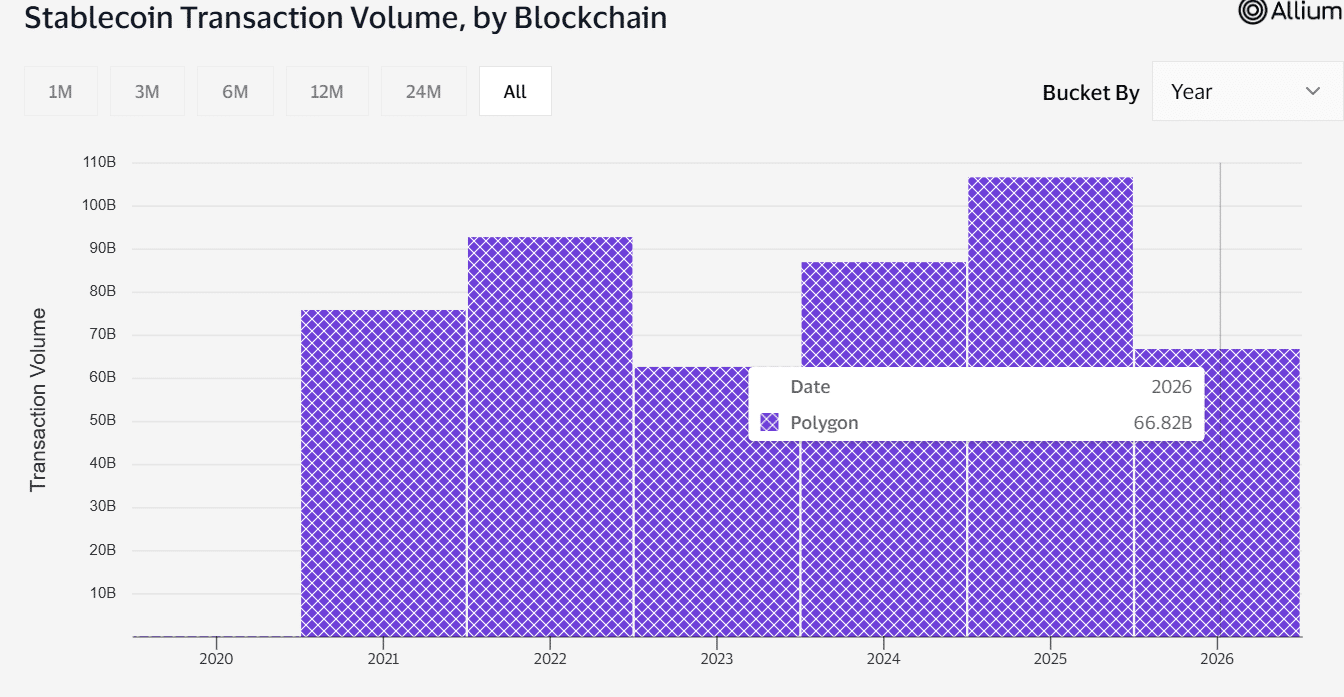
Polygon has long been a titan in the stablecoin space. In 2025, the network processed a record-breaking $106 billion in annual stablecoin volume. However, raw volume can be a misleading metric when the broader market is growing at an exponential rate.
While the network continues to facilitate high transaction counts—clocking in at $70 billion in volume for the first half of 2026—its market share dominance has been systematically eroded. According to data from Visa and Allium:
- 2023: Polygon held a 1.54% share of the stablecoin settlement market.
- 2026: That share has dwindled to just 0.72%.
In a market defined by rapid innovation, Polygon has effectively lost half of its market share in three years. The primary beneficiaries of this shift have been emerging ecosystems like Solana and Base. Solana, in particular, has seen its market share surge from near zero to 22%, while Base has captured 16%.
This data paints a troubling picture for investors: while the "payments" narrative is being used to justify corporate restructuring, the network is losing its competitive edge in the most critical use case for blockchain payments—stablecoins.
The Silence from the C-Suite
For Marc Boiron, CEO of Polygon Labs, the strategy is clear: focus on operational efficiency and pivot toward a sustainable business model to ensure the company reaches profitability by 2027. This includes trimming overheads and refocusing engineering efforts on high-margin payment integrations.
However, this corporate-centric approach has met with silence regarding the community’s demands. As of mid-July 2026, neither Polygon Labs nor the Polygon Foundation has issued a formal response to the queries raised by Hopmans and others regarding the allocation of the community treasury or the mechanism by which corporate profit will filter down to POL holders.
This lack of communication is viewed by many as a breach of the "social contract" inherent in decentralized projects. When a project moves from a community-driven DAO-like structure to a for-profit corporate entity, the lack of transparency regarding treasury management—specifically the 50 million POL movement—is not just a technical oversight; it is a catalyst for market-wide loss of confidence.
Implications: The Future of the "Payments" Pivot
The implications for the Polygon ecosystem are twofold:
1. The Tokenomics Crisis
If POL holders remain unable to see a clear link between Polygon Labs’ profitability and their own holdings, the token risks becoming "utility-less" in the eyes of the market. If the governance token does not capture value, institutional and retail capital will likely continue to rotate into ecosystems where the relationship between network growth and token price is more direct and transparent.
2. The Credibility Gap
Polygon’s history of "resilience" is being tested. Historically, the project has been excellent at business development and institutional partnerships. However, if the pivot to payments is perceived as an attempt to "cash out" on the corporate side while leaving the community to hold a depreciating asset, the long-term impact on developer sentiment could be devastating.
Developers gravitate toward networks where the incentive structure is clear. If the community feels alienated, they will migrate to networks where the ecosystem governance is perceived to be more aligned with the long-term interest of the token holders.
Conclusion: A Critical Juncture
The transition to a for-profit payments entity is a high-stakes gamble for Polygon. While the ambition to capture the global payments market is theoretically sound, the execution has thus far been marred by a lack of transparency and a failure to address the concerns of its most loyal stakeholders.
The path forward requires more than just better payment infrastructure; it requires a renewed commitment to the community. Polygon Labs must move beyond corporate silence and provide a comprehensive roadmap that explains:
- Treasury Transparency: A full audit and clear explanation of the 50 million POL movement.
- Value Accrual: A concrete mechanism that links the commercial success of the payments platform to the POL token.
- Governance Reform: A clear definition of the role of the community in a post-transition landscape.
Without these steps, the "Polygon Paradox" will persist—a network that is technically functional and widely used, but financially disconnected from the very people who staked their capital on its future. The coming months will be the definitive test of whether Polygon can evolve into a sustainable business without alienating the decentralized community that built it.
