


As the cryptocurrency market prepares to turn the page toward the final quarter of the year, a critical financial narrative is quietly unfolding beneath the surface of price charts and market sentiment. While broader digital asset valuations endured a punishing risk-off correction during the late second and early third quarters—shedding nearly 30% in total market capitalization—a powerful counter-trend has emerged.
Liquidity, the ultimate lifeblood of crypto market cycles, is staging a dramatic comeback. At the epicenter of this resurgence is the stablecoin market, which is currently experiencing its strongest monthly expansion since April. With billions of dollars flooding back into digital dollars, analysts are pointing to this pivotal shift as the primary catalyst for an impending Q4 risk-on rally.
However, this recovery is far from uniform. A fascinating divergence is playing out across the Layer-1 (L1) landscape, accompanied by a historic convergence between traditional finance (TradFi) and decentralized finance (DeFi). Together, these forces are reshaping the competitive dynamics of blockchain networks and setting the stage for what could be a defining quarter for digital assets.
Main Facts: The Return of Crypto Liquidity
The primary takeaway from recent on-chain and market data is a striking divergence: while crypto asset prices experienced steep drawdowns over the summer, the underlying plumbing of digital finance is rapidly refilling.
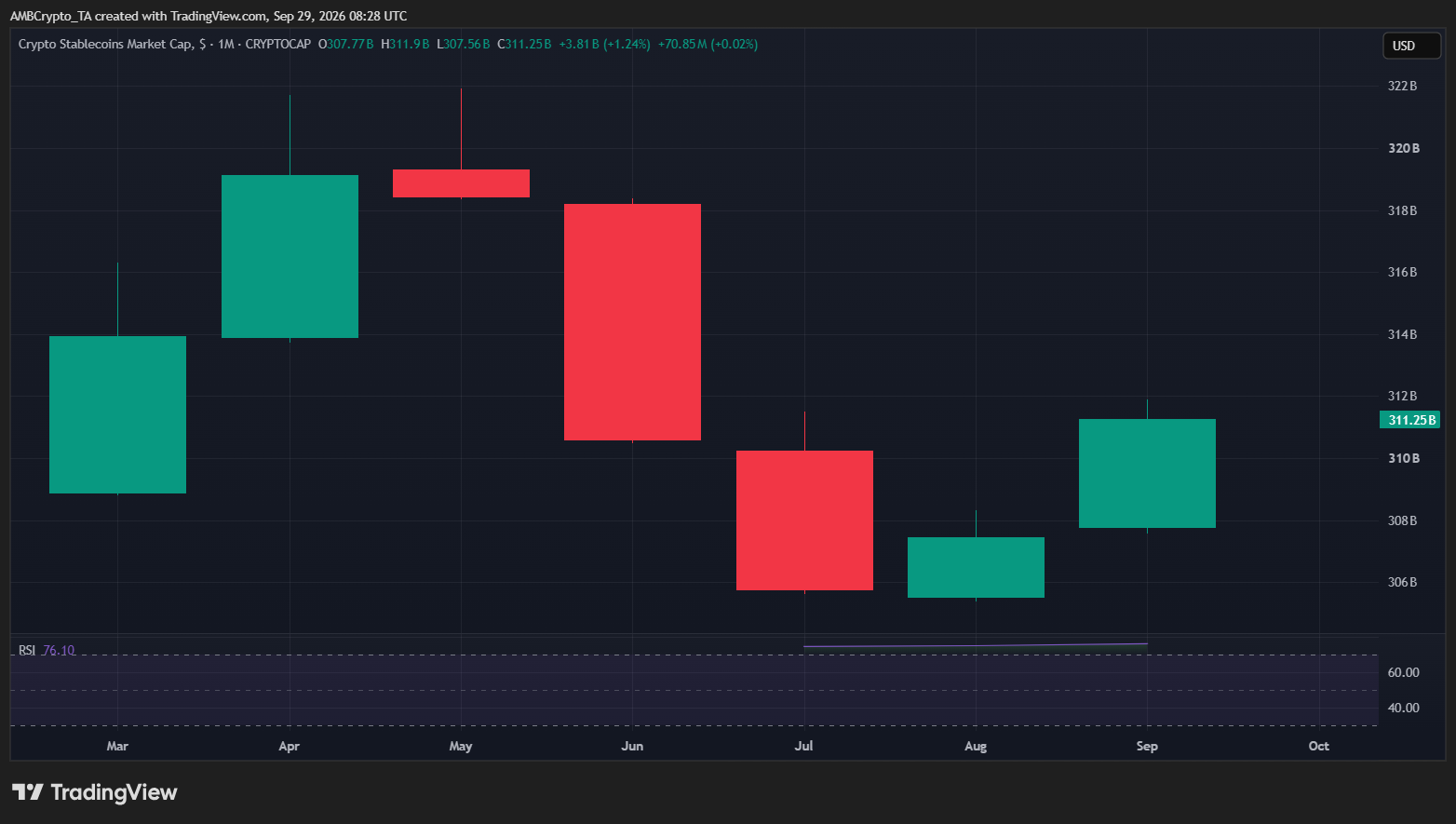
- The Stablecoin Rebound: The total stablecoin market capitalization has climbed by 1.24%, positioning itself for its most robust monthly expansion since the April cycle.
- Bridging the Summer Drain: This positive momentum marks a sharp reversal from late Q2 through early Q3, a turbulent period that saw approximately $15 billion wiped from the stablecoin market—representing the largest liquidity outflow since the opening weeks of the year.
- Massive Monthly Inflows: Reversing this deficit, more than $4 billion has poured into the stablecoin ecosystem in recent weeks. This sudden influx is providing a much-needed liquidity tailwind just as macroeconomic fear, uncertainty, and doubt (FUD) threaten to rattle traditional markets heading into Q4.
- The L1 Power Struggle: This shifting liquidity is not distributing evenly. A fierce battle for dominance is playing out between leading Layer-1 networks—most notably Ethereum and TRON—as they vie for stablecoin market share and transactional volume.
Chronology of the Shift: From Summer Outflows to Autumn Inflows
Understanding how the market arrived at this juncture requires tracing the trajectory of liquidity flows over the course of the year.
Q1 to Early Q2: Optimism and Peak Supply
The year began with robust risk-on momentum, driving heavy capital inflows into digital assets. During this phase, Ethereum’s stablecoin supply swelled to historic heights, peaking at roughly $182 billion in the final quarter of 2025. Broad market sentiment was largely optimistic, fueled by expanding institutional interest and favorable macro conditions.
Late Q2 to Early Q3: The Great Flush and Market Correction
As macroeconomic pressures mounted and regulatory headwinds persisted, the broader crypto market entered a sustained risk-off phase. Total cryptocurrency market capitalization plunged by nearly 30%. Concurrently, the stablecoin market suffered an unprecedented drain. Nearly $15 billion in stablecoin liquidity exited the ecosystem—the largest capital flight seen since early Q1—as investors moved to cash out or retreated to sidelines amid heightened volatility.

Mid-to-Late Q3: The Inflection Point
The tide began to turn in September. As markets stabilized, institutional and retail capital began re-entering the digital economy via stablecoins. Surpassing $4 billion in net monthly inflows, this reversal signaled a psychological and structural bottom. Rather than fleeing the ecosystem entirely, capital was being repositioned into digital dollars, effectively locking and loading capital reserves for the next market cycle.
Supporting Data: The Metrics Driving the Narrative
Data analytics from platforms like TradingView and Token Terminal highlight the quantitative realities behind the stablecoin resurgence and the shifting fortunes of major blockchains.
Macro Stablecoin Expansion
- Monthly Growth Rate: Up 1.24% and accelerating toward the strongest monthly growth metric since April.
- Net Inflows: Over $4 billion added to the aggregate stablecoin supply within a single month, neutralizing a significant portion of the summer capital flight.
The L1 Divergence: Ethereum vs. TRON
A granular look at the two dominant chains for stablecoin deployment reveals starkly contrasting trajectories:
- Ethereum [ETH]: Despite maintaining the largest overall share of USDT supply, Ethereum has experienced a notable contraction in stablecoin liquidity. Circulating stablecoins on the network have receded from a peak of approximately $182 billion down to roughly $163 billion. While Ethereum remains the undisputed capital of high-value DeFi and institutional settlement, its immediate retail and high-velocity stablecoin footprint has faced downward pressure.
- TRON [TRX]: In sharp contrast, TRON has enjoyed an uninterrupted wave of stablecoin momentum. On-chain data reveals that TRON has processed an astonishing cumulative lifetime transfer volume of $30 trillion, maintaining an average of roughly $25 billion in stablecoin transfers every single month. Year-to-date, the network has already processed $6 trillion in volume. Furthermore, TRON’s circulating USDT supply has climbed from approximately $78 billion to $92 billion, highlighting its unmatched utility as a high-speed, low-cost settlement layer for digital dollars.
Official Responses and Institutional Integration: The TradFi-DeFi Bridge
Beyond raw on-chain metrics, the structural integrity of the stablecoin market is being reinforced by landmark partnerships between legacy financial institutions and crypto-native giants. These developments are bridging the gap between TradFi and DeFi, setting the stage for mainstream adoption in Q4.
Citi and Coinbase Join Forces
In a landmark development for institutional crypto adoption, banking titan Citi partnered with Coinbase to enable seamless stablecoin payment infrastructure for an estimated 150 million holders and institutional clients. This move signals a profound shift in how traditional banking institutions view digital assets, moving away from exploratory skepticism and toward active integration.
Circle and Volante Technologies Expand USDC Rails
Simultaneously, stablecoin issuer Circle announced a strategic partnership with Volante Technologies. The collaboration is designed to embed USDC directly into existing enterprise and banking payment rails, drastically reducing the friction associated with cross-border payments and corporate treasury management.
Industry Implications of the Convergence
Market analysts view these developments not as isolated announcements, but as components of a much larger trend. The convergence of TradFi and DeFi serves as a critical barometer for institutional liquidity. By embedding stablecoins into traditional payment architecture, these partnerships normalize digital dollars for corporate treasuries, creating a reliable pipeline for fresh capital to enter the blockchain ecosystem during the final quarter of the year.
Implications for Q4: What This Means for Investors and L1s
As the market transitions into Q4, the confluence of returning stablecoin liquidity, institutional adoption, and L1 competition carries profound implications for the broader cryptocurrency landscape.
1. Liquidity as the Precursor to Price Action
History demonstrates that significant stablecoin expansions invariably precede broader crypto market rallies. Stablecoins represent "dry powder"—capital sitting on the sidelines, waiting for optimal entry points into risk assets. With over $4 billion re-entering the ecosystem this month, the foundation for a liquidity-driven rally is firmly in place, helping to cushion the market against potential macroeconomic shocks.
2. The Resurgence of TRON and Valuation Pressures on TRX
TRON’s ability to aggressively expand its stablecoin supply to over $92 billion—even during a broader market consolidation phase—cements its status as a primary utility layer for global stablecoin transactions. If this trend persists through Q4, the heightened on-chain activity and sustained demand for network bandwidth could translate into a stronger fundamental demand backdrop for the native TRX token.
3. Ethereum’s Institutional Moat vs. Retail Velocity
While Ethereum’s stablecoin supply has contracted from its late-2025 highs, it continues to command the lion’s share of complex financial applications, layer-2 scaling ecosystems, and institutional-grade deployments (evidenced by the Citi-Coinbase initiative). Rather than a sign of weakness, Ethereum’s liquidity contraction reflects a maturing ecosystem where capital is increasingly abstracted into L2 rollups and specialized financial protocols.
4. Navigating Macro FUD in Q4
As global markets face ongoing macroeconomic uncertainties—including shifting central bank policies, geopolitical tensions, and regulatory developments—crypto investors are increasingly turning to stablecoins as a safe harbor. This defensive positioning could quickly pivot into aggressive accumulation if technical breakouts occur, turning fourth-quarter volatility into an opportunity for growth.
Conclusion
The resurgence of stablecoin liquidity marks a definitive turning point for the cryptocurrency market. By healing the scars of summer outflows with over $4 billion in fresh inflows, the digital asset ecosystem has demonstrated remarkable resilience. Coupled with historic TradFi integrations and a fascinating tug-of-war between Layer-1 giants like Ethereum and TRON, the stage is set for a dynamic fourth quarter. For investors and market observers alike, keeping a close eye on stablecoin minting rates and on-chain velocity will remain the ultimate compass for navigating the risk-on cycle ahead.
