

In a landmark report released on June 15, 2026, global financial giant Standard Chartered Bank initiated coverage on Uniswap (UNI), the decentralized finance (DeFi) protocol, with a highly optimistic long-term outlook. The bank’s digital assets research team, led by Geoff Kendrick, projected that the UNI token could appreciate by as much as 4,000%—hitting a price target of $100—by the end of 2030. This bold prediction has ignited a fierce debate across the cryptocurrency landscape, pitting traditional institutional optimism against the skeptical rigor of native DeFi analysts.
The Institutional Thesis: Why Uniswap?
Standard Chartered’s bullish stance is predicated on the massive impending growth of the tokenization sector. In a letter to clients, Kendrick articulated a vision where traditional assets—ranging from real estate and private credit to government bonds—are migrated onto blockchain infrastructure.
“We expect the value of tokenized assets active in DeFi to grow 37x between now and end-2030,” Kendrick noted. “Uniswap is uniquely positioned to scale to meet this opportunity, in our view.”
The bank’s analysis hinges on several core pillars:
- Infrastructure Dominance: Uniswap is viewed not merely as a decentralized exchange (DEX), but as a fundamental "all-purpose infrastructure layer" for the future of finance.
- Institutional Adoption: With $2.7 trillion projected to be locked into DeFi protocols over the next four years, the bank argues that Uniswap’s brand recognition and robust security make it the primary candidate to capture a significant portion of this liquidity.
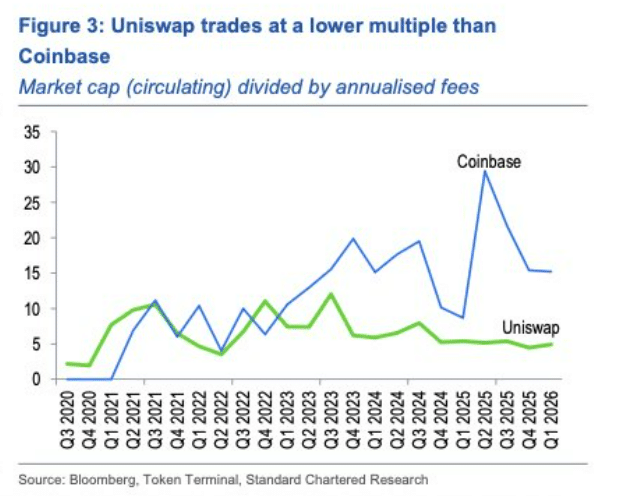
- Market Multiples: Standard Chartered suggests that Uniswap currently trades at an undervalued market-cap-to-annualized-fees ratio compared to centralized competitors like Coinbase. If the market begins to value Uniswap as a high-growth financial technology firm rather than a speculative crypto asset, the bank believes the token could significantly outperform major assets like Bitcoin and Ethereum.
A Chronology of the UNI Evolution
The journey toward this price target is built upon a series of strategic pivots the protocol has made over the last 18 months.
Early 2026: The Institutional Integration
The narrative shifted significantly in early 2026 when financial behemoths BlackRock and Fidelity integrated with the Uniswap protocol. By leveraging Uniswap’s architecture to scale their tokenized money market funds, these firms provided a seal of legitimacy that had previously eluded the DeFi sector. This integration acted as a catalyst, proving that decentralized infrastructure could meet the rigorous compliance and security standards required by Wall Street.
December 2025 – June 2026: The Fee Switch Era
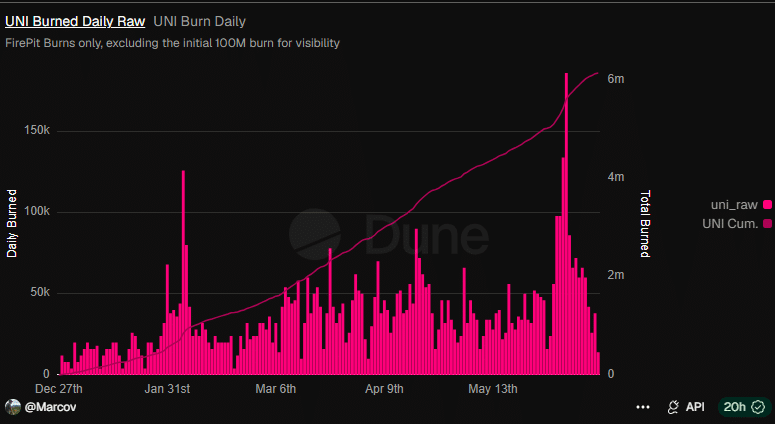
Perhaps the most significant technical milestone was the implementation of the "fee switch." By enabling a mechanism to burn UNI tokens—effectively creating a deflationary pressure on supply—the protocol transformed its tokenomics. Since December 2025, the protocol has successfully burned over 106 million UNI. Excluding the initial one-time burn of 100 million tokens, the protocol has maintained a steady burn rate of approximately 1 million UNI per month throughout 2026, signaling a commitment to long-term token value accrual.
Supporting Data and Quantitative Analysis
To understand the scale of the $100 target, one must look at the protocol’s current financial engine. Uniswap currently generates approximately $858 million in annualized fees. This massive flow of capital represents the protocol’s utility; it is a revenue-generating machine that functions 24/7 without traditional intermediaries.
Standard Chartered’s model relies on the assumption that as traditional financial firms (TradFi) increase their partnerships with the protocol, these fee volumes will grow exponentially. However, the data is not universally interpreted as a green light for investors. Skeptics point out that the "valuation" of a decentralized protocol is notoriously difficult, as it lacks the traditional balance sheets of a public company.
The bank’s comparison to Coinbase has drawn specific criticism. By using annualized fees as a metric, analysts argue that Standard Chartered may be conflating protocol revenue with the value that actually accrues to the UNI token holder. The divide between "protocol revenue" and "token holder equity" remains the single largest point of contention in modern crypto-valuation models.
Official Responses and the "Chart Crime" Controversy
The reaction to the Standard Chartered report was immediate and polarized. Hayden Adams, the founder of Uniswap, publicly praised the report as a "great piece," viewing the endorsement as a validation of years of development.
However, the sentiment was far from unanimous. Omar Kanji, an investor at the prominent crypto-venture firm Dragonfly, took to social media to deliver a blistering critique of the bank’s methodology. Kanji accused the research team of "chart crime," arguing that including Liquidity Provider (LP) fees in the annualized fee calculation—then using that total to justify a lower valuation multiple than Coinbase—was "serious slop analysis."
According to critics, the bank is conflating the fees earned by the liquidity providers (the people supplying the capital) with the revenue that the protocol (and by extension, the UNI token) captures. This distinction is vital: if the fees do not accrue to the token holders, the correlation between fee volume and token price becomes significantly weaker.
Market Implications: The Immediate Surge
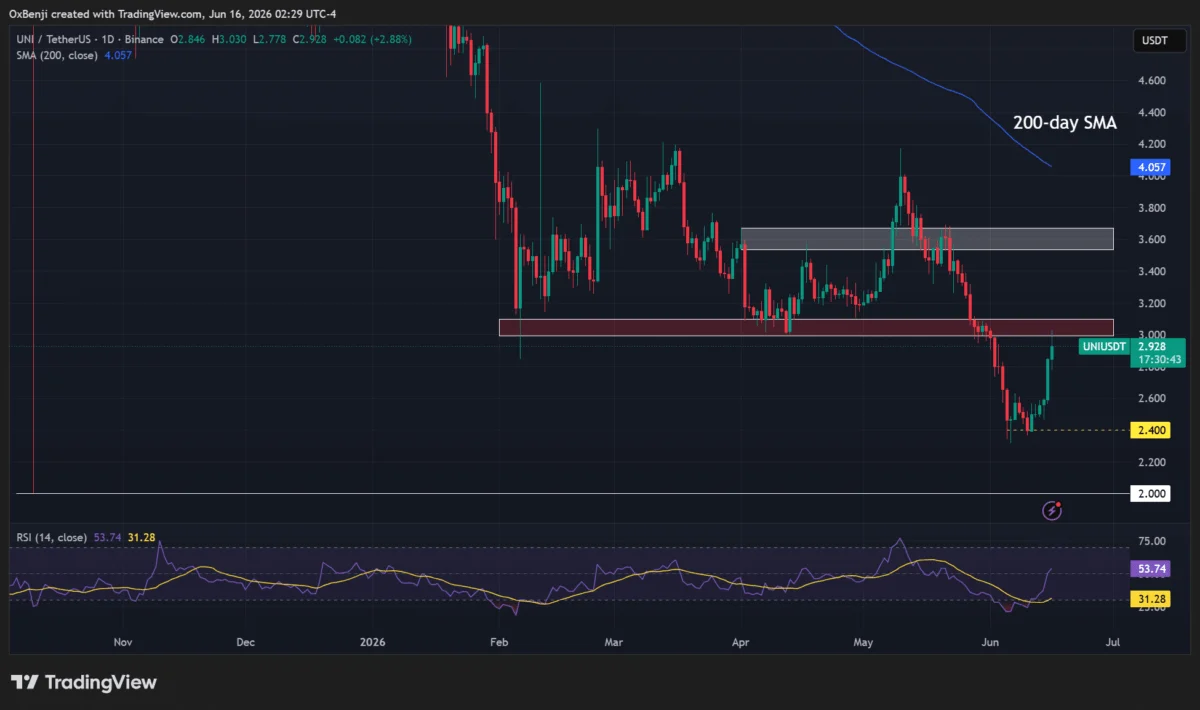
Regardless of the academic debates, the market reacted with immediate, high-volume buying pressure. Upon the release of the news, UNI experienced an 18% surge, reclaiming the $3.00 price level and effectively erasing the losses accumulated during the first two weeks of June.
Technical Outlook
- Bullish Scenario: For the momentum to continue, traders are watching for a sustained daily close above the $3.00 psychological barrier. If this level is flipped to support, the technical roadmap points toward resistance targets at $3.60 and $4.00.
- Bearish Scenario: A failure to hold the $3.00 mark would likely invite a wave of profit-taking. Should the price be rejected, short-term sellers may attempt to drag the token back into the $2.60 to $2.40 range, where the previous accumulation zone resides.
Broader Implications for the DeFi Sector
The Standard Chartered coverage of Uniswap is a watershed moment for the crypto industry. It signals that traditional banking institutions are moving beyond mere Bitcoin and Ethereum exposure. They are beginning to conduct fundamental financial analysis on decentralized applications, applying the same valuation frameworks used for traditional equities.
If this trend continues, we may see a "re-rating" of the DeFi sector. For years, DeFi tokens have been valued primarily on hype, liquidity mining rewards, and speculative fervor. If institutions begin to treat these protocols as "yield-generating infrastructure" rather than "crypto-assets," the floor price for high-quality protocols like Uniswap could shift permanently higher.
However, this transition is not without risks. Regulatory oversight remains the ultimate "black swan" event. As Uniswap becomes the backbone for institutional tokenization, it will inevitably draw the attention of global financial regulators. The question of how the protocol handles compliance, KYC (Know Your Customer) requirements for institutional users, and potential governance capture will be the defining factors in whether the $100 price target becomes a reality or remains a cautionary tale of institutional exuberance.
Conclusion
Standard Chartered’s prediction of a $100 UNI by 2030 is less a price forecast and more a declaration of the bank’s belief in the future of the tokenized economy. While the methodology behind the target has sparked valid, heated debate among crypto-native professionals, the fact that such a conversation is taking place at the highest levels of global finance is, in itself, a victory for the DeFi movement.
As the protocol continues to burn supply, integrate with traditional giants, and scale its infrastructure, the gap between "experimental code" and "financial backbone" continues to narrow. Whether or not UNI reaches the century mark by 2030, the path it has paved for institutional-grade decentralized finance is now a well-trodden road that others are bound to follow. Investors, meanwhile, are left to weigh the bank’s optimistic projections against the inherent volatility and regulatory uncertainty that still defines the frontier of digital assets.
