


In a move that signals a tectonic shift in the European digital asset landscape, Revolut, the continent’s largest fintech platform, has officially announced the delisting of Tether’s USDT. This decision marks a significant milestone in the ongoing friction between global crypto-native assets and the European Union’s Markets in Crypto-Assets (MiCA) regulation. As platforms scramble to align with the new, stringent legal framework, users are being forced to navigate a rapidly evolving ecosystem where compliance, not just liquidity, dictates market access.
Main Facts: The End of an Era for USDT on Revolut
Revolut has set a strict timeline for the complete phase-out of Tether (USDT) on its platform. Effective immediately, the company has begun winding down support, with a hard deadline for deposits and trading activities. According to official communications sent to its vast user base, all USDT deposits will be disabled by the end of July. Following this, the platform will completely delist the asset by August 31, 2026.
The transition process is automated for those who do not act. Revolut has informed its customers that any USDT remaining in their accounts after the August 31 deadline will be automatically converted into fiat currency at the prevailing market rate. This proactive—or perhaps forced—liquidation highlights the firm’s commitment to avoiding regulatory exposure as the MiCA enforcement period matures.
Market analyst Max Karpis suggests that this reversal is a direct result of "compliance fatigue." Only recently, Revolut had doubled down on its stablecoin offerings, introducing zero-fee transfers and seamless 1:1 swaps between USDT and USDC. That they have now pivoted toward a total removal underscores how drastically the regulatory environment has darkened for non-compliant issuers within the Eurozone.
Chronology: From Expansion to Exclusion
The relationship between major European fintechs and stablecoins has been volatile. To understand the current climate, one must look at the recent trajectory of these assets:
- Early 2026: Revolut expands its crypto infrastructure, positioning itself as a hub for stablecoin utility. It actively promotes USDT/USDC pairs, encouraging users to utilize the platform for liquidity and cross-asset management.
- June 2026: The transition period for the European Union’s MiCA regulation reaches a critical juncture. The European Securities and Markets Authority (ESMA) begins applying increased pressure on exchanges to ensure all listed stablecoins meet the rigorous transparency and reserve requirements mandated by the new law.
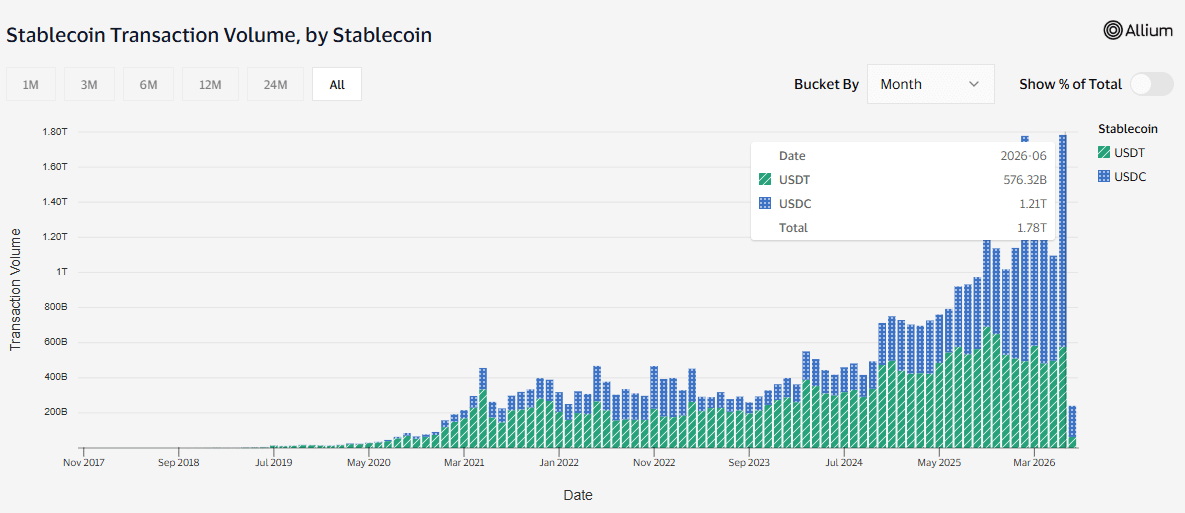
- July 2026: Data from Visa indicates a massive surge in USDC transfer volumes, hitting $1.21 trillion, significantly outpacing Tether. The writing is on the wall for platforms that wish to remain compliant in the EU.
- Late July 2026: Revolut announces the imminent delisting of USDT, citing "regulatory and risk reasons."
- August 31, 2026: The final deadline. USDT ceases to exist as a tradable or held asset on the Revolut platform.
Supporting Data: The Rise of the Compliant Stablecoin
The market is reacting in real-time to the regulatory shift. While Tether (USDT) continues to hold the title for the largest total supply in the global crypto market, its dominance in European transfer volumes is under siege.
Data provided by Visa for June 2026 reveals a staggering shift in user behavior. USDC, the stablecoin issued by Circle, recorded $1.21 trillion in transfer volume, effectively doubling that of USDT. This trend has accelerated into July, where early metrics suggest USDC’s volume is outpacing Tether’s by a factor of three.

This data is not merely a statistical anomaly; it represents a fundamental migration of capital. As EU-based investors and institutional players move to mitigate the risk of holding assets that may be delisted, they are gravitating toward Circle’s USDC—a stablecoin that has actively sought and secured MiCA-compliant status.
Furthermore, the trend extends to Euro-denominated stablecoins. According to data from TRM Labs, while USD-based stablecoin volumes on certain European channels have shrunk, Euro-denominated stablecoins have seen an 11x increase in volume. This indicates a broader, state-led push toward the "Europeanization" of digital payments, potentially setting the stage for the eventual integration of a Digital Euro.
Official Responses: The Clash of Philosophies
The tension between Tether and European regulators is characterized by a fundamental disagreement over the nature of financial safety. Tether CEO Paolo Ardoino has been vocally critical of MiCA, labeling it "dangerous" for the stability of the entire crypto ecosystem.
Ardoino’s core grievance lies in the liquidity requirements mandated by the EU. MiCA requires that 60% of a stablecoin’s reserves be held in uninsured cash deposits within European banks. Ardoino argues that this creates a systemic vulnerability:
"The problem I have with MiCA is that it’s very dangerous for stablecoins. What will happen next year is that a few banks in Europe will go belly up because of MiCA’s requirement that 60% of stablecoin reserves be kept in uninsured cash deposits in European banks."
He further notes that major global banking institutions, such as UBS, have largely remained on the sidelines, unwilling to accept the risk profile of stablecoin issuers. This leaves issuers to rely on smaller, potentially less resilient banks, which Ardoino believes could trigger a banking crisis if a 20% redemption spike were to occur.
From Ardoino’s perspective, MiCA is not just a consumer protection measure; it is a mechanism to centralize control over fund flows to benefit the Digital Euro. By refusing to chase MiCA compliance, Tether has effectively distanced itself from the European market, opting instead to focus on emerging markets where the regulatory burden is less restrictive and the demand for dollar-pegged liquidity remains high.
Implications: A Fragmented Future for Crypto
The delisting of USDT by a giant like Revolut carries profound implications for the future of decentralized finance (DeFi) in Europe.
1. The "Compliance-First" Business Model
Fintech platforms are choosing survival over variety. The cost of maintaining regulatory compliance under MiCA is extremely high. By removing assets that do not conform, companies like Revolut reduce their legal liability, simplify their audit processes, and solidify their relationships with traditional banking partners.
2. Market Fragmentation
We are entering an era of "geographical stablecoins." While Tether may remain the global standard for offshore and emerging market trading, the European Union is actively constructing a walled garden. This may lead to a price or liquidity premium for compliant stablecoins like USDC within the EU, while USDT may continue to trade in a parallel, non-compliant ecosystem.
3. The Digital Euro Catalyst
The growth in Euro-denominated stablecoins suggests that the European Central Bank’s long-term goal of controlling the digital flow of money is being aided by the very regulations that discourage foreign stablecoins. If private, compliant stablecoins (like USDC) can capture the market share left behind by USDT, it serves as a bridge to the eventual mass adoption of a central bank digital currency (CBDC).
4. The End of "Neutral" Crypto
For the average retail user, the era of "crypto as an untethered asset" is fading. The necessity for platforms to report, verify, and restrict assets based on political jurisdiction means that digital assets are becoming as regionalized as traditional fiat currencies.
As August 31 approaches, the industry will be watching closely to see if other major European exchanges follow Revolut’s lead. If they do, it will confirm that the European Union has effectively successfully mandated a new, highly regulated order for the stablecoin market—one where the world’s most used stablecoin, USDT, no longer has a seat at the table.
