

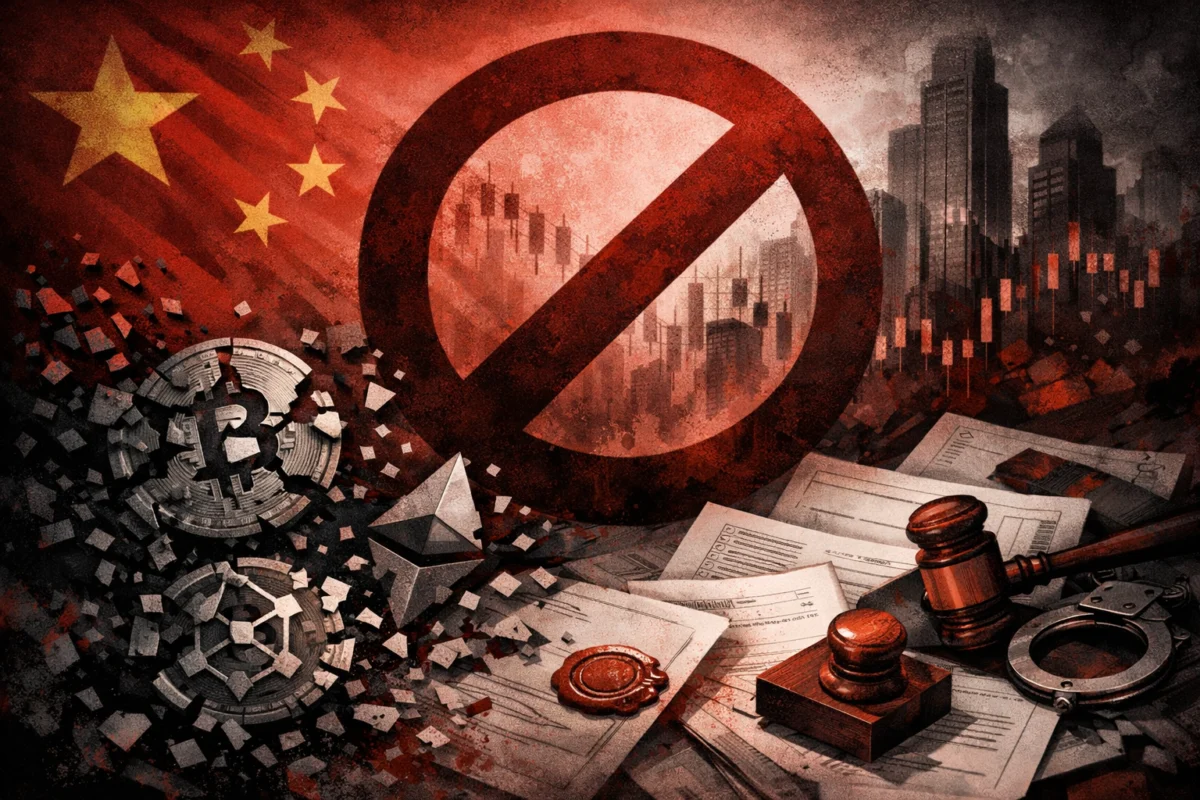
In a definitive move that effectively slams the door on one of the most promising sectors of the digital asset industry, Chinese authorities have formally classified the tokenization of Real-World Assets (RWA) as an illegal financial activity. This sweeping prohibition, signaled by a coordinated notice from seven of the nation’s most powerful financial industry associations, signals a hardening of Beijing’s stance on decentralized finance. By placing RWA tokenization in the same category as illicit cryptocurrency trading, stablecoin issuance, and mining, China has made it clear that it will not tolerate the blending of traditional financial instruments with blockchain-based decentralized structures.
The Scope of the Crackdown: A Unified Front
The declaration is not the work of a single regulatory body, but a rare, synchronized warning from seven major pillars of the Chinese financial apparatus:
- The China Internet Finance Association
- The China Banking Association
- The China Securities Association
- The China Asset Management Association
- The China Futures Association
- The China Association of Listed Companies
- The China Payment and Clearing Association
By gathering these seven entities to issue a unified front, Beijing has effectively signaled that no loophole remains for RWA projects to exploit. The directive explicitly states that tokenized assets have no legal basis under current Chinese law, regardless of whether the projects claim to be in a “pilot” phase or awaiting regulatory sandbox approval.
Chronology of Regulatory Friction
The path to this total ban was not sudden, but rather the culmination of years of escalating tension between Chinese state planners and the burgeoning Web3 sector.
- 2017-2021: The initial crackdown focused on Initial Coin Offerings (ICOs) and domestic cryptocurrency exchanges, culminating in the 2021 blanket ban on all crypto-related transactions.
- 2022-2024: As the global market pivoted toward "Real-World Assets"—the process of putting stocks, bonds, or real estate on a blockchain—many startups believed this represented a "compliant" path forward, as the underlying assets were tangible and traditional.
- Late 2024: Reports surfaced of regulators investigating offshore projects that maintained substantial operational footprints within mainland China.
- January 2026: The current directive, which marks the first time that "RWA tokenization" has been explicitly named as a prohibited financial activity, effectively ending the speculation that tokenization might be exempt from the 2021 crypto ban.
Defining the Illegal: The Regulatory Perspective
At the heart of this regulatory intervention is a fundamental disagreement over the nature of value. Regulators define the prohibited RWA activity as "financing and trading through the issuance of tokens or token-like rights and debt instruments."
From the perspective of the Chinese state, these structures introduce "layered risks" that are inherently incompatible with a controlled financial system. Authorities highlighted three primary areas of concern:
- Fictitious Assets: The fear that the underlying assets backing these tokens are either over-leveraged, non-existent, or subject to opaque accounting practices.
- Operational Failure: The lack of traditional oversight means that when a platform fails, there is no legal recourse for the average retail investor.
- Speculative Volatility: Regulators view the "tokenization" of assets as a mechanism to facilitate speculative trading, which threatens the stability of the broader financial market.
The Legal Trap: Criminal and Securities Law Violations
The notice does not merely issue a warning; it provides a roadmap for prosecution under China’s Criminal and Securities Laws. Any entity or individual participating in the issuance or facilitation of RWA tokens faces significant legal exposure:
- Illegal Fundraising: Issuing tokens to the public that represent a fractional interest in an asset is now classified as unauthorized public fundraising.
- Unlicensed Securities Offerings: Facilitating the distribution or secondary market trading of these tokens is treated as an illegal securities offering.
- Illegal Futures Business: Any trading model that incorporates leverage, betting mechanisms, or derivatives—a staple of many DeFi protocols—is now officially categorized under illegal futures business operations.
The Long Arm of the Law: Beyond the Mainland
Perhaps the most significant aspect of this directive is its reach. The warning explicitly targets projects attempting to circumvent mainland rules by registering in Hong Kong or offshore jurisdictions while keeping their development, marketing, or administrative staff in mainland China.
The China Securities Regulatory Commission (CSRC) has begun urging domestic brokerages to sever ties with any RWA projects operating in Hong Kong. This creates a "guilt by association" framework: institutions or individuals who knew—or should have known—that they were supporting virtual currency or RWA-related business can now be held legally accountable.
This policy effectively destroys the "offshore model" that many Web3 startups have relied upon. By targeting the human capital—the developers, the operational staff, and the marketing agencies—China is making it impossible for these projects to function, even if they are technically headquartered in a more lenient jurisdiction.
Implications for the Web3 Service Chain
The crackdown is not limited to the project founders. The directive casts a wide net that captures:
- Technology Outsourcers: Software development firms that write the smart contracts or maintain the platforms.
- Marketing and Influencers: Individuals or agencies promoting these assets to Chinese users.
- Payment Providers: Any entity providing an on-ramp or off-ramp for fiat currency to enter these tokenized ecosystems.
The threshold for enforcement is incredibly low. Even employing a single operations worker within mainland China is enough to expose an entire global project to enforcement action. This is a clear signal that the Chinese state is prioritizing absolute control over its financial borders above the potential for technological innovation in the RWA space.
The Strategic Context: The Rise of the Digital Yuan
The timing of this crackdown is not coincidental. It arrives alongside a renewed push by the People’s Bank of China (PBOC) to internationalize the digital yuan (e-CNY). By creating a centralized, state-controlled digital currency and launching new centers for cross-border payments, China is positioning itself to lead in the future of digital finance—but on its own terms.
The existence of private, blockchain-based RWA tokens presents a direct challenge to the state’s monopoly on currency issuance and monetary policy. By eliminating private stablecoins and RWA projects, Beijing is clearing the field for its state-sanctioned digital currency infrastructure.
Conclusion: A New Era of Enforcement
The formal classification of RWA tokenization as an illegal financial activity serves as a stark reminder of the limitations of the "offshore" strategy for Chinese-linked firms. For the global blockchain community, this means that the world’s second-largest economy is effectively closed to tokenization, regardless of how legitimate the underlying assets may be.
As regulators continue to tighten the net, the message to the industry is unequivocal: the era of gray-area innovation in China is over. For those operating in the RWA space, the choice is no longer about finding a regulatory loophole—it is about choosing between total compliance with the state’s centralized financial vision or a complete exit from the Chinese market. The "Web3" dream of decentralized ownership of real-world assets will have to find its footing elsewhere, as the Chinese state moves to ensure that the future of finance remains firmly in the hands of the regulator.
