

The decentralized finance (DeFi) sector, once hailed as the bedrock of the next-generation financial system, is currently navigating its most precarious period in recent history. Throughout the first half of 2026, the industry has been besieged by a compounding crisis: a relentless wave of security breaches coupled with a significant, sustained withdrawal of liquidity. As investor confidence wavers under the pressure of constant headline-grabbing exploits, the sector is witnessing a profound "flight to safety," leaving total value locked (TVL) metrics at their lowest points in years.
The Shrinking Ecosystem: Main Facts of the 2026 Downturn
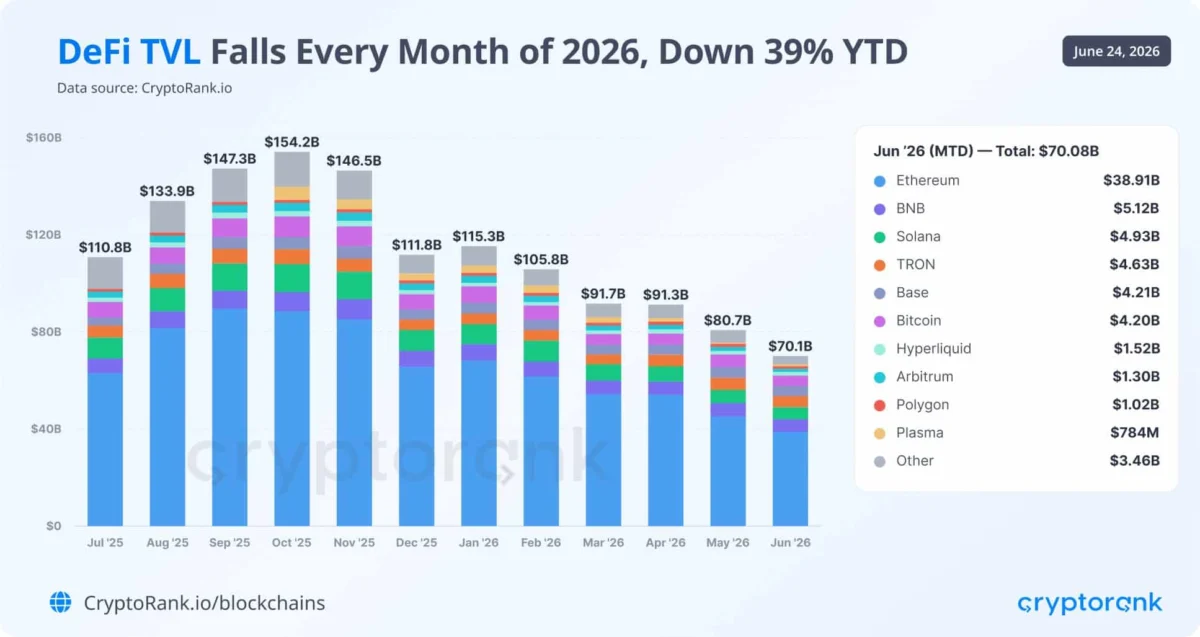
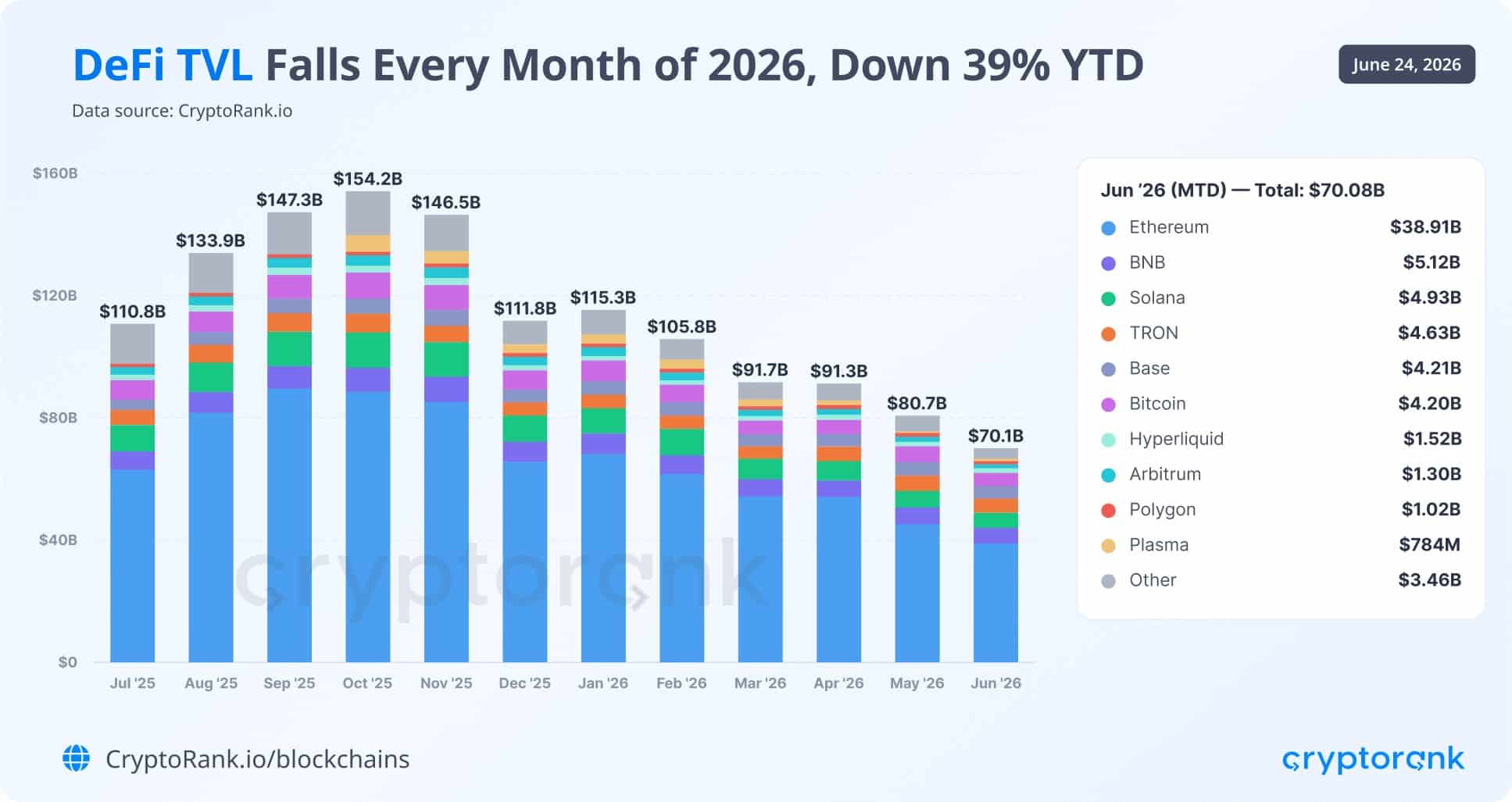
The numbers paint a stark picture of a sector in retreat. At the onset of 2026, the DeFi landscape held approximately $115 billion in total value locked. By the end of June, that figure had plummeted to nearly $70 billion. This represents a staggering 39% contraction in capital, a decline that has not been characterized by sudden, volatile drops, but rather by a slow, agonizing bleed occurring month after month.
This systemic decline is particularly striking when contrasted against the exuberance of late 2025, when industry-wide TVL sat comfortably above the $150 billion threshold. The transition from that peak to the current malaise reflects a fundamental shift in market sentiment. Investors are no longer chasing the high-yield, high-risk "degen" strategies that characterized the previous bull run. Instead, they are aggressively de-risking, pulling capital out of experimental protocols and moving toward more liquid or centralized environments.
While Ethereum remains the dominant force in the DeFi ecosystem, it has been unable to shield itself from this broader capital flight. Even as the primary hub for decentralized activity, Ethereum’s liquidity pool has been steadily depleted. The contagion of caution has spread across almost all major chains, with very few exceptions. Only select projects, such as TRON (TRX) and Hyperliquid (HYPE), have managed to buck the trend, showing growth of 5% and 7% respectively—a rare bright spot in an otherwise gloomy landscape.
A Chronology of Decline: From Highs to Hacking Havoc
The timeline of 2026 has been marked by a transition from speculative optimism to a focus on defensive capital preservation.
- Q4 2025 – The Peak: The sector exited 2025 on a high note, with liquidity abundant and innovation thriving. DeFi protocols were attracting billions in fresh capital as the market anticipated a sustained growth cycle.
- January – March 2026 – The Early Erosion: As the new year began, a subtle shift occurred. The "easy money" phase evaporated, and as market conditions cooled, capital began flowing out of riskier, smaller protocols.
- April – June 2026 – The Security Crisis: The second quarter proved to be a watershed moment for the wrong reasons. A surge in security breaches transformed a market correction into a crisis of confidence. According to data from CryptoRank, Q2 2026 set a grim record, witnessing 85 individual hacks—the busiest quarter for crypto exploits in the industry’s history.
- Mid-2026 – The Current Stand: As of July, the industry is grappling with a cumulative total of 121 hacks year-to-date. With losses approaching the $1 billion mark, the narrative has shifted from "growth at all costs" to "survival and security."
Supporting Data: The Anatomy of the Exodus
The disconnect between the total stablecoin supply and the DeFi TVL is perhaps the most telling metric. While the total DeFi TVL has cratered from its former highs of $178 billion to current levels near $72.5 billion, the broader stablecoin supply has remained remarkably resilient, hovering around $315 billion.
This discrepancy confirms that liquidity has not vanished from the cryptocurrency ecosystem entirely. Rather, it has migrated. Investors are currently holding their assets in stablecoins, likely on centralized exchanges or in cold storage, waiting for a clearer signal that the DeFi space is once again "safe" for deployment. This behavior indicates a sophisticated, risk-averse investor base that is no longer willing to gamble on unproven smart contracts.
The concentration of risk is further highlighted by the frequency of incidents. While the dollar-value of losses per hack has not always reached the catastrophic levels of previous years, the sheer volume of attacks—85 in a single quarter—suggests that hackers have developed a more efficient, high-frequency playbook for draining liquidity pools. This constant state of being "under fire" has made it impossible for the sector to build the momentum required for a sustained recovery.
Official Responses and Industry Sentiment
Industry leaders and security analysts have been vocal about the need for a paradigm shift. The consensus is that the "move fast and break things" era of DeFi must come to an end if the industry intends to attract institutional grade capital.
Leading security firms have echoed these sentiments, noting that many of the hacks occurring in 2026 are not sophisticated nation-state level attacks, but rather failures in fundamental logic, improper access controls, and a lack of rigorous auditing for secondary or tertiary protocol upgrades.
"We are seeing a crisis of technical debt," notes one lead researcher at a prominent blockchain security firm. "Protocols are rushing to ship features to stay relevant in a competitive market, and they are cutting corners on security audits. The market is finally punishing this behavior with an exit."
The sentiment across major community forums and governance channels has also hardened. There is a palpable demand for more robust insurance mechanisms and "circuit breaker" protocols that can halt activity in the event of an anomaly. Without these safety nets, developers are finding it increasingly difficult to convince users to deposit liquidity into new or even established protocols.
The Implications: What Does This Mean for the Future?
The long-term implications of this sustained decline are profound. First, the industry is likely to face a period of intense consolidation. Smaller, less-secure protocols that cannot demonstrate long-term viability or top-tier security standards will likely wither away, leaving the market share to a smaller group of "blue-chip" protocols that can prove their reliability through years of incident-free operation.
Second, the regulatory landscape is set to tighten. The high frequency of hacks serves as a convenient catalyst for global regulators to push for more stringent oversight of decentralized protocols. If the industry cannot prove it can self-regulate and secure user funds, the likelihood of imposed regulatory frameworks—which many purists argue contradict the ethos of DeFi—increases significantly.
Third, we are witnessing the professionalization of the DeFi investor. The days of "blindly yield farming" are likely over. The future of the sector will be defined by rigorous due diligence, with TVL flowing toward protocols that offer radical transparency, verifiable code audits, and perhaps even decentralized insurance coverage.
Conclusion: The Road to Redemption
The 39% decline in DeFi TVL throughout 2026 is a sobering reality check for the entire blockchain space. It serves as a reminder that financial innovation cannot survive without the foundational trust that only robust security can provide.
Until the sector can reverse the trend of frequent exploits, the path to recovery will remain uneven and slow. The current exodus of capital is not necessarily a sign of the death of DeFi, but rather a necessary recalibration. Investors are demanding a higher standard of protection, and the market is responding by stripping away the weak. For those protocols that can survive this "winter of insecurity," the future may involve a more stable, mature, and ultimately sustainable financial environment. However, until the code is proven, the market will remain rightfully cautious, keeping its capital on the sidelines.
