

In a move that highlights the volatile intersection of speculative trading and decentralized infrastructure, dYdX Labs—the development powerhouse behind the prominent decentralized exchange (DEX) for perpetual contracts—has officially launched "Arcus." This new platform, built on the Robinhood Chain, represents a significant expansion of the dYdX ecosystem. However, the market reaction to this unveiling has been anything but smooth, serving as a textbook example of the "buy the rumor, sell the news" phenomenon that frequently characterizes the cryptocurrency landscape.
The Genesis of Arcus: Bridging TradFi and DeFi
Arcus is designed as a standalone platform, operating independently of the main dYdX chain. Its primary value proposition is the integration of high-performance decentralized trading with the deep liquidity and accessibility associated with the Robinhood ecosystem. By leveraging the Robinhood Chain, Arcus aims to eliminate the friction typically found in crypto-native perpetual trading.
The platform distinguishes itself through a zero-fee trading model, a feature intended to lower the barrier to entry for retail traders who are often discouraged by the cumulative costs of on-chain transactions. At launch, Arcus provides 24/7 access to a robust menu of 95 tokenized stocks and perpetual contracts.
According to dYdX Labs, the platform’s roadmap is ambitious. While the initial release focuses on standard perpetual and stock trading, the team intends to expand into more sophisticated financial products. Future iterations are expected to include pre-IPO offerings and the innovative use of tokenized stocks as collateral, effectively bridging the gap between traditional equity markets and decentralized finance.
A Chronology of the Rally and Retracement
The narrative of Arcus began long before the official launch, as market participants engaged in aggressive speculation throughout the preceding five days.
The Pre-Announcement Surge
As whispers of a major "ecosystem announcement" circulated, traders began front-running the news. This speculative activity led to a massive accumulation phase for the DYDX token, which saw its value nearly double in a short window. The anticipation was fueled by social media sentiment and market analysts who correctly identified the upcoming integration as a potential catalyst for price action.
The "Sell-the-News" Event
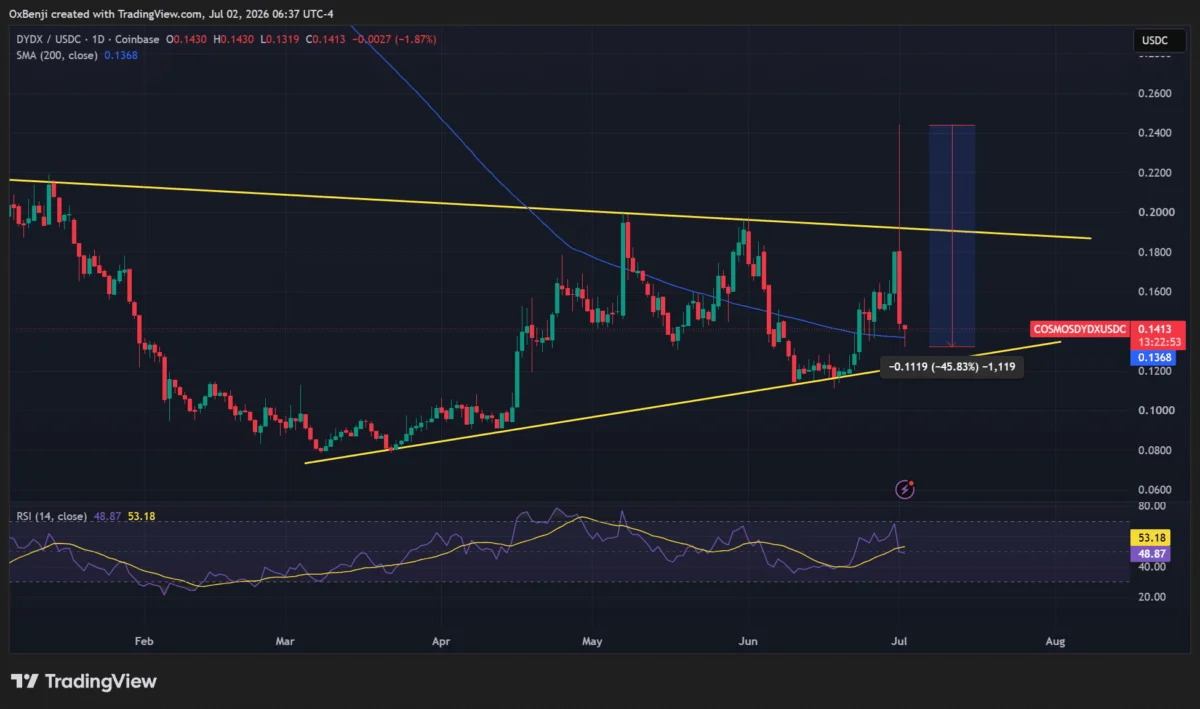
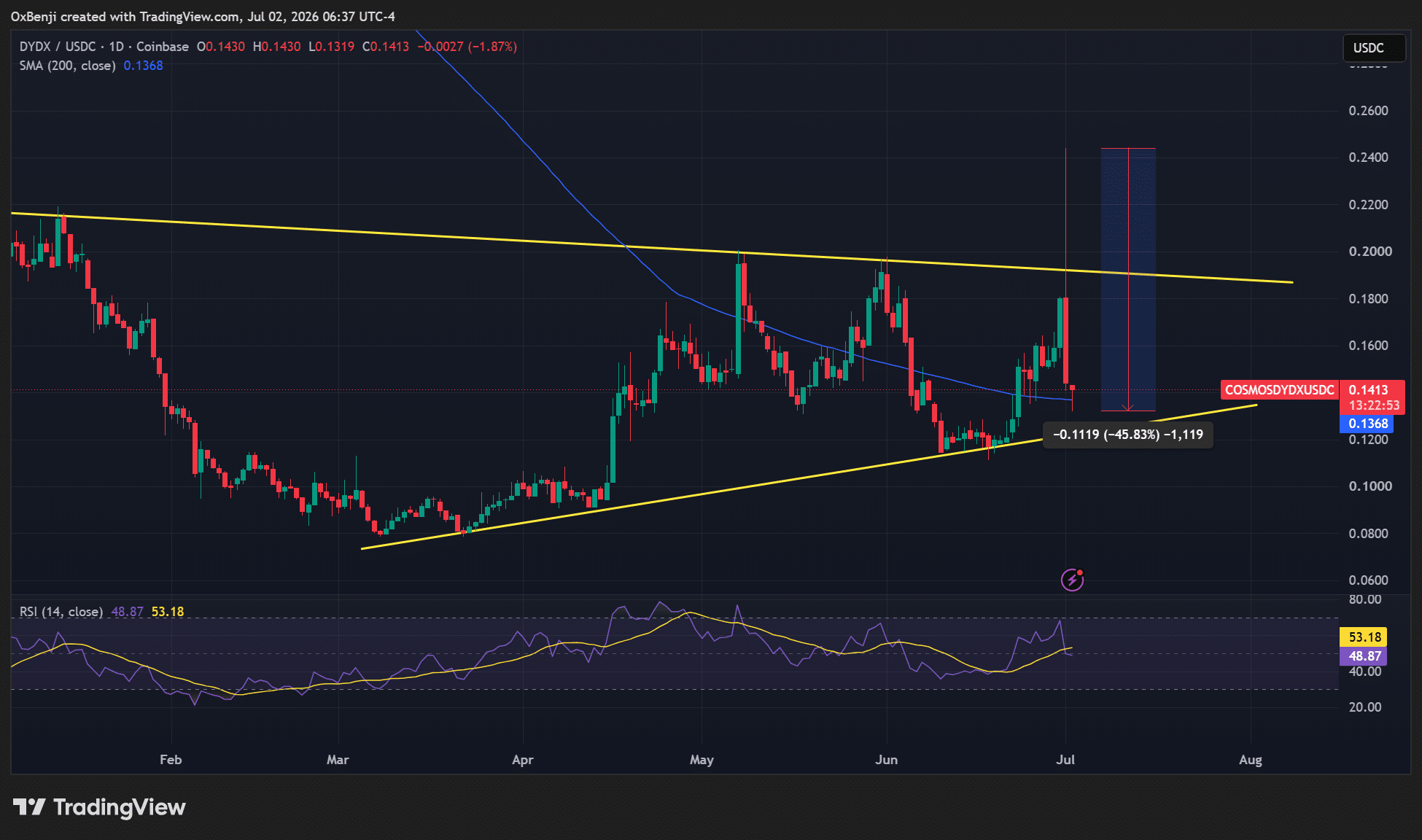
On the day of the official announcement, the market narrative shifted abruptly. Despite the news being objectively positive from a technical and developmental standpoint, the price of DYDX plummeted. Within hours of the debut, the token experienced a sharp 45% decline, effectively wiping out the entirety of the gains accrued during the five-day lead-up. This violent correction underscored a reality often ignored by retail participants: in crypto markets, the announcement of a partnership or product launch is frequently the signal for professional traders to take profits rather than accumulate further.
Supporting Data: Sentiment vs. On-Chain Reality
A deep dive into the on-chain metrics provided by platforms like Santiment reveals why the price movement was so decoupled from the "positive" nature of the announcement.
Weighted Sentiment and Exchange Activity
Leading up to the launch, the DYDX token recorded a significant surge in Weighted Sentiment, a metric that measures the ratio of positive to negative discussions across social channels. This reflected the "hype" phase of the cycle. However, as the price reached its local peak, data indicated a noticeable uptick in the supply of DYDX held on exchanges.
Conversely, the amount of tokens held outside of exchanges—a metric often used to track long-term holding patterns—remained stagnant. This divergence is critical: it suggests that while the news generated social interest, it failed to generate a corresponding surge in "cold storage" accumulation. In essence, the buyers were traders looking for a quick exit rather than long-term investors looking to build a position based on the new product’s fundamentals.
Technical Support and Price Floors
From a technical analysis perspective, the recent dump has forced the token into a consolidation phase. Traders are currently looking toward the 200-day Moving Average (MA) as a potential psychological and structural support level. Should the token find a floor near this trendline, it could offer a more stable entry point for investors. However, as with all crypto assets, this support remains heavily contingent on the broader market sentiment, which has been grappling with macroeconomic uncertainty.
Official Responses and Clarifications
In the wake of the volatility, the dYdX Foundation moved quickly to manage expectations and provide clarity regarding the token’s utility. To mitigate confusion among holders, the Foundation issued a firm statement regarding the relationship between the new platform and the native token.
"DYDX is, and remains, the governance and staking token of dYdX Chain. Its mechanics, supply, and operational characteristics remain unchanged," the Foundation clarified.
This statement was a strategic move to decouple the token’s price action from the success or failure of Arcus. By reinforcing that DYDX does not serve as a utility token for the Arcus platform, the Foundation effectively signaled to the market that the "pump" associated with the announcement was driven by speculative fervor rather than a change in the token’s underlying value proposition.
Implications for the Future
The launch of Arcus and the subsequent market reaction offer several lessons for the industry.
1. The Democratization of Finance
Robinhood Crypto’s director of product management, Seong Seog Lee, highlighted the move as a fundamental step toward democratizing financial markets. "Robinhood has always believed that the financial system should work for everyone. Arcus is the natural extension of that mission into the on-chain world," Lee stated. The integration represents a broader trend: traditional fintech giants are increasingly seeking to utilize decentralized infrastructure to offer products that were previously the exclusive domain of institutional investors.
2. The Danger of Speculative Overextension
The 45% dump serves as a stark reminder of the risks associated with "front-running" news. When an asset experiences a 100% gain in anticipation of an event, the "price" has already accounted for the news. Investors who entered the market during the peak of the hype were essentially left "holding the bag" when the market pivoted to a profit-taking stance.
3. Separation of Product and Token Value
The most important takeaway for investors is the distinction between the success of a development team and the value of a governance token. The Arcus platform may prove to be a highly successful, high-liquidity venue for trading. However, its success does not automatically translate into a deflationary mechanism or a utility requirement for the DYDX token. As the market matures, investors are learning to differentiate between platforms that "need" a native token for operations and those that simply exist within an ecosystem where the token serves a separate, governance-only purpose.
Conclusion: A New Chapter for dYdX
The debut of Arcus marks a turning point for the dYdX ecosystem. While the short-term price action of the DYDX token was marked by volatility and a harsh correction, the long-term potential of the Arcus platform remains high. By providing 24/7 access to tokenized assets with zero fees, the team is positioning itself at the forefront of the inevitable merger between DeFi and TradFi.
For the average trader, the events of the past week provide a masterclass in market psychology. The "sell-the-news" event was not a rejection of the Arcus platform, but rather a correction of an overheated speculative bubble. As the dust settles, the focus for the dYdX community will likely shift from price speculation to the actual adoption and utility of the Arcus platform. If Arcus can successfully deliver on its promise of deep liquidity and seamless trading, it may well prove that the true value of the ecosystem lies not in the price of its token, but in the efficiency of its technology.
