

After nearly seven years at the forefront of the decentralized finance (DeFi) revolution, Zapper, a cornerstone asset management platform, has officially announced it will cease operations. The platform, which once served as a primary gateway for millions of users to navigate the complex world of yield farming, liquidity pools, and token swapping, will shut its doors completely on August 3, 2026. This exit marks a poignant turning point for the DeFi industry, underscoring the widening chasm between rapid user adoption and the harsh realities of sustainable business economics.
Main Facts: The End of a DeFi Journey
The announcement has sent ripples through the crypto ecosystem, as Zapper was long considered a "blue-chip" interface for the DeFi power user. At its zenith, the platform boasted a staggering 2 million active monthly users and had facilitated over $13 billion in cumulative transaction volume. These figures solidified Zapper’s status as a critical piece of infrastructure, acting as an aggregator that simplified the fragmented DeFi landscape.
Despite these impressive metrics, the internal reality at Zapper grew increasingly difficult. The company, which had successfully navigated the volatility of various market cycles, ultimately succumbed to the pressure of an evolving, hyper-competitive landscape. As revenue streams stagnated and profit margins were squeezed by the proliferation of rival aggregators and integrated wallet features, the leadership team faced an inescapable conclusion: the current business model was no longer viable.
The upcoming August 3rd shutdown date is not merely a cessation of services; it is a signal of a broader market maturation. Zapper has committed to assisting its user base during this transition period, ensuring that assets remain accessible and that users are guided toward alternative platforms, effectively closing the book on a seven-year chapter of decentralized financial innovation.
Chronology of a Platform’s Rise and Fall
Zapper’s journey began during the nascent stages of the "DeFi Summer," a period defined by explosive growth and rapid experimentation.
- 2019-2020: The Inception: Zapper emerged as a vital tool for the growing community of decentralized finance enthusiasts. By providing a unified dashboard to track assets across various protocols, it solved a critical pain point: the inability of users to easily view their holdings scattered across multiple smart contracts.
- 2021: Scaling and Capital Injection: Recognizing the platform’s importance, major venture capital firms—including Framework Ventures, Coinbase Ventures, and ParaFi Capital—poured $15 million into Zapper. This capital was intended to fuel product development, expand cross-chain compatibility, and cement Zapper’s position as the "front page" of DeFi.
- 2022-2024: The Competitive Squeeze: As the DeFi sector matured, the "aggregator" model faced existential threats. Decentralized exchanges (DEXs) began integrating portfolio management tools directly into their frontends, and non-custodial wallets like MetaMask and Rabby began offering native tracking features, effectively cannibalizing the market share of dedicated platforms like Zapper.
- 2025: The Revenue Crisis: Intensified competition led to "fee compression," where the margins available to aggregators vanished. While user numbers remained high, the ability to monetize that traffic diminished significantly.
- 2026: The Final Curtain: Following a period of strategic re-evaluation, CEO Seb Audet confirmed that the company could no longer bridge the gap between its mission and its economic reality. The decision was made to wind down operations, concluding the company’s seven-year mission.
Supporting Data: The Illusion of Scale
To understand why a platform with 2 million monthly users and $13 billion in transaction volume would close its doors, one must look at the discrepancy between "traffic" and "profitability."
In the early years of the Web3 boom, venture capital firms prioritized growth above all else. The strategy was to acquire users at any cost, assuming that monetization would naturally follow as the ecosystem matured. However, Zapper’s data reveals a different story. While the $13 billion in transaction volume sounds massive, the actual revenue capture—often derived from small percentage-based fees on swaps—was insufficient to cover the escalating costs of blockchain infrastructure, security audits, and engineering talent.
The cost of maintaining high-quality, real-time data feeds for thousands of different liquidity pools across multiple blockchains (Ethereum, Arbitrum, Optimism, etc.) is substantial. As the number of supported chains increased, so did the "infrastructure tax." When combined with the reality that users were increasingly migrating to "all-in-one" wallets that offered lower fees or better integrated UX, Zapper’s cost-to-revenue ratio became inverted. The platform was essentially subsidizing the user experience, a strategy that is sustainable with venture funding but catastrophic in a high-interest-rate, low-liquidity environment where capital injections have dried up.
Official Responses: Acknowledging the Gap
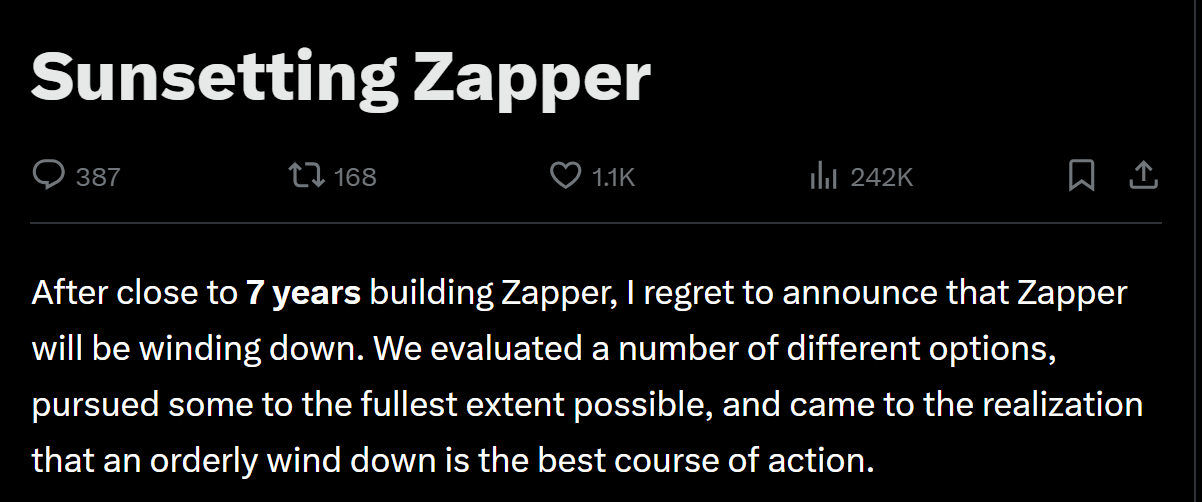
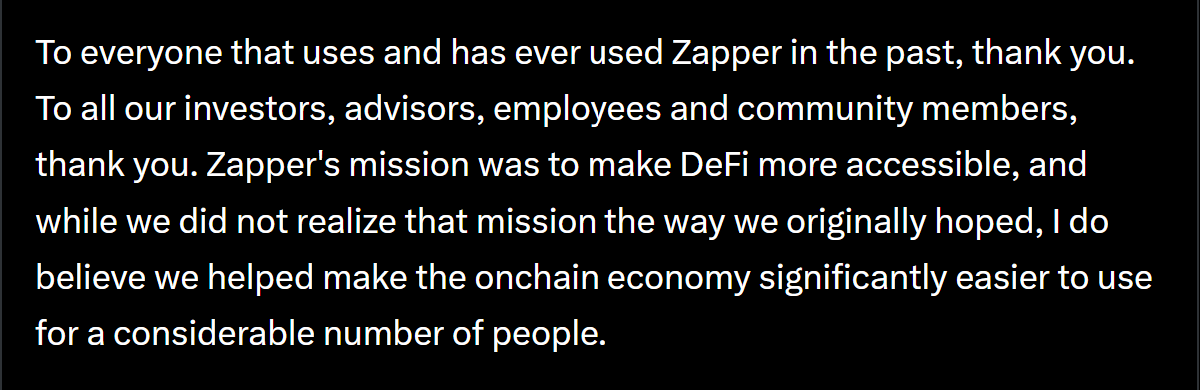
The sentiment from Zapper’s leadership is one of somber reflection. Co-Founder and CEO Seb Audet took to the social media platform X (formerly Twitter) to address the community directly. His statement, while brief, served as a candid admission of the challenges facing the broader industry.
"Zapper’s mission was to make DeFi more accessible," Audet noted. "While we did not realize that mission the way we originally hoped, the journey has been an incredible testament to the power of decentralized collaboration."
The response from the community has been largely one of respect. Industry veterans and former users have acknowledged Zapper’s role in onboarding thousands of individuals to DeFi. However, the tone of the discourse is shifting from nostalgia to pragmatism. Analysts and developers alike are using Zapper’s exit as a case study for "DeFi 2.0" startups, emphasizing that a project is only as strong as its moat and its bottom line.
Implications: The New Mandate for DeFi
Zapper’s closure provides several critical lessons for the future of the decentralized finance sector:
1. The Death of the "Growth-First" Model
The era of "growth at any cost" is effectively over. In the current market cycle, investors are no longer satisfied with high DAU (Daily Active Users) metrics if they are not backed by a clear, defensible revenue model. Projects that rely on speculative user incentives or thin margins on top of other protocols are particularly vulnerable to being "disintermediated" by the very protocols they serve.
2. The Need for Defensive Moats
Zapper’s struggle highlights the "aggregator trap." When a product’s primary value proposition is simply aggregating data that is publicly available on-chain, it is incredibly easy for competitors or native protocols to replicate that functionality. Future successful DeFi projects will likely need to move up the value chain—offering proprietary financial products, unique risk-management tools, or institutional-grade services that cannot be easily copied by a basic frontend update from a wallet provider.
3. Sustainable Economics as a Competitive Advantage
Moving forward, we can expect to see a shift toward "lean" DeFi infrastructure. This involves disciplined spending, smaller teams, and a focus on monetization from Day 1. The days of relying on endless rounds of venture funding to cover operating losses are drawing to a close. The market is demanding that projects prove their utility not just through "total value locked" (TVL), but through sustainable, long-term profit generation.
4. A Maturing Ecosystem
While the loss of Zapper is a blow to the current ecosystem, it is also a sign of a maturing industry. Just as the dot-com bubble cleared out unsustainable businesses to pave the way for the giants of today, the current "DeFi correction" is weeding out platforms that lack a sustainable economic foundation.
In conclusion, the sunset of Zapper is more than just a business closure; it is a catalyst for change. The platform served its purpose in the early years of the industry, but the sector has outgrown the infrastructure that once defined it. As DeFi enters this new, more demanding phase, the survivors will be those that prioritize economic sustainability, technical differentiation, and a clear, unwavering path to profitability. The "DeFi Summer" may be long gone, but the "DeFi Autumn" is proving to be a time of necessary, if painful, harvest.
