

In a move that has sent shockwaves through the decentralized finance (DeFi) sector, global banking giant Standard Chartered has initiated coverage on Uniswap (UNI), delivering a staggering long-term price target. In a research note distributed to clients on June 15, 2026, the bank’s Global Head of Digital Assets Research, Geoff Kendrick, forecasted that the UNI token could appreciate by 40x, potentially reaching a valuation of $100 per token by the end of 2030.
This bold prediction rests on the premise that the "tokenization boom"—the migration of traditional financial assets onto blockchain ledgers—is entering an exponential growth phase. As the infrastructure layer for the world’s most liquid decentralized exchange, Uniswap is positioned, according to Kendrick, to capture a significant portion of this burgeoning value.
Main Facts: The Bull Case for Uniswap
The core of Standard Chartered’s thesis is the anticipated transformation of global financial markets. Kendrick estimates that the total value locked (TVL) within DeFi protocols will swell to an unprecedented $2.7 trillion over the next four years. This capital influx will not merely be speculative; it will be driven by the institutional adoption of tokenized real-world assets (RWAs).
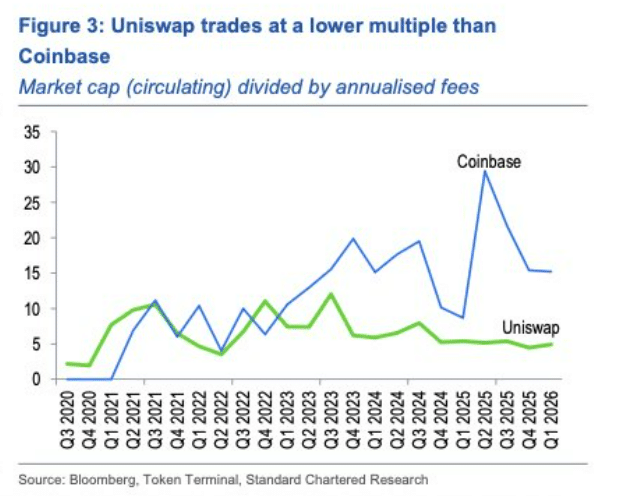
Standard Chartered posits that Uniswap is not just a trading venue but an "all-purpose infrastructure layer." Its brand recognition, security, and deep liquidity pools provide it with an insurmountable moat against smaller competitors. The bank’s valuation model compares Uniswap favorably to Coinbase, noting that Uniswap’s current market-cap-to-annualized-fees ratio suggests the token is significantly undervalued relative to its potential earnings power.
If Uniswap successfully accelerates its partnerships with TradFi (traditional finance) entities, the bank expects UNI to outperform both Bitcoin and Ethereum, effectively positioning itself as the "Goldman Sachs of DeFi."
Chronology of the Tokenization Wave
The narrative of Uniswap’s evolution has been defined by a series of strategic pivots that have bridged the gap between niche crypto-trading and mainstream institutional finance:
- The Early Foundation (2020-2024): Uniswap cemented its reputation as the leading Automated Market Maker (AMM), pioneering liquidity provision models that allowed for decentralized, permissionless trading.
- The "Fee Switch" Implementation (2025): A landmark governance decision saw the protocol activate a fee-sharing mechanism. This move was transformative, shifting the UNI token from a purely governance-based asset to a yield-bearing instrument, with a portion of protocol fees allocated to token buybacks and burns.
- The Institutional Pivot (Early 2026): Uniswap officially integrated with major financial titans. BlackRock and Fidelity began utilizing the protocol’s architecture to scale their tokenized money market funds, signaling that the "Wall Street" era of DeFi had arrived.
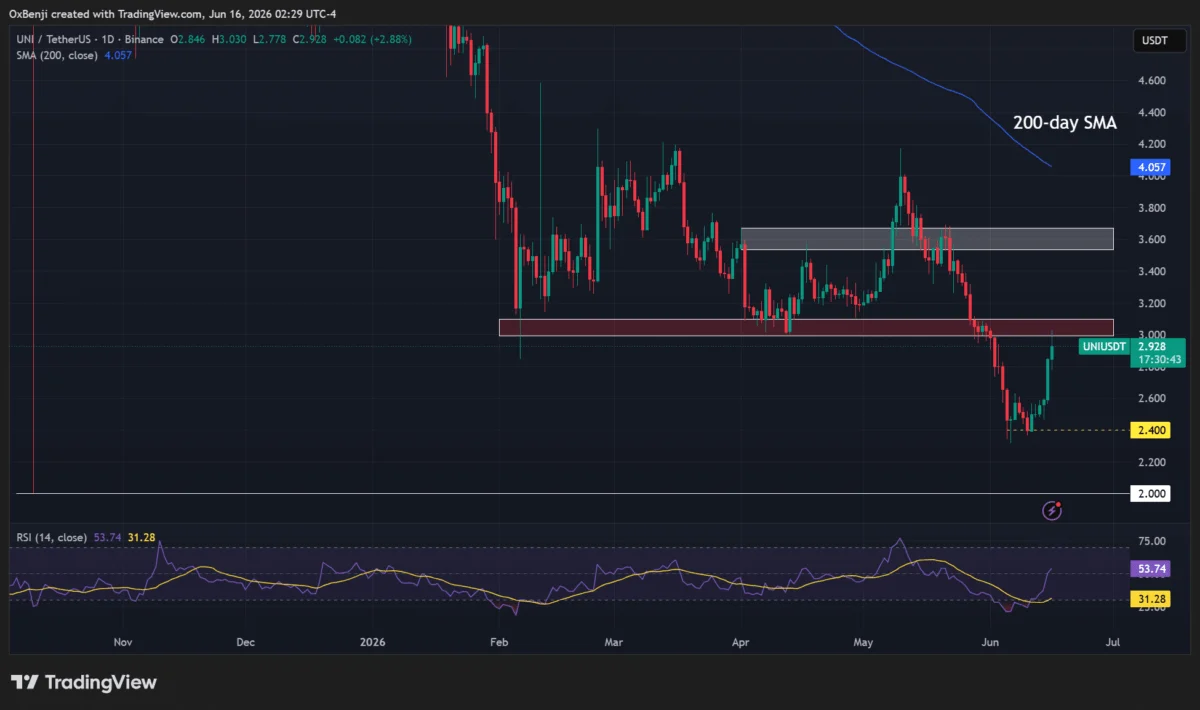
- The Standard Chartered Coverage (June 2026): The bank’s formal entry into the narrative provided a massive boost in sentiment, sparking an immediate 18% price rally that reclaimed the $3 psychological resistance level.
Supporting Data: Examining the Protocol’s Economic Engine
The skepticism surrounding crypto valuations is often met with the hard data of on-chain activity. Uniswap currently generates approximately $858 million in annualized fees. Unlike many "vaporware" projects, this revenue is tangible and stems from high-volume transaction activity.
The Burn Mechanism
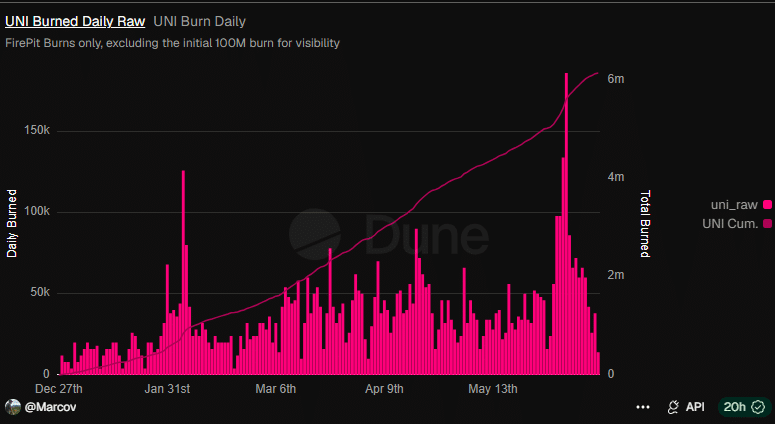
A critical component of the value proposition is the aggressive reduction of supply. Since the implementation of the fee switch last year, the protocol has burned roughly 106.15 million UNI tokens. If we account for the initial 100 million token burn associated with the protocol upgrade, the network has been consistently removing approximately 1 million UNI from circulation every month throughout 2026. This deflationary pressure is a core pillar of the $100 price target, as it ensures that as demand increases—driven by institutional adoption—the supply side remains constrained.
The TradFi Integration
The integration of BlackRock’s BUIDL fund and Fidelity’s FIDO on the Ethereum network—both of which rely on the Uniswap infrastructure—provides a real-world validation of the protocol’s scalability. By acting as the settlement layer for these multi-billion dollar firms, Uniswap is transitioning from a retail trading platform to a critical utility for global capital markets.
Official Responses and Industry Contention
The response to Standard Chartered’s report has been polarized, reflecting the broader divide between institutional analysts and the "crypto-native" community.
The Proponents
Hayden Adams, the founder and CEO of Uniswap, publicly endorsed the report, labeling it a "great piece of research." For Adams, the recognition by a tier-one global bank represents the culmination of years of work in building a resilient, decentralized trading architecture that can withstand the rigors of institutional-grade finance.
The Critics
Not all industry participants share the optimism. Omar Kanji, an investor at the prominent crypto-focused venture firm Dragonfly, took to social media to challenge the bank’s methodology. Kanji described the report as "straight-up chart crime," arguing that the bank’s valuation metrics are flawed. Specifically, he criticized the inclusion of liquidity provider (LP) fees in the annualized revenue calculations, suggesting that comparing Uniswap’s metrics directly to Coinbase’s market cap—without adjusting for the fundamental differences between a centralized exchange and a decentralized protocol—is "slop analysis."
Critics further argue that the $100 target is a "pie-in-the-sky" number that ignores regulatory headwinds and the potential for future governance disputes that could paralyze the protocol.
Implications: What Comes Next for UNI?
The immediate market impact of the report was undeniable. The 18% spike to $3 demonstrated that even in a maturing market, "institutional seal of approval" remains a powerful catalyst for retail sentiment.
Short-Term Technical Outlook
The $3 level remains the critical pivot point. For bulls, the goal is to flip $3 from resistance to support. If this level holds, traders are looking toward $3.60 and $4.00 as the next immediate upside targets. Conversely, should the price fail to hold this level, the market may see a retest of the $2.60 or $2.40 support zones as short-sellers attempt to regain control.
Long-Term Strategic Implications
The broader implication of this coverage is the legitimation of DeFi as an asset class. When a bank like Standard Chartered models a 40x return for a decentralized protocol, it suggests that the "decentralized vs. centralized" debate is shifting. The focus is no longer on whether DeFi will replace banks, but rather on how banks will utilize DeFi infrastructure to achieve greater efficiency.
For Uniswap, the road to $100 depends on several variables:
- Regulatory Clarity: Continued operation within legal frameworks without compromising decentralization.
- Protocol Governance: The ability of the UNI community to manage the fee-switch mechanism effectively without inciting regulatory intervention or developer fragmentation.
- Institutional Adoption: The degree to which major players like BlackRock continue to commit volume to the Uniswap liquidity pools.
Conclusion
The Standard Chartered report has effectively drawn a line in the sand. Whether the $100 prediction proves to be prophetic or hyperbolic, it has forced the market to take notice of the protocol’s underlying economic mechanics. As the divide between TradFi and DeFi continues to blur, Uniswap finds itself at the epicenter of a historic shift in how global assets are traded, settled, and governed. For investors, the coming months will be a test of whether the protocol can sustain its momentum and prove that the current fee-generation model is a precursor to a new era of decentralized finance.
