


The financial landscape is currently embroiled in a high-stakes intellectual tug-of-war. At the center of this debate are two titans of the investment world: venture capital giant Andreessen Horowitz (a16z) and the innovation-focused asset manager Ark Invest. The point of contention is a fundamental question about the future of global finance: Is traditional finance (TradFi) genuinely embracing the decentralized, open-source promise of Decentralized Finance (DeFi), or is it merely cherry-picking blockchain technology to optimize its own bottom line?
This debate has transcended theoretical discourse, becoming a defining narrative for institutional adoption of digital assets. While a16z suggests that TradFi’s relationship with blockchain is purely transactional and efficiency-driven, Ark Invest argues that this perspective is overly cynical and underestimates the long-term gravity of public, permissionless networks.
The Core Argument: Convergence or Co-option?
The conflict began when a16z challenged the prevailing industry narrative that TradFi is actively converging with the DeFi ecosystem. According to the firm, the idea that traditional banks are "adopting DeFi" is a comforting myth for crypto-native developers, but one that is fundamentally disconnected from the motivations of legacy financial institutions.
a16z’s position is grounded in cold, corporate pragmatism. The firm argues that institutions will only deploy blockchain technology where it demonstrably reduces the Cost of Goods Sold (COGS). From this viewpoint, a bank’s interest in blockchain is strictly utilitarian; if a private, permissioned ledger can settle trades faster or cheaper than a legacy database, they will use it. This, however, is not "DeFi." It is simply the modernization of existing, centralized infrastructure.
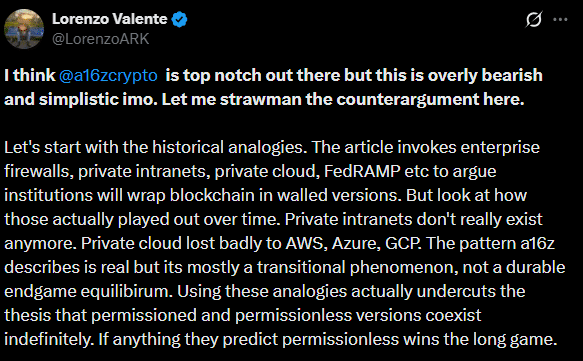
Conversely, Ark Invest, represented by its Director of Crypto Research, Lorenzo Valente, has labeled this perspective as "overly bearish and simplistic." Valente contends that while efficiency is a component of the shift, it ignores the growing institutional demand for open access and global liquidity—features that only public, permissionless blockchains can provide.
Chronology of the Divide: From Private Pilots to Public Adoption
To understand the current tension, one must look at the timeline of institutional experimentation over the last several years.

- The Early Phase (The Private Ledger Experiment): Following the initial hype cycle of 2017–2018, the financial sector largely focused on "permissioned" blockchains. Projects like Hyperledger and various consortium-led initiatives promised to bring the benefits of DLT (Distributed Ledger Technology) to banking without the risks of public, unregulated networks.
- The Rise of Institutional Stablecoins: The narrative shifted as stablecoins like USDC and USDT gained massive traction. Financial giants, including Visa, Mastercard, and PayPal, began integrating stablecoins into their payment rails. This proved that legacy institutions were willing to interact with public chains if the liquidity was sufficient.
- The Tokenization Wave: In the last 24 months, the industry has seen a massive surge in the tokenization of Real World Assets (RWAs). BlackRock’s BUIDL fund and various treasury-backed tokenized products have gone live, often utilizing public infrastructure like Ethereum.
- The "Private vs. Public" Climax: The current discourse reflects a fork in the road. On one side, institutions are building "Corporate Chains" (such as Canton or Google Cloud’s GCUL), while on the other, public chains like Ethereum continue to dominate the settlement of stablecoins.
Supporting Data: Where the Battle Lines Are Drawn
The divergence between the two philosophies becomes clear when examining the data regarding market share and utility.
Stablecoins and Public Dominance
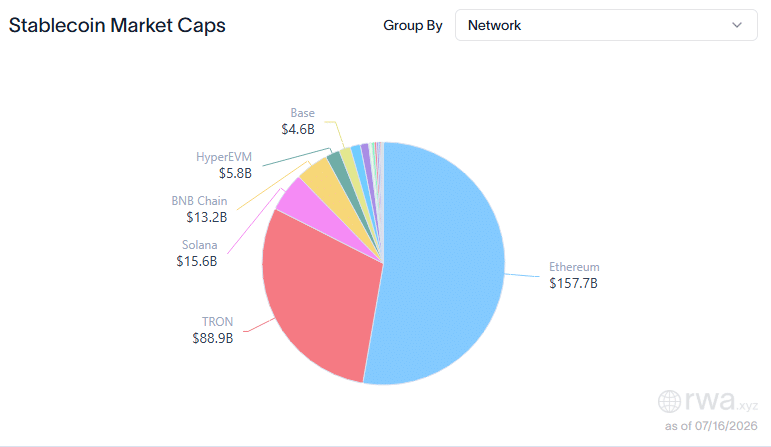
The stablecoin sector is the primary battlefield for public chains. Ethereum and Tron, both of which operate as permissionless, public networks, account for approximately 75% of the total stablecoin market. This dominance is not accidental; it is a testament to the "network effect" of public chains. These networks provide a global, interoperable settlement layer that no private bank-led consortium has been able to replicate.
Tokenization and the Private Moat
Conversely, when examining the broader tokenization of securities and financial assets, the narrative flips. Corporate-led, private, or permissioned chains like Canton and Provenance currently control roughly 85% of the market share for tokenized assets. Ethereum, while a pioneer in the space, currently accounts for only about 4% of this segment.
This data provides a nuanced view:
- For payments and global liquidity: Public chains are the undisputed winners.
- For highly regulated, private securities issuance: Corporate chains retain a massive competitive moat due to privacy, compliance, and control requirements.
Official Responses and Strategic Interpretations
The a16z Perspective: The "COGS" Thesis
a16z emphasizes that the adoption of blockchain by TradFi is a "compelling COGS story." The firm cites the work of entities like SWIFT and various institutional consortia as evidence that the goal is not to decentralize finance, but to make centralized finance more efficient. By utilizing blockchain in a controlled, "walled-garden" environment, banks can maintain regulatory compliance and operational control, which are non-negotiable for traditional financial entities.
The Ark Invest Perspective: The "Intranet" Theory
Lorenzo Valente and other proponents of the public-chain-first model argue that private chains are merely the "intranet" phase of the internet’s evolution. Just as companies once built private, internal networks before realizing that the open internet was the superior medium for communication, financial institutions will eventually find that private chains suffer from isolation.
Carlos Domingo, CEO of Securitize, has articulated this view poignantly, noting that private chains are a "transitional step" toward a truly open, permissionless financial architecture. For Ark, the long-term winners will be the networks that can offer the most liquidity, which inherently favors open, public protocols.
Implications: The Future of Global Markets
The implications of this debate are profound for investors, developers, and policymakers.
1. The Fragmentation of Financial Infrastructure
If both sides are correct—that TradFi will selectively adopt blockchain while public chains continue to capture the stablecoin market—we are likely looking at a bifurcated future. We may see a world of "institutional-grade" private ledgers that communicate with the public DeFi ecosystem through interoperability bridges, rather than a full-scale migration of assets to public chains.
2. The Regulatory Arbitrage
A major driver for the "private chain" preference is regulation. Regulators are generally more comfortable with permissioned systems where "know your customer" (KYC) and "anti-money laundering" (AML) protocols are baked into the network layer. If public chains want to capture more of the RWA market, they will likely need to adopt "identity layers" that satisfy institutional compliance requirements without sacrificing their permissionless nature.
3. The Death of Isolated Silos
Ark Invest’s assertion that private chains will "die in isolation" serves as a warning to institutions building proprietary networks. If a chain does not allow for composability—the ability for assets to move freely between applications and other protocols—it will eventually become a legacy burden rather than a competitive advantage. The history of technology is littered with the corpses of closed, proprietary systems that failed to adapt to open standards.
Conclusion: The Synthesis of Two Worlds
The disagreement between a16z and Ark Invest is not a zero-sum game; it is a reflection of the "salami-slicing" approach currently being taken by global finance.
TradFi is not a monolith. It consists of massive, risk-averse institutions that move slowly, and more agile, forward-thinking entities that are willing to experiment with public infrastructure. While a16z is correct that firms are currently prioritizing efficiency over decentralization, Ark Invest is likely correct that the gravity of the public network—its liquidity, its innovation, and its global access—will ultimately prove too powerful to ignore.
As we look toward the end of the decade, the winners will likely be those who can bridge the two worlds: providing the privacy and compliance of a private ledger with the connectivity and liquidity of a public one. Whether this is achieved through private chains "joining" public ones, or public chains evolving to accommodate private needs, the outcome is clear: blockchain technology has officially moved beyond the stage of mere experimentation and into the era of fundamental infrastructure.
The debate is no longer about if blockchain will be used, but how it will be structured to define the next hundred years of global commerce.
