

The financial sector stands at a critical juncture. As institutional adoption of blockchain technology accelerates, a fundamental debate has emerged among industry titans: Is traditional finance (TradFi) genuinely embracing the decentralized ethos of DeFi, or is it merely stripping the technology of its utility to bolster legacy systems?
The discourse recently reached a boiling point as Ark Invest, the asset management firm led by Cathie Wood, publicly dismissed a thesis proposed by the venture capital giant Andreessen Horowitz (a16z). At the heart of the disagreement is the assertion by a16z that "TradFi does not want DeFi; it only wants blockchain."
The Core Contention: A Clash of Philosophies
The tension began when a16z published a critical analysis arguing that the narrative of a seamless convergence between decentralized finance and traditional banking is a "comforting story" that is fundamentally flawed. According to a16z, the institutional pursuit of blockchain is driven purely by pragmatic business logic—cost reduction, operational efficiency, and the optimization of existing workflows—rather than any ideological commitment to decentralization.
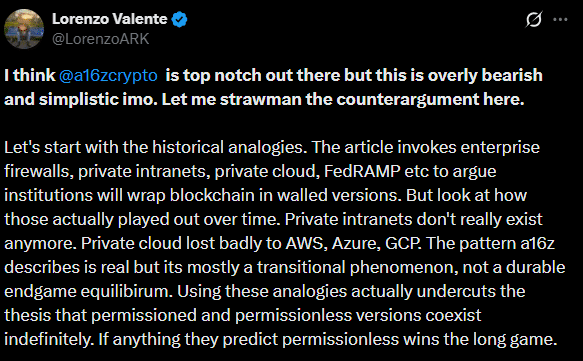
In a direct rebuttal, Lorenzo Valente, Director of Crypto Research at Ark Invest, characterized the a16z position as "overly bearish and simplistic." While acknowledging the stature of a16z as a premier voice in the crypto ecosystem, Valente argued that the venture firm’s perspective ignores the undeniable momentum of open, permissionless systems.
"I think a16z Crypto is top-notch out there, but this is overly bearish and simplistic in my opinion," Valente stated. The debate underscores a growing rift in the industry: are private, permissioned ledgers the final destination for institutional finance, or are they merely a "transitional intranet" for a more decentralized future?
Chronology: The Evolution of the Institutional Blockchain Narrative
To understand the current impasse, one must look at the timeline of institutional blockchain adoption.
- The Early "Permissioned" Era (2015–2019): Financial institutions experimented with private, consortium-based blockchains. During this period, the focus was on distributed ledger technology (DLT) that mimicked legacy database structures.
- The Rise of Stablecoins (2020–2022): The rapid growth of USDT and USDC demonstrated to banks that there was a massive, liquid market for programmable, blockchain-native dollars. This period marked the first time TradFi began to look at public chains not as a threat, but as a potential settlement layer.
- The Tokenization Gold Rush (2023–2025): Major players, including BlackRock with its BUIDL fund, began tokenizing real-world assets (RWAs). This forced a collision between private, enterprise-grade chains (like Canton or Provenance) and the public, transparent nature of Ethereum and other Layer-1 networks.
- The 2026 Reckoning: The current debate highlights the realization that institutional "private chains" (like those proposed by Stripe or Google Cloud) are now competing for dominance against established public infrastructure.
Supporting Data: Public vs. Private Market Share
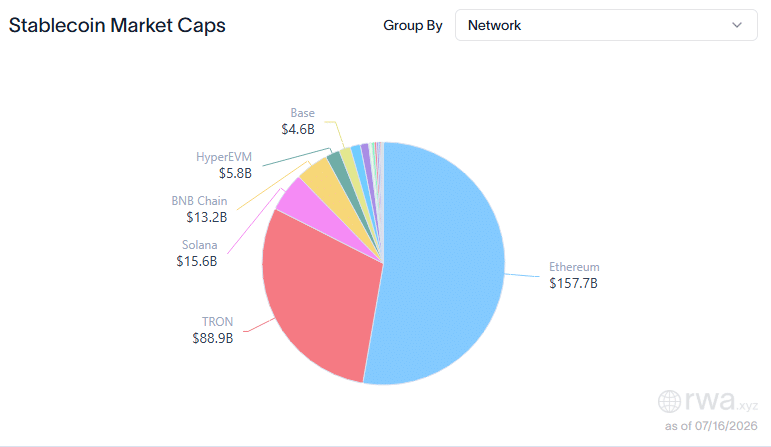
The data reveals a bifurcated market that partially validates both sides of the argument. In the realm of stablecoins—the lifeblood of modern crypto-finance—public chains remain the undisputed kings. Ethereum and Tron, for instance, control nearly 75% of the stablecoin sector. This supports the Ark Invest contention that the market consistently "votes for open access." When users want to move value across borders or settle transactions, they prioritize the liquidity and interoperability of public networks.
Conversely, in the arena of tokenized securities and regulated assets, corporate chains hold a formidable lead. Provenance and Canton collectively account for approximately 85% of the market share in the tokenized assets segment, while public networks like Ethereum hold a modest 4% share.
This data paints a nuanced picture: TradFi is, in fact, using blockchain technology to improve its Cost of Goods Sold (COGS), as a16z suggests, but it is doing so within silos that are increasingly being challenged by the efficiency and transparency of public protocols.
Official Responses and Strategic Disagreements
The disagreement between Ark Invest and a16z is not merely academic; it represents a strategic divide in how these firms allocate capital and project the future of the digital economy.
The a16z Perspective: The "Utility" Argument
The analysts at a16z emphasize that institutions are risk-averse by design. When they integrate blockchain, they are looking for specific, measurable outcomes. They point to the development of the "Arc Chain" by Circle, which is designed to facilitate institutional-grade stablecoin payments within a controlled regulatory environment. For a16z, initiatives like SWIFT’s blockchain-enabled payment pilots are clear indicators that banks will adopt only the "pieces that fit" their current risk-management models.
The Ark Invest Perspective: The "Open Access" Argument
Valente and the Ark Invest team argue that the "siloed" approach is inherently fragile. They suggest that as private chains proliferate—such as Google Cloud’s Universal Ledger (GCUL)—they will face the same fate as private corporate intranets in the 1990s. Eventually, the demand for interoperability and global liquidity will force these private chains to bridge into permissionless, public ecosystems.
Carlos Domingo, CEO of Securitize, has reinforced this view, suggesting that current private or "pseudo-private" chains are merely a transitional phase—a digital "intranet" that will eventually be swallowed by the open, permissionless innovation model.
Implications for the Future of Finance
The collision between these two viewpoints suggests three major implications for the evolution of the global financial system:
1. The Death of the "Walled Garden"
While banks may currently prefer the control of private chains, the network effect of public chains is too significant to ignore. The dominance of public chains in the stablecoin market proves that liquidity flows toward open systems. Banks that persist in using isolated, proprietary ledgers may find themselves cut off from the global liquidity pool, eventually forcing them to adopt hybrid models that communicate with public networks.
2. Selective Adoption as a Temporary Strategy
The a16z thesis holds weight in the short term. Regulated entities cannot simply "go DeFi" overnight due to compliance, KYC (Know Your Customer), and AML (Anti-Money Laundering) requirements. Their selective adoption of blockchain features—such as smart contracts for settlement—is a rational path toward modernization. However, this "selective" approach may eventually prove too costly as the infrastructure for public, regulated DeFi matures.
3. The Rise of Hybrid Infrastructure
The most likely outcome is a convergence of the two models. We are seeing the rise of "institutional DeFi," where regulated financial intermediaries participate on public chains through permissioned pools or identity-verified layers. This allows banks to satisfy their regulatory requirements while benefiting from the massive, global liquidity and 24/7 settlement capabilities of public blockchains.
Conclusion: The Synthesis of Two Truths
Ultimately, the debate between Ark Invest and a16z is a reflection of the "clash of civilizations" between legacy finance and the crypto-native future. The truth likely lies in the middle: TradFi is indeed prioritizing efficiency and cost-reduction, but those very pursuits are leading them directly toward the technologies that were pioneered by the DeFi movement.
Private chains may hold the market share today for tokenized securities, but they are playing a game of catch-up. As public chains continue to harden their security, scalability, and compliance features, the barrier between the "intranet" of the banking world and the "internet" of the public blockchain will continue to blur. Both firms are right in their own context—a16z is correct about the intent of current institutional players, while Ark Invest is correct about the inevitable trajectory of the technology itself. The future of finance will not be defined by a choice between TradFi or DeFi, but by the successful integration of the two.
