

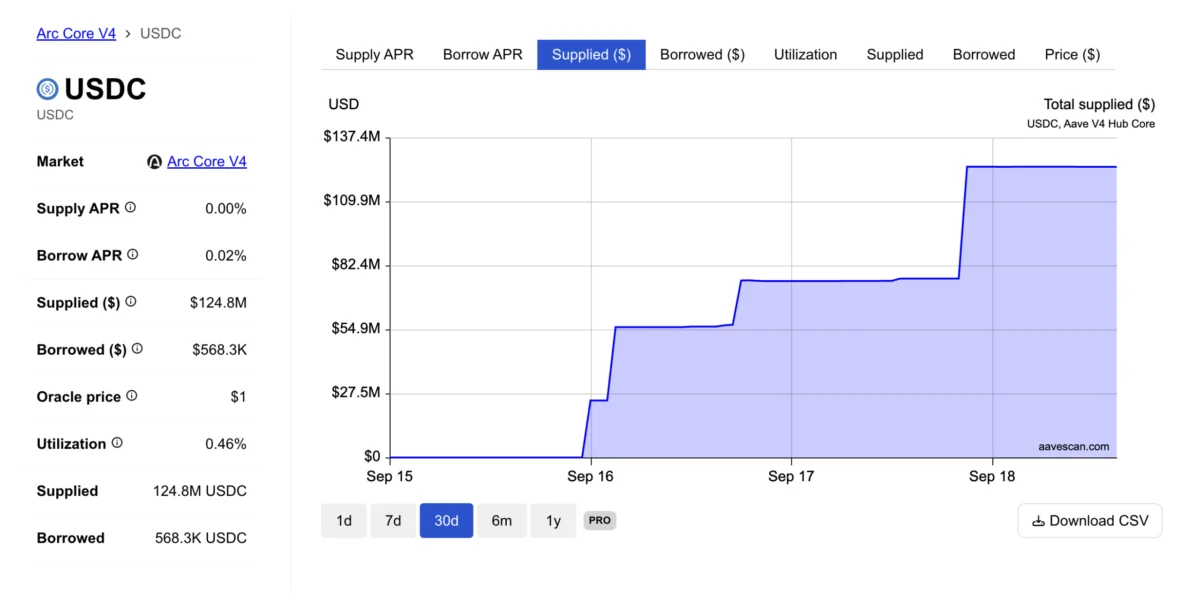
Aave, the titan of decentralized finance (DeFi), has long been the primary engine for crypto-native lending and borrowing. However, its latest expansion—the introduction of a specialized lending market on the Arc network—has brought to light a significant structural challenge. As of September 18, 2026, the Aave Arc V4 market has attracted a staggering $125 million in USDC deposits, yet borrower participation remains remarkably tepid, with less than $600,000 currently deployed.
This massive disparity between supply and demand poses a fundamental question for the protocol’s architects: Is the influx of liquidity a sign of institutional confidence, or is it merely capital sitting idle in search of a utility that has yet to materialize?
The Main Facts: A Disconnected Market
The Aave Arc V4 platform was designed to bridge the gap between traditional institutional requirements and the permissionless nature of DeFi. By providing a regulated, KYC-compliant environment, Aave hoped to attract institutional players who were previously hesitant to enter the broader DeFi ecosystem.
However, the current data paints a picture of extreme imbalance. With nearly $125 million in USDC sitting in the protocol and only a fraction of that amount being borrowed, the market is currently "liquidity-heavy" and "utility-starved." As of the most recent reporting, the utilization rate—a key metric in DeFi that measures the percentage of supplied assets currently borrowed—stands at a negligible 0.46%. Effectively, 99.54% of the capital supplied to the Arc V4 market is sitting dormant, failing to generate yield for the depositors who placed it there.
Chronology of the Surge: A Rapid Influx
The movement of capital into the Arc V4 market has been nothing short of explosive, even if the deployment of that capital has not followed suit. The timeline of this liquidity surge reveals a rapid acceleration in interest from market participants:
- September 16: The market began showing signs of excess liquidity, with total deposits recorded at approximately $24.5 million.
- September 17: Deposits more than tripled in a 24-hour window, surging to $75.8 million. At this stage, borrowing activity was virtually non-existent, highlighting a growing disconnect between capital supply and market demand.
- September 18: The trend continued unabated, with total USDC deposits reaching $124.8 million. During this same window, there was a minor uptick in borrowing activity, with loans climbing from approximately $73,400 at midnight to $568,300 later in the day.
While the rise in borrowing activity is a positive signal, it is dwarfed by the sheer volume of new deposits. The market is witnessing a "supply-side shock" where liquidity is flooding into the protocol faster than the ecosystem can find viable use cases or credit-worthy borrowers to utilize the funds.
Supporting Data and Market Dynamics
To understand why this imbalance matters, one must look at the mechanics of the Aave protocol. Aave functions as a decentralized liquidity pool where depositors provide assets to earn interest, which is paid by borrowers. The interest rate is a function of supply and demand; as utilization increases, the cost of borrowing rises, incentivizing more supply and eventually cooling demand.
Currently, the Arc V4 market is caught in a stagnant cycle:
- Supply APY: 0.00%
- Borrow APY: 0.02%
Because the utilization rate is so low, there is virtually no yield being generated for the suppliers. In a traditional market, a 0% return on supply would trigger a withdrawal of liquidity. However, in the institutional space, capital is often parked in "safe" liquidity protocols while waiting for specific market opportunities or regulatory windows to open. This suggests that the $125 million might not be waiting for traditional "borrowers" in the retail sense, but rather for institutional-grade strategies or arbitrage opportunities that have yet to launch on the Arc network.

The Institutional Perspective: Why Arc Matters
The Aave Arc network is not a standard Aave pool. It requires participants to undergo a rigorous onboarding process, including KYC (Know Your Customer) and AML (Anti-Money Laundering) checks. This "permissioned" aspect is the primary selling point for institutional investors who have mandates to only interact with vetted counterparties.
Industry analysts suggest that the current deposit surge is likely the result of institutional treasury managers "testing the waters." By placing capital into the Arc market, these entities are establishing a presence in the ecosystem, ensuring their liquidity is ready when their internal risk management teams authorize larger-scale deployments. The lack of borrowing, therefore, is not necessarily a failure of the protocol, but rather a reflection of the cautious, deliberate pace at which institutional capital enters new DeFi infrastructures.
Implications for the Future of Aave V4
The current state of the Arc V4 market carries several implications for the future of Aave’s institutional strategy:
1. The "Chicken and Egg" Problem
Lending markets rely on deep liquidity to attract large borrowers. Large borrowers, in turn, are needed to provide the interest that compensates liquidity providers. Aave has successfully solved the supply side, but the demand side remains the missing link. Without a robust pipeline of institutional borrowers—such as market makers, hedge funds, or protocols requiring bridge liquidity—the Arc market risks becoming a stagnant pool of trapped capital.
2. The Need for Product-Market Fit
The discrepancy between the $125 million in supply and the $568,300 in borrowing suggests that the current products offered on Arc V4 may not yet meet the specific borrowing needs of its target audience. Whether this is due to high collateral requirements, limited asset support, or the nascent nature of the regulatory framework, Aave must iterate quickly to provide value to the very institutions it is trying to onboard.
3. Measuring Success via Utilization
Moving forward, the success of the Arc V4 expansion will not be measured by the total value locked (TVL). In a traditional bank, TVL is a metric of health; in a lending protocol, TVL is only useful if it is being utilized. Market observers should shift their focus away from the daily deposit totals and toward the "borrowing velocity"—the speed and volume at which capital is being rotated through the market. A sustained increase in the utilization rate will be the only reliable indicator that the market has transitioned from a treasury parking spot to a functioning credit market.
Conclusion: A Waiting Game
Aave’s expansion into the Arc network is a bold, high-stakes move to bring the legacy financial sector into the decentralized fold. The $125 million in deposits confirms that there is significant interest from capital-rich institutions. However, the current data serves as a stark reminder that liquidity is only one half of the DeFi equation.
For Aave, the challenge over the coming months will be to facilitate the transition from passive deposits to active lending. If the borrowing demand fails to catch up, the protocol may need to incentivize participation or introduce new features that make borrowing more attractive to institutional players.
For now, the market is in a state of suspended animation. The capital is present, the infrastructure is live, and the regulatory boxes are checked. All that remains is for the borrowers to decide that the Arc network is the most efficient place to conduct their business. Until then, the protocol remains a monument to institutional caution—an immense pool of potential waiting for the spark of utility to bring it to life.
