

In a landmark development for the decentralized finance (DeFi) sector, Aave, the industry’s leading lending protocol, has unveiled a groundbreaking proposal aimed at bridging the long-standing divide between traditional institutional finance and on-chain liquidity. The proposal, centered on "custodied collateral lending," seeks to unlock vast tranches of institutional capital by allowing regulated entities to borrow stablecoins against assets held within institutional-grade custody. By partnering with Anchorage Digital, Aave is positioning itself to capture the "currently unreachable" collateral that has historically remained siloed outside of the DeFi ecosystem.
Main Facts: The Mechanism of Custodied Collateral
The core of Aave’s proposal rests on solving the fundamental disconnect between institutional asset storage and DeFi participation. Historically, institutional players—such as hedge funds, family offices, and asset managers—have been unable or unwilling to engage with DeFi due to strict regulatory requirements regarding self-custody. These entities are mandated to hold their digital assets with qualified, regulated custodians like Anchorage, which inherently prohibits the movement of these assets into smart contract wallets.
Aave’s solution introduces a sophisticated bridge using Chainlink’s CustodySync technology and Custodied Collateral Tokens (CoCTs). Under this framework, the actual collateral (such as Bitcoin) remains safely locked within the regulated, secure environment of Anchorage. Simultaneously, the value of those assets is represented on-chain via CoCTs. These tokens act as verifiable, cryptographic receipts of the underlying assets.
The workflow is designed for seamless institutional integration:
- Asset Deposit: An institution deposits collateral (e.g., BTC) into their Anchorage account.
- Tokenization: Via Chainlink’s CustodySync, a corresponding CoCT is minted on-chain, reflecting the value of the custodied asset.
- Lending Activity: The institution deposits these CoCTs into the Aave V4 protocol as collateral.
- Liquidity Access: The institution borrows stablecoins (such as USDC) against this collateral, effectively gaining DeFi liquidity without moving their base assets.
- Settlement: Upon repayment of the loan plus interest, the CoCTs are burned, and the original collateral is released from the Anchorage vault.
This model bypasses the need for "wrapped" assets like WBTC, which, while useful, often introduce additional layers of smart contract risk and regulatory uncertainty. By keeping the collateral in a qualified custodian, Aave effectively removes the compliance friction that has kept institutional billions on the sidelines.
Chronology: The Road to Governance
The proposal, currently under discussion in the Aave governance forum, follows a period of rapid development and strategic planning.
- Early 2024: Aave Labs begins internal research into institutional adoption, identifying that the lack of custodial integration is the primary barrier to entry for large-scale institutional participants.
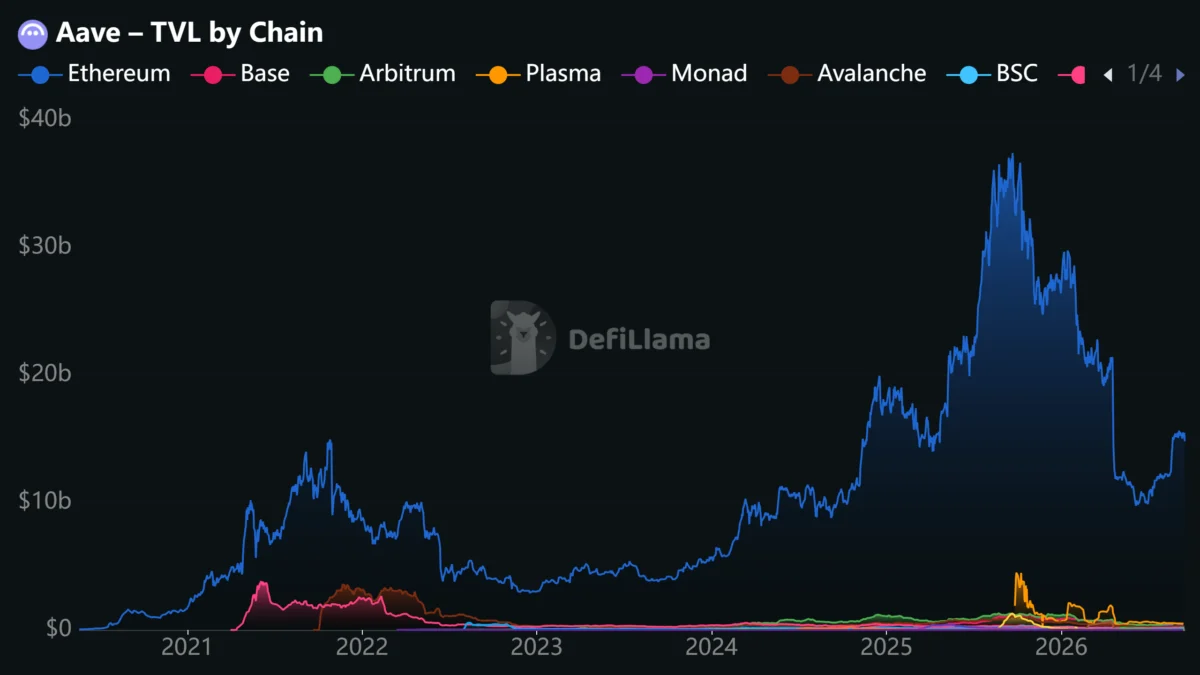
- Q3 2024: Aave observes a massive rebound in its Total Value Locked (TVL), climbing from $12.5 billion in June to nearly $19 billion. This surge underscores a growing appetite for on-chain leverage, even among existing market participants.
- September 2026: The official proposal for "Custodied Collateral Lending" is posted to the Aave governance forum. The document outlines the "Hub-Spoke" architecture, marking the transition into the formal proposal phase.
- Current Status: The community is currently engaged in discourse regarding the technical implementation, risk assessment, and potential security audits required to integrate Chainlink’s infrastructure into the Aave V4 core.
- Future Roadmap: Following the current discussion phase, the proposal is expected to move toward a Snapshot vote. If successful, the final phase will involve the deployment of smart contracts, rigorous auditing by security firms, and final execution on the mainnet.
Supporting Data: Why Now?
The timing of this proposal is no coincidence. Aave has seen a significant 52% recovery in TVL since mid-2024, signaling that the broader crypto market is entering a new phase of maturity. However, the protocol’s internal analysis reveals that nearly $17 billion worth of capital remains "idle" or inaccessible within the ecosystem because it cannot be efficiently bridged from institutional vaults to DeFi protocols.
The reliance on synthetic assets like Wrapped Bitcoin (WBTC) has historically served as a stop-gap. However, recent concerns regarding the centralization and management of these bridges have prompted institutions to demand more robust, regulated alternatives. By integrating directly with a qualified custodian, Aave is positioning itself as the primary infrastructure for "Institutional DeFi."
Data from the DeFi sector suggests that for every dollar of institutional capital that enters the on-chain lending market, there is a multiplier effect on liquidity, enabling deeper markets and more stable interest rates. If Aave can successfully onboard even 10% of the institutional assets currently sitting in custodial storage, the resulting TVL boost would likely cement its position as the dominant lending protocol in perpetuity.
Official Responses and Strategic Vision
Aave founder Stani Kulechov has been vocal about the importance of this shift, characterizing the proposal as a "first-of-its-kind" leap for the industry. In his commentary, Kulechov emphasizes that the goal is not to force institutions to change their behavior, but to build the infrastructure that meets them where they are.

"This integration onboards a class of collateral that is currently unreachable for Aave: assets held with a regulated custodian by institutional borrowers who cannot or will not self-custody," the proposal document states.
From the perspective of custody providers like Anchorage, the integration serves as a validation of their business model. By allowing their clients to tap into DeFi without compromising on security, custodians can offer a broader range of services, effectively becoming the "gateways" for institutional access to decentralized protocols. This symbiotic relationship between DeFi protocols and traditional custodians is widely seen by analysts as the "Holy Grail" for widespread crypto adoption.
Implications: A Shift in the DeFi Landscape
The implications of this proposal extend far beyond Aave’s own growth. If successful, it will likely set a new industry standard that other protocols will be forced to follow.
1. Competitive Pressure on Peers
Rival lending platforms like Morpho and Kamino will face immediate pressure to develop similar integrations. Currently, the "lending war" is fought over liquidity and APY. However, if Aave successfully captures the institutional market, the battleground will shift to compliance and accessibility. Protocols that fail to offer institutional-grade custodial bridges may find themselves relegated to the "retail-only" tier of the market.
2. Regulatory Normalization
This proposal represents a significant step toward the normalization of DeFi in the eyes of regulators. By working within the existing framework of qualified custodians—who are already subject to SEC and other global financial regulations—Aave is effectively "softening" the regulatory perimeter. It demonstrates that DeFi is not necessarily about bypassing the law, but about creating more efficient, transparent, and programmable financial infrastructure.
3. The Rise of "Institutional DeFi"
We are witnessing the birth of a hybrid ecosystem. Traditional finance is not being replaced; it is being "DeFi-ed." As more institutional capital flows into Aave through this custodial bridge, the lines between CeFi (Centralized Finance) and DeFi will continue to blur. This could lead to a massive increase in the utility of stablecoins like USDC, as they become the primary bridge currency for large-scale institutional borrowing and lending.
4. Risks and Challenges
Despite the optimism, the proposal is not without risks. The introduction of CoCTs adds a layer of dependency on Chainlink’s CustodySync. If there were a failure in the communication between the custodian and the on-chain protocol, it could lead to "stuck" collateral or liquidation issues. Furthermore, the protocol must ensure that the legal framework governing the seizure of collateral in the event of a default is ironclad. If a hedge fund fails to pay back a loan, how exactly does the DAO, or the smart contract, gain access to the BTC held at Anchorage? These are the complex legal and technical questions that will dominate the upcoming months of governance.
Conclusion
Aave’s move to embrace custodied collateral lending is a bold, calculated bet on the future of financial markets. By prioritizing institutional requirements—security, compliance, and custodial integrity—the protocol is aiming to tap into a reservoir of capital that dwarfs the current DeFi TVL. While the journey from a governance proposal to a fully functional, secure, and regulated lending bridge is fraught with technical and legal hurdles, the potential rewards are immense.
If this initiative succeeds, it will not only solidify Aave’s dominance in the lending space but also serve as a blueprint for how the next generation of financial markets will operate. The era of "siloed" institutional finance is slowly coming to an end, and if Aave has its way, the future of collateralized lending will be decentralized, yet held in the safest of hands. As the proposal moves closer to a final vote, all eyes in the crypto industry will be on Aave to see if it can successfully bridge the gap between the old world of finance and the new frontier of blockchain.
