

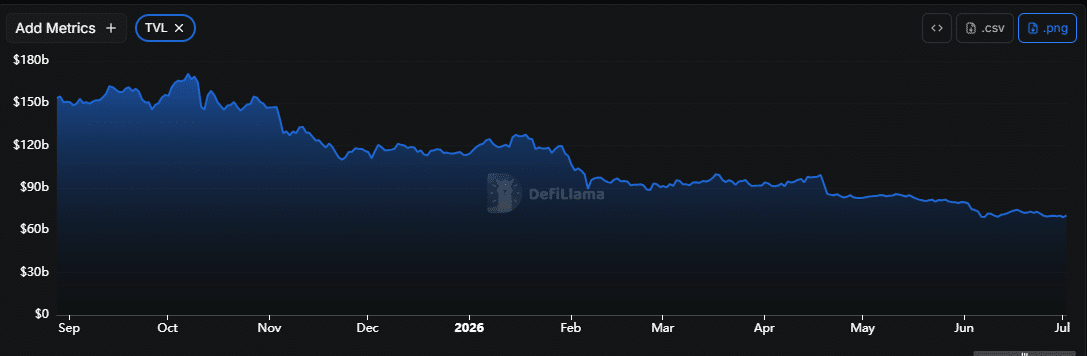
The decentralized finance (DeFi) sector has long been characterized by its high-octane volatility, but the second quarter of 2026 proved to be a particularly sobering period for the ecosystem. After riding a wave of optimism, the market hit a formidable wall of fear, uncertainty, and doubt (FUD), resulting in a liquidity crunch that saw over $20 billion vanish from major protocols. As total value locked (TVL) plummeted from its pre-October 2025 highs of $150 billion to a floor of roughly $70 billion, analysts began questioning the structural integrity of the sector.
However, as we transition into the third quarter, a nuanced recovery is beginning to take shape. With stablecoin inflows rising across major layer-1 networks and a shifting sentiment from centralized to decentralized platforms, the market may be witnessing a pivotal rotation in capital allocation.
The Anatomy of the Q2 Liquidity Shakeout
The downturn in Q2 was not merely a reaction to cooling price action across the broader cryptocurrency market; it was fundamentally driven by a crisis of confidence. The quarter was punctuated by a series of high-profile protocol exploits, which collectively siphoned more than $600 million from the ecosystem.
These security failures acted as a catalyst for a "risk-off" sentiment that rippled through the entire DeFi landscape. When users lose trust in the smart contracts underpinning their yield-bearing assets, the immediate reaction is to unstake, withdraw, and move toward safer, albeit less productive, capital positions. This mass exodus triggered a liquidity cascade, forcing even the most robust protocols to grapple with a shrinking TVL base.
Chronology of the Decline
- Pre-October 2025: The DeFi market peaked with TVL reaching approximately $150 billion, supported by high institutional and retail engagement.
- Early Q2 2026: A sequence of sophisticated protocol exploits surfaced, exposing vulnerabilities in yield-farming and lending platforms.
- Mid-Quarter: Following the high-profile KelpDAO exploit, panic set in. Aave, the industry’s flagship lending protocol, saw its TVL crater by 18% in a single 24-hour window, shedding nearly $3.2 billion.
- Late Q2: The contagion spread beyond individual protocols to the Ethereum ecosystem, which suffered a total TVL reduction exceeding $10 billion. By the close of the quarter, the industry had recorded its sharpest quarter-over-quarter decline in TVL since the turbulent markets of 2021.
Supporting Data: By the Numbers
To understand the magnitude of this correction, one must look at the data provided by platforms like DeFiLlama and CryptoQuant. The $80 billion drop in TVL from the 2025 highs represents more than just a price correction of underlying assets; it represents a fundamental withdrawal of liquidity.
The Aave Case Study
Aave serves as the bellwether for the DeFi lending market. Its swift 18% drop following the KelpDAO incident underscored the "speed-to-exit" behavior of modern DeFi participants. However, data from early Q3 suggests a reversal. Aave recently recorded 1,806 new wallet addresses in a single 24-hour period—the highest rate of network growth since October 2021. This metric suggests that while the "smart money" fled in Q2, a new wave of users is looking to capitalize on the lower valuations of the current market.
Stablecoin Inflows as a Leading Indicator
Stablecoins function as the "dry powder" of the crypto economy. When stablecoin supply increases on-chain, it is a high-conviction signal that investors are preparing to deploy capital.
- Solana: Finished Q2 with a record-breaking $16.6 billion in stablecoin supply, signaling that despite the market-wide FUD, the ecosystem retained significant institutional interest.
- Stellar: Recorded a 32.6% increase in 30-day stablecoin transfer volume, highlighting increased utility and transactional velocity.
- Cardano: Demonstrated a 20% surge in native stablecoin supply within a single week, suggesting that liquidity is actively flowing back into decentralized networks.
The CeFi-to-DeFi Migration
One of the most compelling narratives emerging from the Q2 data is the contraction of the Centralized Finance (CeFi) sector. According to a recent report from CryptoQuant, CeFi lending contracted by 6% quarter-over-quarter, totaling $23.3 billion. This marks the first such decline since Q3 2024.
This contraction is not a coincidence. It is an indication of a structural rotation. As centralized entities face increasing regulatory scrutiny and market volatility, liquidity is gravitating back toward decentralized, permissionless protocols. Investors are clearly demonstrating a preference for the transparency of on-chain activity over the opaque balance sheets of centralized lenders. This shift suggests that the market is beginning to prioritize protocol-level trust—governed by code—over institutional-level trust, which has been severely damaged by the events of the past eighteen months.
Official Perspectives and Market Implications
Industry experts are divided on whether this recovery is a "dead cat bounce" or the start of a sustainable Q3 rally. The core argument for a recovery rests on the "cleansing" effect of the Q2 crash. By weeding out over-leveraged protocols and forcing a re-evaluation of security standards, the market has arguably emerged more resilient.
"The market is moving from a phase of speculative expansion to one of cautious utility," says one lead researcher at a prominent crypto-analysis firm. "The fact that stablecoins are moving on-chain at a time when CeFi is contracting suggests that the ‘decentralization’ value proposition is gaining ground again. If this trend holds, we are likely looking at a more sustainable, albeit slower, growth trajectory for the remainder of the year."
Potential Risks
Despite the optimistic signals, risks remain:
- Smart Contract Vulnerabilities: The memory of the Q2 exploits remains fresh. Another major hack could reverse the current sentiment in a matter of hours.
- Regulatory Uncertainty: Ongoing debates surrounding stablecoin regulation could impact the liquidity flow if governments impose stricter "on-ramp" or "off-ramp" controls.
- Macroeconomic Pressure: With global interest rates remaining a variable, the "risk-on" appetite for DeFi may still be tethered to traditional market performance.
Final Summary: Looking Toward Q3
The second quarter of 2026 will be remembered as a stress test for the DeFi sector. The $20 billion withdrawal was a painful but necessary correction that underscored the fragility of the ecosystem. However, the data entering the third quarter provides a compelling counter-narrative.
The increase in network growth, the building of stablecoin liquidity on major layer-1s, and the measurable shift of capital from centralized lenders to decentralized protocols indicate that the market is beginning to bottom out. While the road to recovering the $150 billion TVL peak will be long and fraught with potential pitfalls, the fundamental behavior of market participants suggests that confidence is returning.
The "risk-off" era of Q2 is showing signs of fading. As investors move back on-chain, the focus has shifted toward fundamental yield, protocol utility, and long-term network growth. If these indicators continue to track upward, Q3 may well prove to be the foundation for the next cycle of crypto-asset growth. For now, the DeFi community remains in a state of watchful optimism, keeping a close eye on security and the steady influx of capital into the decentralized landscape.
