

Google’s generative AI ecosystem expanded significantly last week with the introduction of Gemini 3.1 Flash Lite (officially released as gemini-3.1-flash-lite-image). Positioned as the new entry point for Google’s image generation stack, this model arrives as a high-velocity, low-cost alternative to the existing Gemini 3.1 Flash (Nano Banana 2) and the flagship Gemini Pro models.
By prioritizing speed and cost-efficiency, Google is making a direct play for the mass-market enterprise and consumer sectors. The model promises text-to-image outputs in approximately four seconds—a 2.7x speed improvement over its predecessor—while maintaining deep integration across Google’s suite of products. But as with any "Lite" iteration, the question remains: does the reduction in computational overhead result in a meaningful loss of creative fidelity?
Main Facts: The New Standard for Efficiency
The introduction of Gemini 3.1 Flash Lite solidifies Google’s three-tier model architecture:

- Gemini 3.1 Flash Lite: Optimized for speed, low-latency applications, and high-volume text-heavy tasks.
- Gemini 3.1 Flash: The "middle ground" model, balancing high-fidelity photographic quality with efficient processing.
- Gemini 3.1 Pro: The heavy-lifting engine reserved for complex, high-resolution, and professional-grade creative production.
At a price point of roughly $0.034 per 1K-resolution image, the Lite model is essentially half the price of the standard Flash model, which currently sits at $0.067. This aggressive pricing brings Google into direct competition with specialized low-cost models like Seedream 5.0 Lite. While niche providers like Reve 2.0 offer even lower price points, they lack the vast, seamless integration that Google offers across its ecosystem, including Search, NotebookLM, the Gemini app, and Google Photos.
Chronology: The Evolution of the Nano Banana Family
The path to the release of the "Lite" model reflects a broader shift in the AI industry toward specialized, task-oriented model deployment:
- Q1 2026: The release of the original gemini-2.5-flash-image set the benchmark for mobile-ready, rapid-response image generation.
- Mid-2026: The launch of Gemini 3.1 Flash (Nano Banana 2) elevated the quality of generated imagery, setting a new standard for realism and prompt adherence in mid-tier models.
- Last Week: Google unveiled Gemini 3.1 Flash Lite, officially replacing the 2.5-era models and completing the current three-tier product hierarchy.
- Integration Phase: Simultaneously, Google rolled out the new Interactions API, enabling users to perform up to three sequential image edits within a single session, working in tandem with the Gemini Omni Flash video generation model.
Supporting Data: Performance Under the Microscope
To determine if the "Lite" designation translates to a significant drop in quality, we conducted a series of head-to-head performance tests against the standard Flash model across five core categories.

1. Realism and Photographic Fidelity
In tests involving complex, high-detail portraiture, the divergence between the models is most apparent. When tasked with rendering a cinematic portrait of an architect, the Lite model succeeded in compositional placement but faltered on technical micro-details. Specifically, the Lite version struggled with anatomical consistency (e.g., oversized hands) and failed to render subtle lighting cues like soft rim lights effectively. The skin texture appeared adequate for social media thumbnails but failed under close scrutiny.
2. Prompt Adherence and Logic
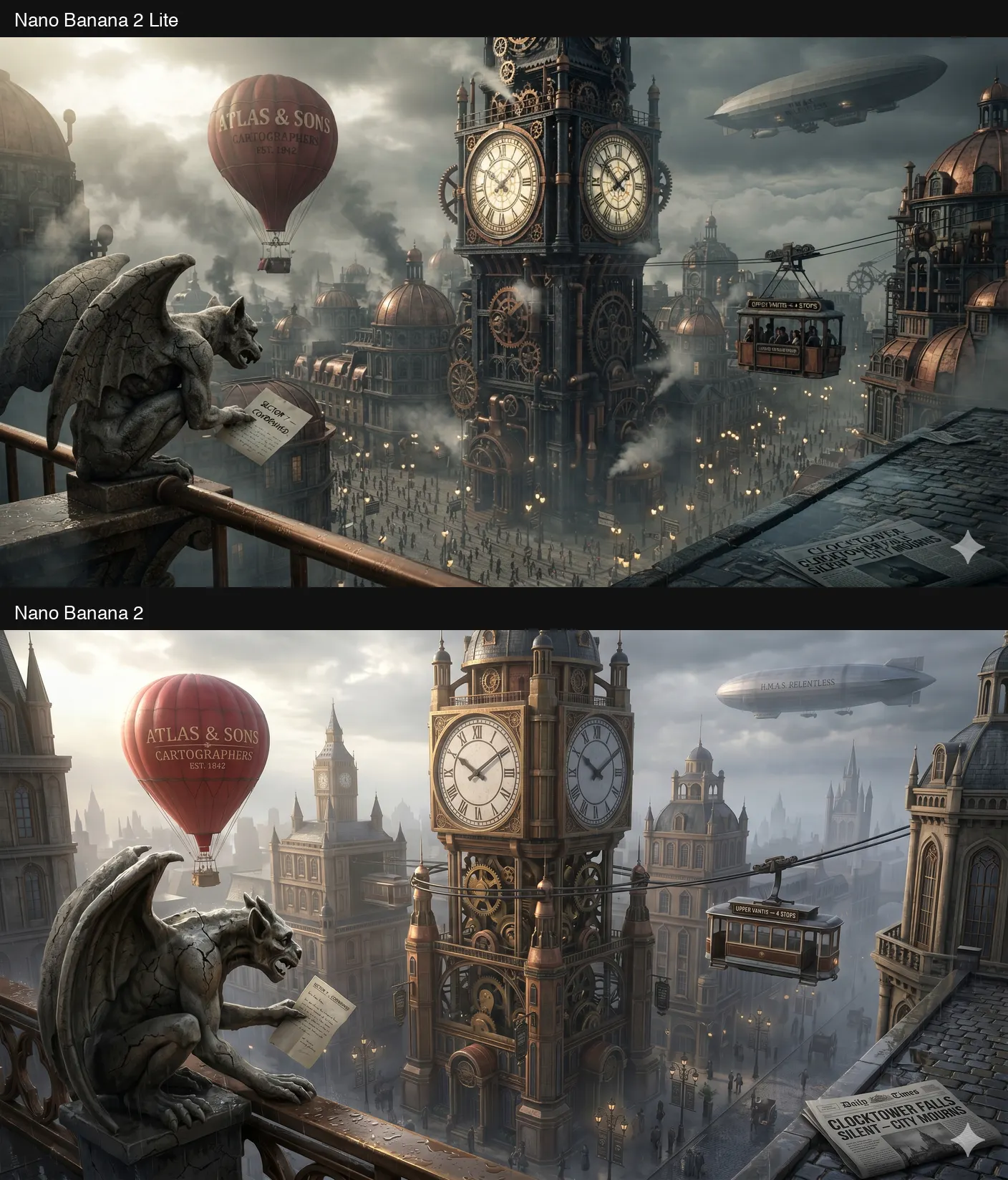
We tested both models on a dense, multi-element steampunk cityscape. The Lite model successfully navigated the scene’s complex architecture, placing objects correctly. However, it struggled with text rendering—a persistent hurdle for generative AI. It consistently misread specific dates and labels, whereas the standard Flash model maintained higher levels of legibility for fine details, such as headlines on a newspaper or specific street signage.
3. Spatial Awareness
Surprisingly, the Lite model performed exceptionally well in terms of spatial grammar. In an experiment involving a cluttered alchemist’s desk, both models successfully established the "depth-of-field" layering, avoiding the common pitfalls of object displacement or structural collapse. The Lite version’s background was slightly "flatter," lacking the atmospheric volumetric lighting of the standard Flash model, but for 90% of use cases, it remained a highly viable tool.

4. Text Generation: The "Lite" Advantage
The most counterintuitive finding was in the realm of text-heavy imagery. When prompted to generate a hardware store exterior covered in diverse text (posters, graffiti, notices, signage), the Lite model outperformed the standard version in pure legibility. By utilizing a brighter, more neutral lighting profile, the Lite model ensured that even small, peripheral text remained readable. In contrast, the standard model’s "cinematic" dark, moody lighting caused smaller text elements to fade into shadows.
Official Perspectives and Market Positioning
Google has framed the Gemini 3.1 Flash Lite not as a "diminished" version of its predecessor, but as a "focused tool" designed for high-efficiency pipelines. In internal briefings, engineers emphasized that the model’s architecture is specifically optimized for tasks where the intent of the prompt—such as including specific text or a specific layout—is more important than the cinematic nuance of the lighting or skin texture.
Competitively, Google is betting on "ecosystem gravity." While models like Reve 2.0 offer lower costs, the barrier to entry for businesses is not just the price-per-image, but the cost of infrastructure integration. By embedding Lite into the existing Gemini API and Enterprise Agent Platform, Google removes the "platform-switching cost" that businesses face when trying to bolt on external, cheaper API services.
Implications for Creative Professionals
The implications of this release are significant for different sectors of the creative economy:
- For Content Creators and Marketers: The Lite model is a win. Its ability to churn out fast, visually competent, and text-accurate graphics at half the price makes it the ideal engine for social media content, rapid visual mockups, and iterative campaign testing.
- For Concept Artists and Worldbuilders: The trade-off is more nuanced. While the Lite model handles spatial architecture well, its tendency to blur text and struggle with complex lighting makes it less suitable for high-end "hero" images or final portfolio pieces. These professionals will likely continue to lean on the "Pro" or standard "Flash" models to avoid the manual correction steps required by the Lite version.
- For Enterprise Software Developers: The integration of the Lite model into the Interactions API provides a massive boost to productivity. Being able to chain three sequential edits with a high-speed model significantly reduces the latency of collaborative AI workflows.
The Bottom Line
Is the quality drop-off worth the savings? For the vast majority of practical, day-to-day business applications, the answer is a resounding "yes."
The Gemini 3.1 Flash Lite excels in tasks where clarity and speed are paramount, such as signage mockups, infographics, and structured scene generation. While it cannot replace the standard Flash or Pro models for cinematic photography, it fills a vital void in the market: a high-speed, reliable, and integrated tool that doesn’t sacrifice functional logic for aesthetic flair. As the industry continues to mature, we expect more companies to follow Google’s lead, moving away from "one-size-fits-all" models toward a tiered approach where the right tool is chosen based on the specific requirements of the creative brief.
