

The decentralized finance (DeFi) ecosystem has once again been rattled by a high-profile smart contract exploit. The Hinkal stablecoin privacy protocol, designed to provide anonymity for on-chain transactions, has suffered a significant security breach resulting in the unauthorized withdrawal of approximately $820,000 in USDC. This incident serves as a sobering reminder of the inherent risks associated with complex smart contract architectures, where even minor oversights can lead to substantial financial hemorrhage.
The Anatomy of the Exploit: A Technical Breakdown
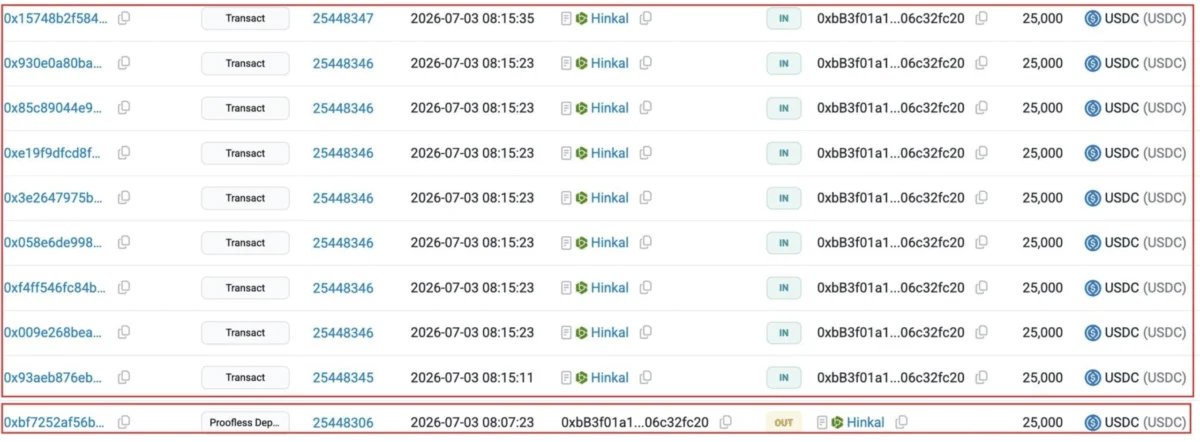
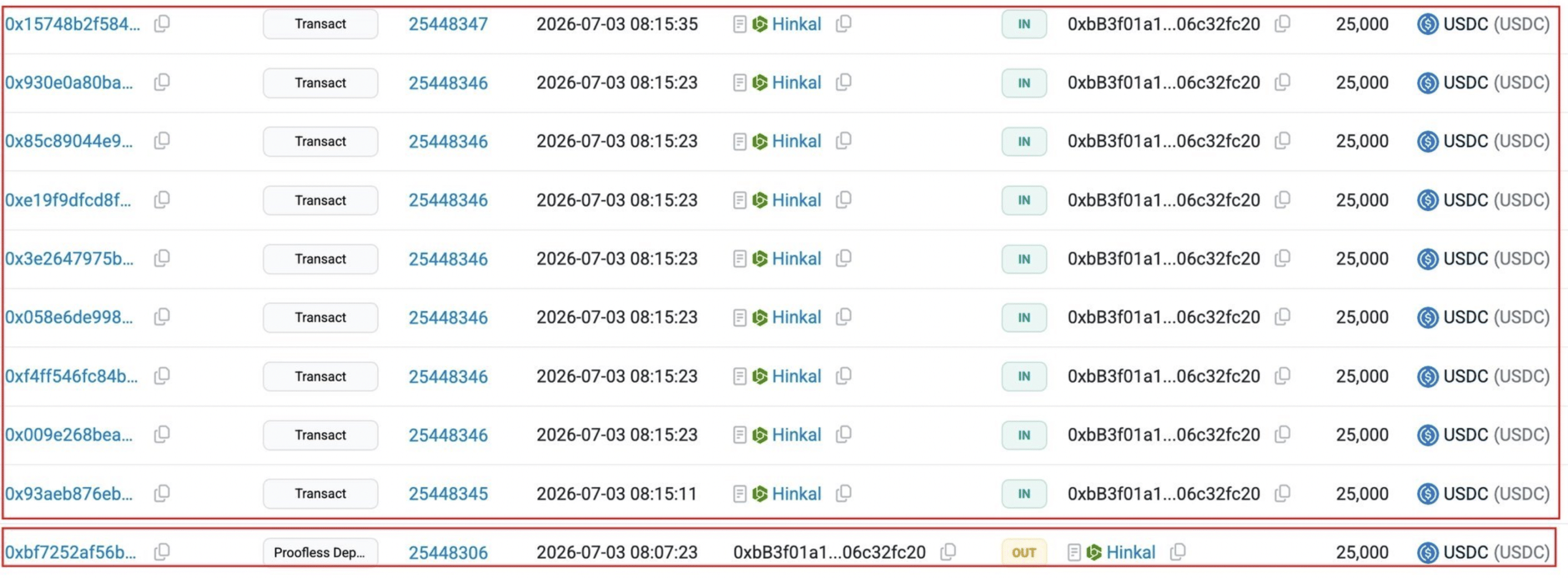
Security researchers and blockchain analysts, including the team at GoPlus Security, have identified the root cause of the Hinkal exploit as a critical vulnerability within the protocol’s smart contract logic. Preliminary investigations suggest that the attacker bypassed standard security measures by manipulating the protocol’s internal functions, specifically targeting the prooflessDeposit() function.
How the Attack Unfolded
The exploitation sequence appears to have been a calculated, multi-step process. By triggering the prooflessDeposit() function, the attacker reportedly circumvented the requirement for valid cryptographic proofs that typically govern asset inflows. With this gatekeeping mechanism bypassed, the perpetrator was able to execute a series of unauthorized transact() calls.
These calls effectively drained the liquidity pool of its USDC reserves. Because the contract failed to adequately validate the legitimacy of these deposits or verify the integrity of the underlying privacy architecture, the system treated the attacker’s malicious requests as valid transactions. This "logic flaw"—where the code executes exactly as written, but fails to account for adversarial inputs—remains one of the most pervasive threats in the DeFi landscape.
Chronology of a Crisis: The 2026 Security Landscape
The Hinkal breach is not an isolated event; rather, it is part of a broader, concerning trend of increased security incidents throughout the first half of 2026. While the blockchain industry continues to innovate, the frequency of exploits suggests that security auditing and defensive programming have not kept pace with the rapid deployment of new protocols.
June 2026: A Month of Volatility
The weeks leading up to the Hinkal incident were marked by several high-profile security failures:
- June 20, 2026: The notorious MEV (Maximal Extractable Value) bot, widely known as "Jaredfromsubway.eth," was successfully targeted in an exploit that resulted in a staggering $7.5 million loss. This attack highlighted that even sophisticated, profit-seeking infrastructure is not immune to well-coordinated exploits.
- Late June 2026: Edel Finance fell victim to a flash loan attack, which manipulated the exchange rate of wrapped xStocks. The vulnerability in the protocol’s oracle allowed the hacker to drain approximately $403,000 from the platform’s lending reserves, further eroding user confidence.
These incidents, when coupled with the Hinkal breach, underscore a recurring pattern: DeFi protocols are being tested by increasingly sophisticated actors who utilize flash loans, oracle manipulation, and smart contract bugs to extract value from decentralized systems.
Supporting Data: The Quantitative Reality of 2026 Hacks
While the frequency of attacks has risen, the broader market data provides a nuanced picture. According to data provided by TRM Labs, the first half of 2026 saw a record-breaking 207 distinct hacks across the blockchain ecosystem. This represents a significant uptick in the number of malicious campaigns aimed at DeFi protocols.
A Comparative Analysis
Despite the high number of incidents, the total value lost provides a different narrative. Data from DeFiLlama indicates that total losses for the first half of 2026 amounted to approximately $948.13 million. When compared to the $2.3 billion stolen during the same period in 2025, the industry is witnessing a paradoxical trend: while the number of attacks is increasing, the average severity of each individual exploit is decreasing.
This shift may be attributed to several factors:
- Improved Security Awareness: Protocols are increasingly prioritizing audits and bug bounty programs, which may be catching larger vulnerabilities before they can be exploited at scale.
- Increased Capital Efficiency: Many modern DeFi protocols now employ circuit breakers, multi-signature controls, and insurance funds that limit the total impact of a successful breach.
- Market Maturity: The industry is moving toward more modular and standardized codebases, which are easier to audit and harder to exploit in ways that allow for massive, protocol-wide drains.
Official Responses and Industry Sentiment
As of this writing, the Hinkal team has acknowledged the incident and is working closely with blockchain security firms to trace the movement of the stolen funds. While an official "post-mortem" report is pending, the community has been active on social platforms like X (formerly Twitter), where security researchers are dissecting the transaction logs to understand how the attacker managed to move the funds through mixing services.
The silence from some major industry stakeholders regarding the specific vulnerability has led to calls for greater transparency. Industry experts argue that when a protocol suffers a breach, the immediate release of a technical breakdown is essential for the rest of the DeFi ecosystem to patch similar vulnerabilities in their own codebases.
Implications: The Future of DeFi Security
The Hinkal exploit serves as a crucial case study for the maturation of decentralized finance. It highlights that the "move fast and break things" ethos—while successful in the early days of Web3—is becoming increasingly incompatible with the demands of institutional-grade financial infrastructure.
The Need for Rigorous Auditing
The vulnerability identified in the prooflessDeposit() function emphasizes that code audits are not a "one-and-done" affair. As protocols upgrade and integrate with other services, the attack surface expands. Future security standards will likely demand:
- Formal Verification: Using mathematical proofs to verify that smart contracts behave exactly as intended, eliminating the possibility of logic-based exploits.
- Real-time Monitoring: Implementing automated security tools that can detect and halt suspicious transactions in real-time, preventing the "draining" of liquidity before the attacker can exit.
- Insurance Coverage: As the sector grows, the role of decentralized insurance protocols will become paramount in protecting liquidity providers from the fallout of smart contract failures.
The Human Element
Beyond the code, the Hinkal incident reiterates the importance of human diligence. Investors are increasingly looking for protocols that demonstrate transparency, have a clear track record of security, and are willing to engage with the white-hat community. The era of "blindly trusting" a protocol based on high yields is rapidly coming to an end.
Final Summary: Lessons Learned
The exploit of the Hinkal privacy protocol is a sharp reminder that the DeFi sector is still in its experimental phase. The loss of $820,000 in USDC is a heavy price to pay for what appears to be a preventable logic error. However, the data provided by TRM Labs and DeFiLlama reveals an industry in flux. While the number of attacks continues to surge, the overall financial impact is being mitigated by a combination of better security practices and a more cautious market.
As we move deeper into the second half of 2026, the industry must decide whether it will continue to accept frequent, smaller hacks as the "cost of doing business" or if it will pivot toward a more rigorous, audit-first approach. For now, users and developers alike would do well to treat the Hinkal incident as a textbook example of why, in the world of smart contracts, every line of code is a potential point of failure. The path forward requires not just better technology, but a more profound commitment to the safety and security of the users who underpin the entire decentralized economy.
