

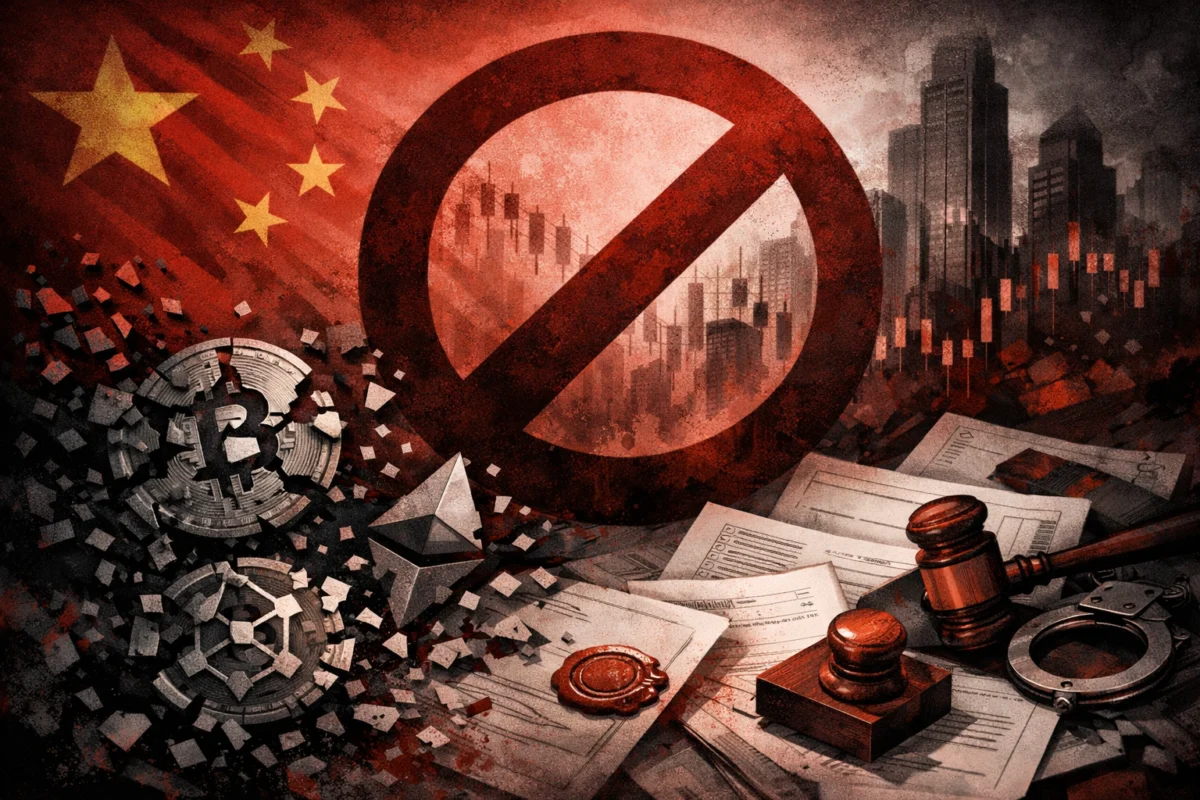
In a move that sends a definitive shockwave through the global digital finance ecosystem, China has issued a sweeping regulatory directive that formally classifies the tokenization of Real-World Assets (RWA) as an illegal financial activity. This coordinated crackdown, executed by seven of the country’s most influential financial industry associations, effectively closes the door on the burgeoning RWA sector within the mainland and signals a zero-tolerance policy toward any business model attempting to bridge traditional assets with blockchain technology.
The directive, which encompasses a wide array of Web3 services, serves to harmonize the regulatory treatment of RWA projects with the country’s existing prohibitions on stablecoins, cryptocurrency trading, and mining. By removing all ambiguity regarding the legality of these instruments, Chinese authorities have signaled that the nation’s future in digital finance will be defined solely by state-sanctioned initiatives, most notably the internationalization of the digital yuan (e-CNY).
The Unified Regulatory Front
The scale of this intervention is underscored by the unprecedented level of inter-agency cooperation. The notice was issued jointly by a coalition representing the entire breadth of China’s financial oversight architecture:
- China Internet Finance Association
- China Banking Association
- China Securities Association
- China Asset Management Association
- China Futures Association
- China Association of Listed Companies
- China Payment and Clearing Association
By uniting these specific bodies, Beijing has signaled that RWA activities are not merely a "crypto concern" but a matter of systemic financial security. The collective stance is clear: RWA tokenization—defined by these bodies as the issuance of tokens representing rights or debt instruments linked to underlying assets—possesses no legal basis under Chinese law.
Regulators have explicitly debunked the narrative often peddled by startups that their projects are operating in "regulatory sandboxes" or pending formal registration. The directive confirms that no such approvals exist, and any claims of legitimacy regarding these projects are fundamentally deceptive.
Chronology and Context: From Speculation to Prohibition
The path to this total prohibition has been paved by a series of escalating warnings and shifting tides in the Chinese regulatory environment.
The Evolution of the Crackdown
- The 2021 Watershed: China’s comprehensive ban on cryptocurrency transactions and mining set the foundational tone for the current directive. At the time, regulators identified the decentralized nature of crypto as a threat to domestic financial stability and the efficacy of monetary policy.
- The Rise of RWA: As the global market pivoted toward "Real-World Assets"—attempting to bring real estate, bonds, and treasury bills on-chain—many developers hoped this would be the "compliant" version of crypto that Beijing might accept.
- The Emergence of Hybrid Models: Over the last 18 months, numerous startups attempted to utilize offshore structures (often based in Hong Kong or Singapore) while maintaining the bulk of their technical and operational teams in mainland China.
- The January 2026 Directive: The current notice represents the final resolution of the "grey area." By explicitly targeting the "entire service chain"—including marketing, tech support, and payments—the government has eliminated the structural loopholes that previously allowed these projects to flourish.
Supporting Data and Legal Framework
The regulatory notice does not simply issue a moral warning; it provides a direct map to the penal code. The associations have clearly outlined how RWA activities trigger specific violations under China’s Criminal Law and Securities Law:
- Illegal Fundraising: Issuing tokens to the public in exchange for capital is being categorized as unauthorized fundraising, a serious criminal offense in China.
- Unlicensed Securities Offerings: Facilitating the distribution or trading of tokens is viewed as an unauthorized public offering of securities.
- Illegal Futures Operations: Any platform offering leverage, betting mechanisms, or derivatives tied to tokenized assets is now being classified as an illegal futures brokerage.
Furthermore, the authorities have fundamentally rejected the "collateral" argument. Many RWA projects claim that because their tokens are backed by tangible assets, they are safer than traditional volatile cryptocurrencies. The Chinese regulators argue the opposite: that the layer of tokenization introduces "fictitious asset" risks and that the underlying ownership structure is legally unenforceable within the Chinese judicial system.
The Reach: Beyond Borders and Staffing
One of the most disruptive aspects of this new directive is its extraterritorial scope. China is now effectively policing the operational geography of Web3 startups.
The End of the "Offshore Narrative"
Many startups have historically operated by registering in offshore jurisdictions to claim compliance with international laws, while continuing to hire developers, marketing teams, and operations staff in mainland China. The new directive holds these staff members, their employers, and even their service providers (such as payment processors) directly accountable.
This creates an "objective liability" standard. If an institution or individual "knew or should have known" that their services were supporting an RWA project targeting Chinese users, they face legal exposure. This has already triggered a mass reassessment of operations for Web3 firms that maintain a physical presence in cities like Shanghai or Shenzhen.
The Hong Kong Factor
The notice also casts a long shadow over Hong Kong. The China Securities Regulatory Commission (CSRC) is reportedly pushing domestic brokerages to sever ties with any RWA tokenization activities occurring within the Hong Kong Special Administrative Region. This is a significant blow to the narrative that Hong Kong would serve as a "safe harbor" or a testing ground for RWA-based financial innovation that could eventually be exported back to the mainland.
Implications for the Global Web3 Ecosystem
The ramifications of this crackdown extend far beyond China’s borders, forcing a structural pivot for the global decentralized finance (DeFi) industry.
1. The Death of the "China-to-World" Talent Pipeline
For years, Chinese blockchain developers and service providers have been the backbone of many global Web3 projects. With the threat of criminal prosecution, these service providers are rapidly retreating. This will likely lead to a "brain drain" of technical talent away from the Chinese mainland to hubs like Dubai, Singapore, or the West, as professionals seek to avoid the reach of Beijing’s financial security apparatus.
2. Marketing and Infrastructure Vulnerabilities
The warning explicitly names "marketing agencies, influencers, and payment interface providers" as targets. This will make it nearly impossible for global RWA projects to engage in any form of community building or user acquisition within the Chinese internet ecosystem. Social media platforms, payment gateways, and even cloud service providers in China are now under pressure to blacklist any service that facilitates RWA transactions.
3. The Digital Yuan (e-CNY) Advantage
The timing of this crackdown is not coincidental. As China moves to internationalize the digital yuan via its new Shanghai center for cross-border payments, it cannot tolerate a parallel, decentralized, or private tokenized asset market. By clearing the field of private RWA competitors, the state ensures that the e-CNY remains the primary vehicle for future digital asset settlements.
Conclusion: A Clear Directive for the Future
The formal classification of RWA tokenization as an illegal financial activity serves as a stark reminder that Beijing’s tolerance for private digital finance remains tethered to its ability to maintain absolute control over the monetary system. For global Web3 startups, the message is unambiguous: the Chinese market is no longer a viable frontier for RWA innovation.
As the industry grapples with these new realities, the focus will likely shift to how global firms can ring-fence their operations to avoid the legal fallout of China’s new, aggressive enforcement posture. In the short term, the landscape for RWA will be characterized by increased volatility, as projects scramble to restructure or exit the region entirely, leaving behind a market that is firmly, and exclusively, under the domain of the state.
