


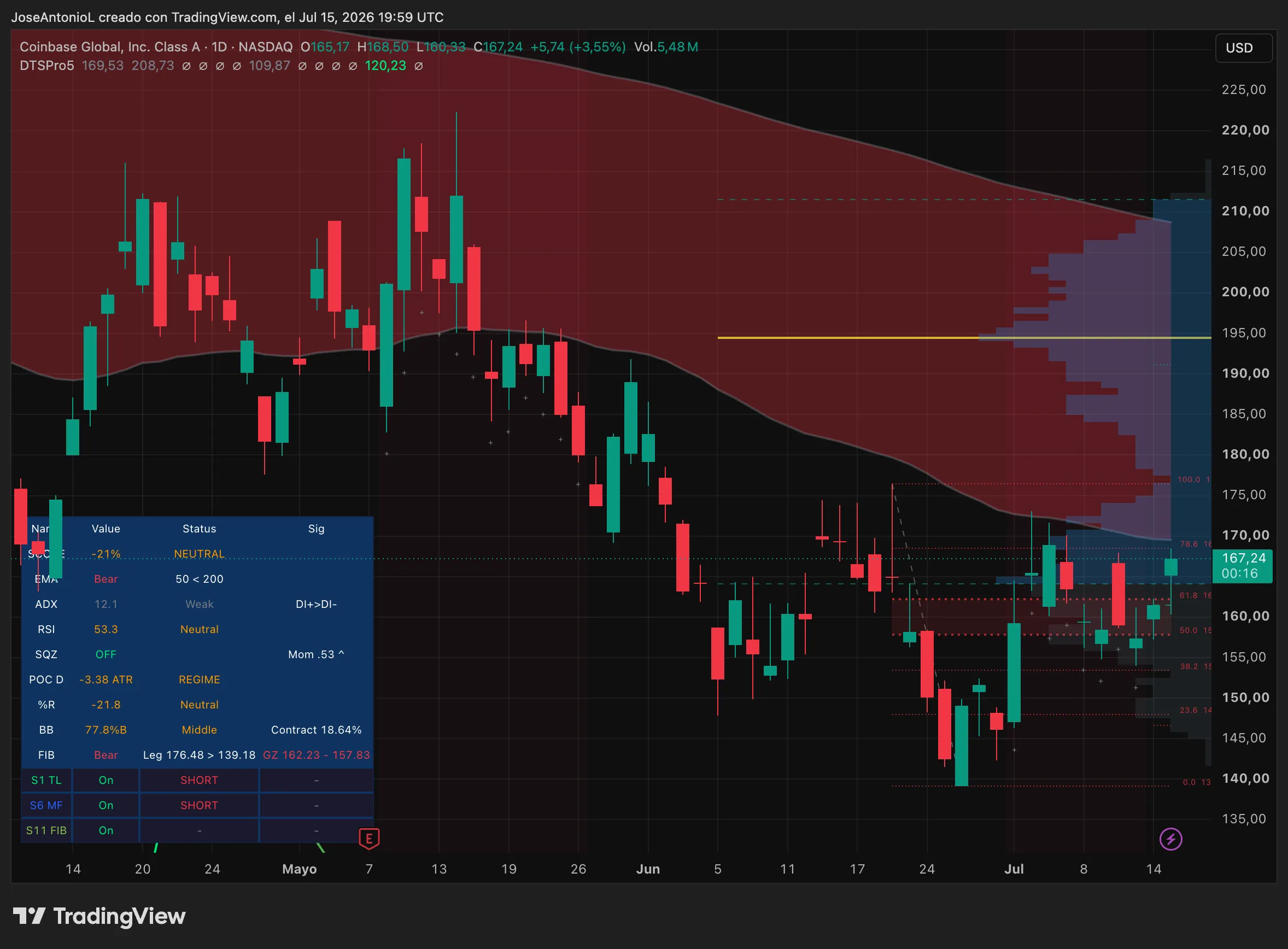
In a curious display of market resilience, shares of Coinbase (COIN) and Circle (CRCL) defied a wave of negative financial revisions this week, each climbing between 3% and 4%. The surge occurred despite a sobering analyst note from William Blair—the storied Chicago investment bank—which slashed revenue and earnings forecasts for the crypto exchange giant.
This counter-intuitive movement has sparked a fierce debate among institutional investors and retail traders alike: Is the crypto sector finally finding its bottom, or is this a classic "bull trap" in a prolonged bear market?
The Disconnect: Earnings Revisions vs. Market Sentiment
The core of the current market narrative is a phenomenon often described as the "pain being priced in." When William Blair analysts Andrew Jeffrey and Adib Choudhury released their updated outlook for Coinbase, the numbers were undeniably grim. The firm cut its 2026 revenue projections for Coinbase by 12%, with 2027 estimates lowered by 13%. More drastically, adjusted EBITDA projections were gutted by 34% for both years.
Yet, despite the slashing of figures, William Blair maintained its "outperform" rating, effectively signaling to investors that the worst of the volatility is already reflected in the current stock price.
"We think investors should stay involved in Coinbase," the firm stated, arguing that earnings are set to trough in the second half of 2026. According to their model, Coinbase’s total trading volume is expected to decline by roughly 44% this year, plummeting to $669 billion. However, the firm projects a significant recovery in 2027, with volume rebounding by more than 32%.
This perspective suggests that the current cycle is structurally distinct from the 2022 market collapse. Unlike that period of unchecked volatility and regulatory ambiguity, today’s market is bolstered by the presence of spot Bitcoin ETFs, institutional-grade infrastructure, and a more mature, albeit still evolving, regulatory framework.
Chronology of a Market Cycle: From Peak to Potential Pivot
To understand the current sentiment, one must look at the recent timeline of the crypto market’s struggle:

- June 2025: Circle makes a splashy debut on the New York Stock Exchange, signaling a new era of mainstream acceptance for stablecoin issuers.
- Early 2026: Coinbase and Bitcoin begin a sustained decline, with COIN shares falling nearly 30% year-to-date and Bitcoin sliding roughly 26% as macroeconomic headwinds mount.
- July 2, 2026: Technical analyst John Bollinger identifies a "W" double-bottom pattern forming on Bitcoin’s daily chart, suggesting a potential trend reversal.
- Mid-July 2026: Glassnode data indicates that long-term holder capitulation—the primary driver of sell-side pressure—reached its cycle peak and has begun to subside.
- Wednesday, July 15, 2026: Despite bearish analyst revisions from William Blair, Coinbase and Circle stocks rally, suggesting investors are looking past near-term earnings dips toward long-term structural value.
Supporting Data: Why Analysts Are Looking at 2027
The optimism from firms like William Blair is not based on blind faith but on the diversification of revenue streams within the crypto ecosystem. While spot trading volume has suffered, other pillars of the business are showing growth.
Coinbase’s Base layer-2 network is increasingly viewed as a primary earnings driver. Furthermore, the firm has seen success in diversifying its revenue base through retail derivatives and prediction markets. Notably, retail derivatives alone crossed $200 million in annualized revenue during the first quarter of 2026.
However, not all analysts are as sanguine. Piper Sandler analyst Patrick Moley, while maintaining a "neutral" stance, recently cut his price target for Coinbase from $170 to $155. Moley pointed to the "significant investor attention on the perpetual future threat" heading into the third quarter. He noted that the World Cup acted as a catalyst for massive growth in prediction market activity in Q2, making these new financial instruments the "defining story" of the quarter.
Official Perspectives and Technical Analysis
The debate has moved beyond fundamental analysis into the realm of technical patterns. John Bollinger, the creator of the globally recognized Bollinger Bands, has been vocal about a developing "W" formation on Bitcoin’s chart.
"We are at a critical point," Bollinger noted in a recent public post. "In a bear market, bullish setups break, and in a bull market, bearish setups break. So, if this ‘W’ pattern is successful, I would see it as a confirmation of a change in trend."
Bollinger’s analysis is particularly noteworthy because it is "perfectly fractal"—meaning the pattern is visible across different timeframes, from the daily charts down to smaller, nested structures. While he has been cautious, his willingness to call this a "confirmation of a change in trend" is his clearest signal yet that the market may be transitioning from a period of capitulation to a period of accumulation.
This aligns with on-chain data provided by Glassnode. Their latest weekly analysis confirms that long-term holder capitulation has peaked and is now trending downward. Furthermore, the "June lows" witnessed a broad wave of accumulation across wallets of all sizes, indicating that while retail sentiment remains fearful, "smart money" may be quietly building positions.
Implications for the Future: Macro Sensitivity Returns
Perhaps the most significant development in the broader market is the return of Bitcoin’s sensitivity to macroeconomic news. For much of the year, crypto assets were caught in a confusing correlation loop. However, the reaction to recent U.S. inflation data provided a glimpse of a return to normalcy: the soft inflation print moved Bitcoin more sharply and decisively than it moved any major equity index.
This suggests that Bitcoin is once again acting as a high-beta asset that reacts logically to monetary policy shifts. As the inverse relationship between the U.S. dollar and Bitcoin deepens, the macro-environment is becoming friendlier to risk-on assets.
The Path Forward
The consensus across both Wall Street and on-chain analysis firms is that the market is currently in a "wait and see" phase. The derivatives market is unwinding, long-term sellers are thinning out, and the fear premium in the options market is slowly dissipating.
However, the "sticking point" remains: the lack of sustained, spot-driven buying. For the recovery to be confirmed, the market requires more than just a lack of sellers; it requires an influx of new capital.
William Blair’s forecast of a 32% rebound in trading volume by 2027 provides a roadmap for what that recovery might look like. If Coinbase and other key players can continue to build out their derivative and L2 ecosystems while the broader Bitcoin market finds its footing, the current "pain" may indeed be the necessary final act of a long-term bottoming process.
For investors, the message is clear: the volatility is not over, but the structural foundations of the industry are significantly stronger than they were four years ago. Whether that strength is enough to carry the market through the remainder of 2026 will depend on whether the "W" pattern identified by technical experts holds, and whether the institutional capital waiting on the sidelines decides that the risk-reward ratio has finally swung in their favor.
