

In a bold move that has sent shockwaves through the digital asset markets, Standard Chartered Bank has initiated coverage of the decentralized finance (DeFi) giant Uniswap. In a comprehensive client briefing issued on June 15, 2026, the global financial institution outlined a staggering long-term price target for UNI, the platform’s native governance token. According to Geoff Kendrick, the bank’s Global Head of Digital Assets Research, Uniswap is positioned for a 40x appreciation, potentially reaching a valuation of $100 per token by the end of 2030.
This forecast, which represents one of the most optimistic institutional outlooks for a DeFi protocol to date, hinges on the rapid integration of traditional finance (TradFi) with decentralized infrastructure. As the financial world pivots toward the tokenization of real-world assets, Standard Chartered posits that Uniswap is not merely a decentralized exchange (DEX), but an essential "infrastructure layer" for the future of global capital.
The Core Thesis: A 37x Explosion in Tokenized Assets
Standard Chartered’s bullish outlook is primarily anchored in the projected growth of the tokenization sector. The bank estimates that the total value of tokenized assets operating within DeFi protocols will surge 37-fold over the next four and a half years. As traditional banking giants seek efficiency, transparency, and liquidity, they are increasingly migrating their ledger-based assets onto blockchain rails.
Kendrick’s research underscores that approximately $2.7 trillion is expected to be locked within DeFi protocols by 2030. Uniswap, with its robust, battle-tested infrastructure, is viewed as the primary beneficiary of this transition. Unlike niche protocols that serve specific markets, Uniswap has established itself as the "all-purpose" liquidity layer of the Ethereum ecosystem—and by extension, the broader multi-chain landscape.
The bank’s analysis highlights three distinct competitive advantages:
- Brand Dominance: As the most recognizable brand in the decentralized space, Uniswap carries a "trust premium" that is vital for institutional adoption.
- Infrastructure Resilience: Its architecture has successfully withstood billions of dollars in volume and extreme market volatility, proving its reliability as a foundational protocol.
- Institutional Interoperability: By maintaining an open, modular structure, Uniswap is perfectly positioned to integrate with the regulatory-compliant pools required by institutional giants.
Chronology: From DEX to Institutional Infrastructure
To understand the weight of this prediction, one must look at the recent evolution of the Uniswap protocol. The project has transitioned from a community-governed experiment into a sophisticated financial hub.
- Early 2026: A pivotal moment occurred as major financial institutions began acknowledging the utility of the protocol. BlackRock and Fidelity, the titans of asset management, expanded their operations to include the protocol to scale their tokenized money market funds. This move validated the "institutional readiness" of the platform.
- Late 2025 – Early 2026: The protocol implemented a long-awaited "fee switch," a governance-driven update that allowed the platform to generate revenue directly. This transition from a purely utility-based model to a cash-flow-generating asset changed the fundamental calculus for valuation models.
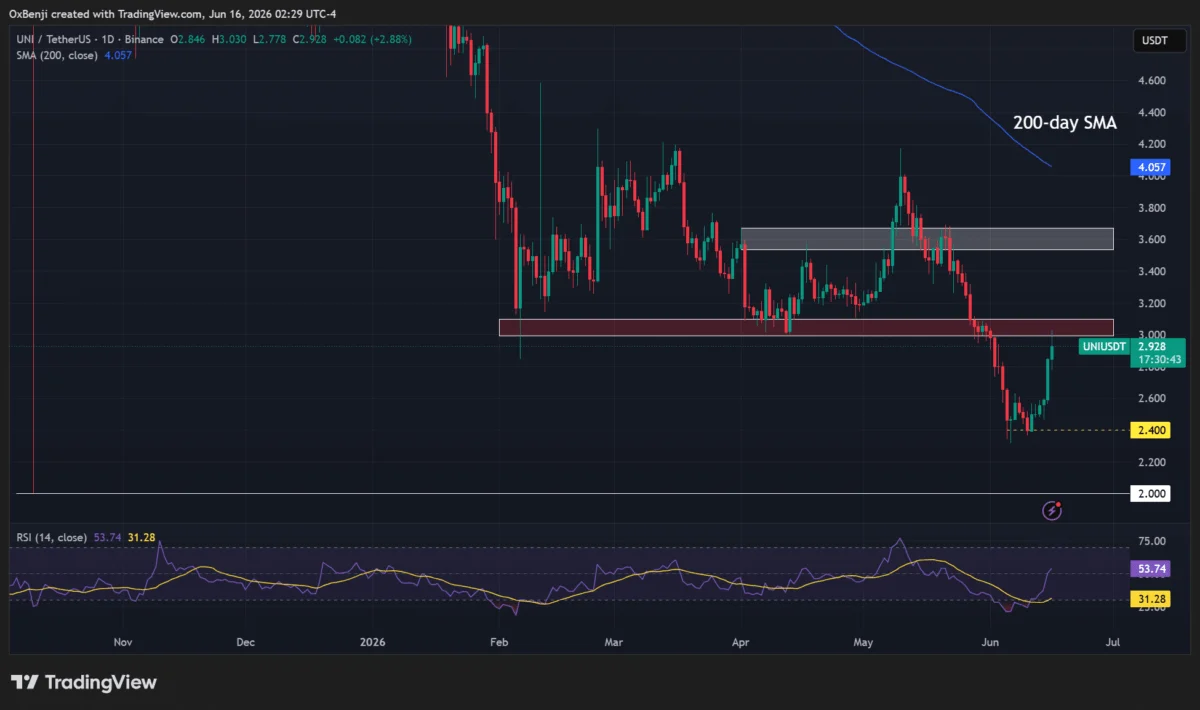
- June 15, 2026: Standard Chartered issues its research note, sparking an immediate market reaction. UNI prices spiked 18% within hours of the announcement, reclaiming the $3 psychological threshold and effectively erasing the losses accumulated during the first half of June.
Supporting Data: The Economics of the Fee Burn
Central to the bank’s valuation is the protocol’s current revenue-generating capacity. Uniswap currently pulls in approximately $858 million in annualized fees. By implementing a mechanism to burn UNI tokens, the protocol has effectively created a deflationary pressure that contrasts sharply with the inflationary models of many legacy cryptocurrencies.
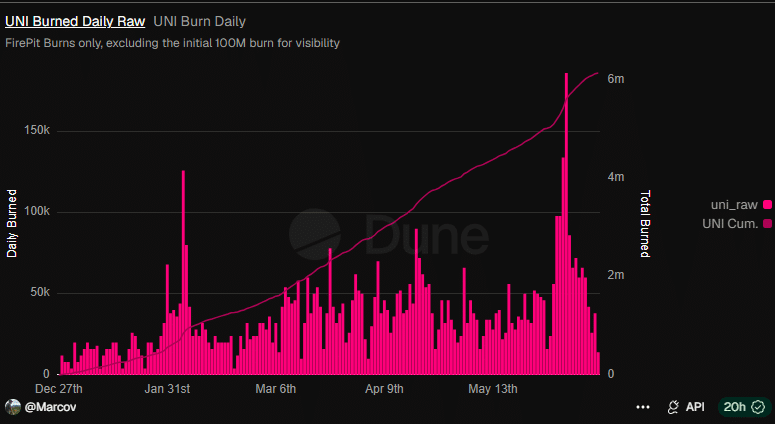
Since the activation of the fee switch in December 2025, the protocol has burned over 106 million UNI tokens. While 100 million of those were part of an initial strategic burn, the ongoing monthly burn rate—averaging roughly 1 million UNI—signals a sustainable model for value accrual. By reducing the circulating supply while simultaneously capturing market share in the booming tokenization industry, Uniswap is creating a "scarcity premium" that Standard Chartered believes will reward long-term holders.
The Institutional Tug-of-War: Critics vs. Proponents
Despite the optimism emanating from Standard Chartered, the market remains deeply divided. The reception to the report has been a microcosm of the current tensions in the crypto-financial space.
Hayden Adams, the founder and CEO of Uniswap, publicly praised the report, labeling it a "great piece" of analysis. His endorsement serves to bridge the gap between traditional research methodologies and the fast-moving, often opaque world of decentralized governance.
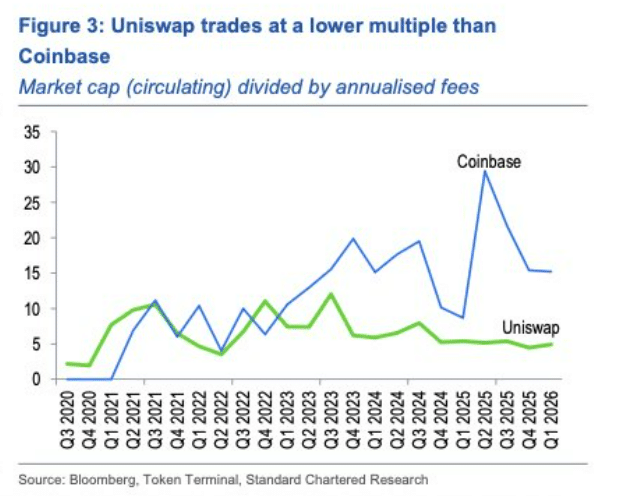
However, not all analysts are convinced by the "40x" narrative. Omar Kanji, an investor at the prominent crypto-venture firm Dragonfly, took to social media to voice sharp criticism. Kanji challenged the bank’s methodology, specifically regarding how they calculated the market-cap-to-annualized-fees ratio. He argued that including Liquidity Provider (LP) fees—which are technically payments to users providing liquidity, not direct revenue for the protocol—in the "annualized fee" calculation constitutes "chart crime" and "slop analysis." According to Kanji, comparing Uniswap to Coinbase using these flawed metrics obscures the true economic realities of the protocol.
This criticism highlights a significant challenge for the industry: the difficulty of applying traditional equity valuation metrics to decentralized protocols that function under entirely different economic paradigms.
Implications for the Future of DeFi
The implications of Standard Chartered’s coverage extend far beyond a single price prediction. If the bank’s thesis holds, it marks the end of the "wild west" era of DeFi and the beginning of its integration into the bedrock of the global financial system.
1. The Death of the "Altcoin" Narrative
By comparing Uniswap to Coinbase, Standard Chartered is explicitly categorizing UNI not as a speculative token, but as a financial service equity. If the market begins to value UNI based on cash flows and dividend-like potential (the fee switch), the token could decouple from the broader, more volatile cryptocurrency market.
2. The Institutionalization of Liquidity
If more traditional firms follow BlackRock and Fidelity into the Uniswap ecosystem, the protocol will effectively become the "liquidity provider of last resort" for the global economy. This creates a feedback loop: more institutional volume leads to deeper liquidity, which attracts more institutional volume.
3. Regulatory Stability
The willingness of a Tier-1 bank to issue such a bold forecast suggests that the regulatory landscape for DeFi is becoming clearer. Institutions are less likely to risk their reputation on a protocol they believe is at imminent risk of regulatory shutdown. Standard Chartered’s coverage acts as a silent signal that the "gray area" of DeFi is rapidly turning into a regulated, investable asset class.
Market Outlook: The $3 Barrier and Beyond
As of the current trading cycle, the market is navigating the immediate aftermath of the report. The 18% surge to $3 has provided bulls with a much-needed morale boost. However, technical analysts warn that this level is a critical test.
- The Bullish Scenario: If the $3 level is successfully converted into a stable support zone, the path is clear for a rally toward $3.60 and potentially $4.00. This would confirm that the institutional-backed narrative has taken hold of the retail market sentiment.
- The Bearish Scenario: A failure to hold $3 could lead to a swift "rejection," where short sellers capitalize on the perceived over-extension of the rally. Such a move could drag the token back toward the $2.60 or $2.40 range, where it would need to re-test buyer interest.
Conclusion
Standard Chartered’s projection of a $100 UNI by 2030 is as much an ambitious roadmap as it is a price target. It envisions a future where decentralized protocols have matured to the point of displacing or augmenting traditional financial gatekeepers. Whether that vision comes to fruition depends on the protocol’s ability to maintain its technological edge, navigate the minefield of global regulation, and successfully balance the competing interests of its community and the institutional players now knocking on its door.
For now, the report serves as a catalyst for a deeper conversation: is DeFi finally ready to grow up? If the trends in asset tokenization continue at the pace predicted by Standard Chartered, the question may not be whether Uniswap can hit $100, but rather how much of the traditional financial system will have been absorbed by the protocol by the time the decade concludes.
