


In an era where traditional financial systems are increasingly struggling to meet the demands of volatile emerging markets, Tether’s USDT stablecoin has emerged as an unlikely pillar of economic stability in Venezuela. Recent data reveals that USDT trading on the Binance P2P (peer-to-peer) platform has reached a staggering $1.4 billion within a single month, marking a historic milestone for digital asset adoption in the South American nation.
This development highlights a fundamental shift in how Venezuelans interact with capital, moving away from constrained domestic banking rails toward a decentralized, dollar-pegged alternative that offers liquidity and accessibility in an environment characterized by systemic instability.
The Scale of the Shift: A Multi-Billion Dollar Reality
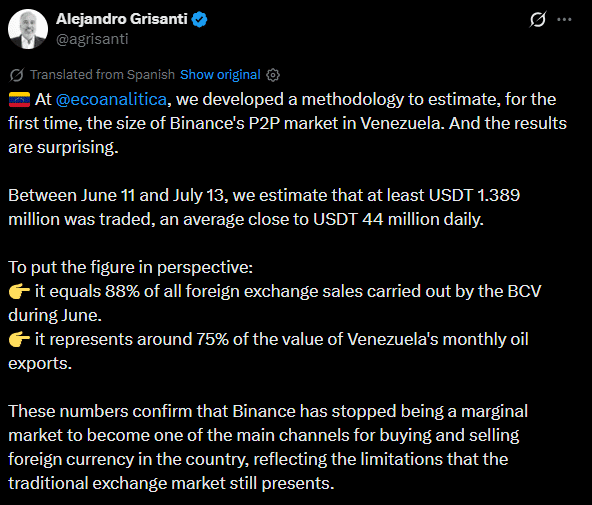
Between mid-June and mid-July 2026, the volume of USDT traded via Binance’s P2P infrastructure in Venezuela averaged approximately $44 million per day. To put this figure into perspective, Alejandro Grisanti, director at the analytical firm Ecoanalítica, emphasizes the sheer magnitude of these numbers.
According to Grisanti, this $1.4 billion monthly volume is not merely a niche activity; it is a macroeconomic force. It represents roughly 88% of all foreign exchange sales executed by the Central Bank of Venezuela (BCV) during the same period. Furthermore, this P2P activity accounts for approximately 75% of the value of the country’s total monthly oil exports.
These statistics confirm a transition that many financial observers have suspected for years: Binance and similar P2P platforms have graduated from being marginal, secondary markets to becoming one of the primary conduits for foreign currency exchange within the country. The limitations inherent in traditional, state-controlled financial systems have created a vacuum that decentralized stablecoins are now filling with remarkable efficiency.
Chronology of Adoption: From Niche Tool to Essential Utility
The integration of USDT into the daily financial life of Venezuelans was not an overnight occurrence. It is the result of a long-term erosion of trust in the local currency and the persistent, artificial limitations placed on access to foreign exchange.

Phase 1: The Inflationary Catalyst
Years of hyperinflation and restricted access to U.S. dollars through official channels forced the population to seek alternatives. Initially, this involved informal physical cash markets, which were prone to theft and lacked scalability.
Phase 2: The Rise of Crypto-Liquidity
As smartphone penetration increased, cryptocurrency became the logical evolution. Users began turning to P2P platforms to swap the local bolívar for USDT, which provided a stable hedge against devaluation.
Phase 3: Mainstream Institutionalization
By early 2026, the volume began to skyrocket. The transition from "fringe tech" to "essential service" was marked by the sheer necessity of the population to move value across borders and pay for goods and services in a digital currency that held its value. The mid-2026 figures reported by Ecoanalítica represent the peak of this integration, where the digital stablecoin began rivaling the state’s own export-backed financial power.
Supporting Data: A Regional and Global Phenomenon
The situation in Venezuela is not an isolated incident; it is part of a broader trend of "stablecoinization" across Latin America. Recent studies from Binance indicate that the number of stablecoin users across the LATAM region has doubled in the last year. This trend is mirrored in neighboring nations, such as Bolivia, where USDT has been formally integrated into payment systems, as highlighted by Tether leadership as a "cornerstone" development for the region.
The Tether Userbase Expansion
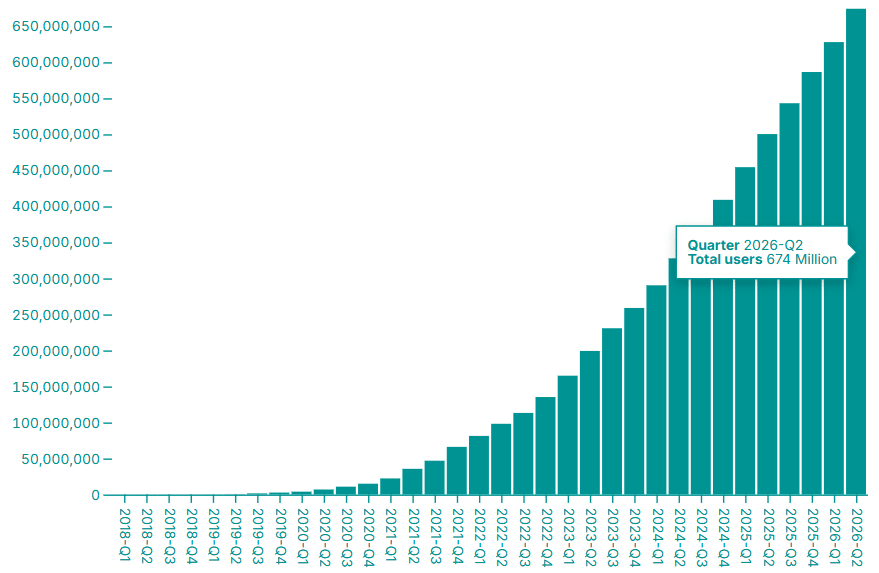
Paolo Ardoino, CEO of Tether, has consistently characterized USDT as the "ultimate social network," pointing to the rapid growth of the stablecoin’s userbase. In the first quarter of 2026, Tether reported 628 million users. By the end of the second quarter, that number had surged to 674 million—an addition of nearly 50 million users in just three months.
Market Dynamics and Capital Outflows
While the user base continues to grow, the broader market environment has been turbulent. Since October 2025, USDT transfer volumes have seen a contraction, falling from $700 billion to approximately $278 million by mid-July 2026. This decline tracks closely with the broader cryptocurrency market downturn, characterized by Bitcoin’s retreat from a high of over $120,000 to the $60,000 range.
Furthermore, the total supply of USDT began to dip in May 2026, falling from nearly $190 billion to $184 billion. This $6 billion outflow suggests that while utility in regions like Venezuela remains high, speculative demand tied to Bitcoin’s price performance still heavily influences the overall liquidity and supply dynamics of the stablecoin.
Official Perspectives: The Institutional View
The rise of P2P stablecoin markets poses a significant challenge to traditional central banking. Alejandro Grisanti argues that the current surge in volume is a direct result of the BCV’s inability to satisfy the market’s demand for foreign exchange.
"These numbers confirm that Binance has stopped being a marginal market to become one of the main channels for buying and selling foreign currency in the country," Grisanti noted. However, he offers a caveat: the dominance of P2P platforms is not necessarily permanent.
If the Central Bank of Venezuela were to significantly increase the supply of foreign exchange and simplify the processes for accessing it through traditional, state-sanctioned financial rails, the volume on platforms like Binance could see a contraction. Essentially, the P2P market is currently serving as an "emergency relief valve" for an economy starved of liquidity. If the pressure is relieved through official policy changes, the reliance on decentralized rails may decrease.
Economic Implications: The Future of Digital Finance in Venezuela
The implications of this data are profound, touching upon monetary policy, technological sovereignty, and social stability.
1. The Challenge to Monetary Sovereignty
When a stablecoin issued by a private entity accounts for nearly 90% of the volume of central bank foreign exchange sales, the state’s ability to control its own monetary environment is severely compromised. Venezuela is witnessing a de facto "dollarization" via the blockchain, which the state cannot easily regulate or tax.
2. Financial Inclusion vs. Risk
For the average Venezuelan, USDT represents financial inclusion. It allows individuals to preserve their purchasing power, receive remittances from abroad without exorbitant fees, and engage in international commerce. However, this also introduces systemic risks. Users are vulnerable to the platform’s stability, potential regulatory crackdowns on exchanges, and the inherent risks of digital asset custody.
3. The "Social Network" of Money
Ardoino’s assertion that money is the "ultimate social network" is increasingly becoming a reality in developing nations. When the social contract between the state and the citizen—specifically regarding the stability of the currency—is broken, citizens migrate to the technology that best facilitates their survival. USDT has become the ledger of choice for a population that has lost faith in traditional institutional accounting.
4. Speculation vs. Utility
The data reveals a dual nature of USDT. On one hand, there is a clear, "utility-driven" demand in markets like Venezuela, where stablecoins are used for survival and daily transactions. On the other, there is a "speculation-driven" demand tied to the price of Bitcoin. Moving forward, the resilience of Tether’s ecosystem will depend on whether its utility-driven growth can outpace the volatility inherent in the speculative crypto markets.
Conclusion
The $1.4 billion trading volume on Binance P2P in Venezuela is a clarion call to global financial authorities. It signals that when traditional systems fail to provide reliable, accessible, and stable money, the global population will turn to decentralized alternatives. Whether this represents a permanent shift or a temporary response to economic crisis remains to be seen. However, one thing is certain: USDT has moved beyond the realm of speculative investment and has entrenched itself as an essential tool for economic survival in the 21st century. As the divide between state-controlled finance and decentralized digital assets widens, the lessons learned in the streets of Caracas may soon become the blueprint for other nations navigating similar economic transitions.
