


The cryptocurrency market is currently navigating one of its most precarious periods in recent memory. Following a brief, optimistic flirtation with the $64,000 resistance zone, Bitcoin has been forced into a defensive retreat. The catalyst for this sudden bearish reversal on July 8 was the collapse of the U.S.-Iran ceasefire, a geopolitical shockwave that triggered an immediate flight from risk-on assets. As the dust settles, the market is grappling not just with the fallout of the news, but with a deeper, systemic issue: a chronic "liquidity famine."
The Anatomy of the July 8 Crash: A Cascade of Liquidations
On July 8, the global geopolitical climate shifted abruptly, and the crypto markets reacted with characteristic volatility. As the U.S.-Iran ceasefire agreement fell apart, uncertainty gripped investors. Bitcoin, which had been attempting to consolidate near the $64,000 level, plummeted back toward the $62,000 support floor.
The movement was swift and brutal. According to data tracked by AMBCrypto, the breakdown of the ceasefire served as the primary trigger for a massive deleveraging event. Within minutes of the news, approximately $300 million in long positions were liquidated across major derivatives exchanges.
This event highlighted a dangerous trend that had been building for weeks: a reliance on high leverage among traders attempting to "catch the bottom." Without structural support or fresh capital inflows to back these bets, the market became a house of cards. When the macroeconomic environment turned hostile, these leveraged positions were forced into liquidation, creating a feedback loop that accelerated the price drop.
Chronology of a Market Contraction
To understand why the market remains so sensitive to bearish catalysts, one must look at the timeline of the current liquidity drain:
- Mid-May: The market experienced a period of relative stability, with the 30-day change in stablecoin market capitalization hovering near zero. At this stage, liquidity was sufficient to support Bitcoin’s price discovery.
- Early June: A sharp divergence occurred. The combined market cap of the industry’s two primary stablecoins, USDT and USDC, dropped by $4.2 billion. This marked the beginning of a sustained exit of capital from the ecosystem.
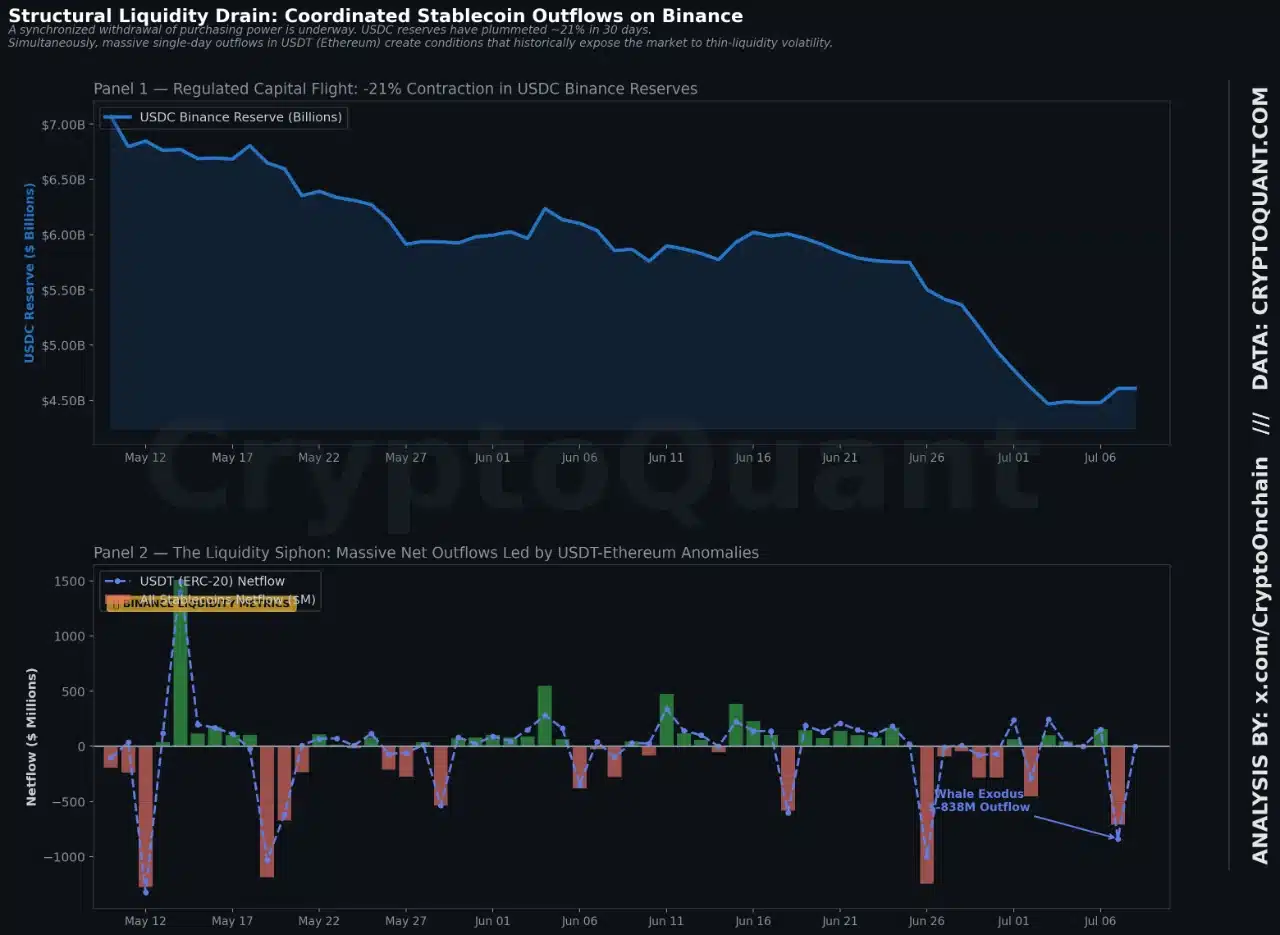
- June 26: Binance, the world’s largest exchange by volume, recorded an anomalous outflow of $997 million in stablecoins. This was the first major alarm bell indicating that institutional or large-scale retail capital was pulling out of centralized exchange (CEX) environments.
- July 7: The pressure intensified with another massive single-day outflow from Binance, totaling $838 million.
- July 8: The geopolitical breaking point. The failure of the ceasefire served as the spark, turning a period of steady capital flight into an acute market sell-off.
The "Dry Powder" Problem: Stablecoin Reserves in Freefall
In the digital asset ecosystem, stablecoin reserves on centralized exchanges are widely viewed as "dry powder"—the ammunition traders use to purchase Bitcoin and other assets during dips. When reserves are high, the market is well-positioned for a recovery. When they vanish, the market loses its ability to absorb selling pressure.

Data from CryptoQuant suggests that Binance has been hit particularly hard. Over the past month, USD Coin (USDC) reserves on the platform have plummeted by 21%. Furthermore, the daily average outflow of stablecoins from the exchange has reached a staggering $115 million per day over the last week.
This is not merely a reallocation of assets within the exchange ecosystem. Analysts suggest that this liquidity is migrating toward cold storage (self-custody), decentralized finance (DeFi) protocols, or, perhaps most significantly, off-exchange via Over-the-Counter (OTC) desks. While these areas are secure, their withdrawal from the active trading order books of major exchanges leaves the market "thin." In a thin market, even minor sell-side pressure can result in outsized price volatility, as there are fewer buy orders to act as a buffer.
The Fuel Shortage: Declining Stablecoin Inflows
Crypto analyst Axel Adler Jr. has provided a granular look at the macro-level capital flows, illustrating that the 21% decline in Bitcoin’s value since May is a direct consequence of a "fuel shortage."
The data is clear: the monthly average inflow of stablecoins to exchanges has contracted by 18%, falling from $3.20 billion to $2.65 billion. This reduction in incoming capital means that the market is currently running on fumes.
Perhaps more concerning is the fact that the total market capitalization of USDT and USDC is shrinking, not just moving. For several weeks, the combined market cap of these assets has been in negative territory, currently sitting at roughly -$3.2 billion. This confirms that capital is not simply rotating from stablecoins into crypto-assets; it is actively leaving the crypto-system and returning to fiat or other traditional financial instruments. This net outflow of capital is the fundamental reason why the market has failed to sustain any meaningful momentum after its previous bounce toward the $83,000 region.
Implications: A Vulnerable Market Architecture
The current state of the market presents several critical implications for investors and observers:
1. Increased Sensitivity to Macro Events
Because the "cushion" of stablecoin liquidity has been removed, the crypto market is now hyper-sensitive to external news. As seen on July 8, a geopolitical event that might have been shrugged off in a high-liquidity environment caused a $300 million liquidation cascade. Investors should expect this heightened sensitivity to persist until stablecoin inflows stabilize and begin to trend upward.
2. The Danger of "Retail" Leverage
The reliance on high-leverage positions by derivatives traders remains a systemic risk. Without the structural support of institutional capital inflow, these traders are essentially betting on a recovery that has no fuel to sustain it. This increases the likelihood of "stop-loss hunting," where the market moves downward specifically to trigger the liquidation of over-leveraged accounts, leading to rapid, high-amplitude price swings.
3. The Shift to Cold Storage and OTC
The migration of liquidity to cold storage and OTC desks suggests that while the "smart money" may not be abandoning the asset class entirely, they are moving into a "wait and see" mode. Investors are prioritizing safety over active trading. This reflects a broader lack of confidence in the short-term price action, suggesting that institutional participants are choosing to hold their assets securely rather than expose them to the volatility of the current order books.
4. Technical Outlook
Technically, the failure to hold the $64,000 resistance zone has turned the $62,000 level into a critical pivot point. If this support fails, the market lacks the liquidity-backed demand to prevent a slide toward lower support tiers. Conversely, a return to bullish sentiment would require a sustained reversal in the stablecoin outflow trend—specifically, a return of stablecoin market cap growth to positive territory.
Conclusion
The recent market volatility is not just a result of geopolitical headlines; it is the manifestation of a fundamental change in the liquidity landscape. The crypto market is currently undergoing a "deleveraging of confidence."
As capital continues to exit exchanges and the total supply of stablecoins shrinks, the ecosystem finds itself in a precarious position. The "dry powder" that once fueled massive bull runs is currently in short supply. For the market to regain its footing, it will need more than just the absence of bad news; it will require a return of inflows and a stabilization of the dollar-based assets that underpin the entire digital economy. Until such time, participants should brace for continued volatility and a market that remains, for now, fragile and undersupplied.
