

The global cryptocurrency market is currently navigating one of its most challenging phases in recent memory. As capital flows continue to retreat from the digital asset ecosystem, Bitcoin [BTC] and a broad array of altcoins have found themselves on the defensive, struggling to establish any meaningful momentum. This prolonged period of bearish pressure is not merely a transient dip; it represents a fundamental shift in market liquidity that has seen a staggering $1.11 trillion in market capitalization—excluding stablecoins—vanish since the peak recorded in January.
As the industry searches for signs of a turnaround, the data suggests a sobering reality: the engine of the next rally has not yet been primed. The market is currently characterized by a "risk-off" sentiment, where institutional and retail participants alike are prioritizing capital preservation over speculative growth.
The Vital Role of Stablecoins as Market "Dry Powder"
To understand the current malaise, one must look at stablecoins. In the context of digital finance, stablecoins function as the market’s "dry powder." They represent the ready-to-deploy capital that sits on the sidelines, waiting for the right moment to rotate into high-growth assets like Bitcoin, Ethereum, and emerging tokens. When stablecoin inflows are robust, it is a hallmark of a healthy, accumulating market. Conversely, when these reserves dwindle, it is a leading indicator of waning interest and systemic risk aversion.
Data Analysis: A Shift in Exchange Reserves
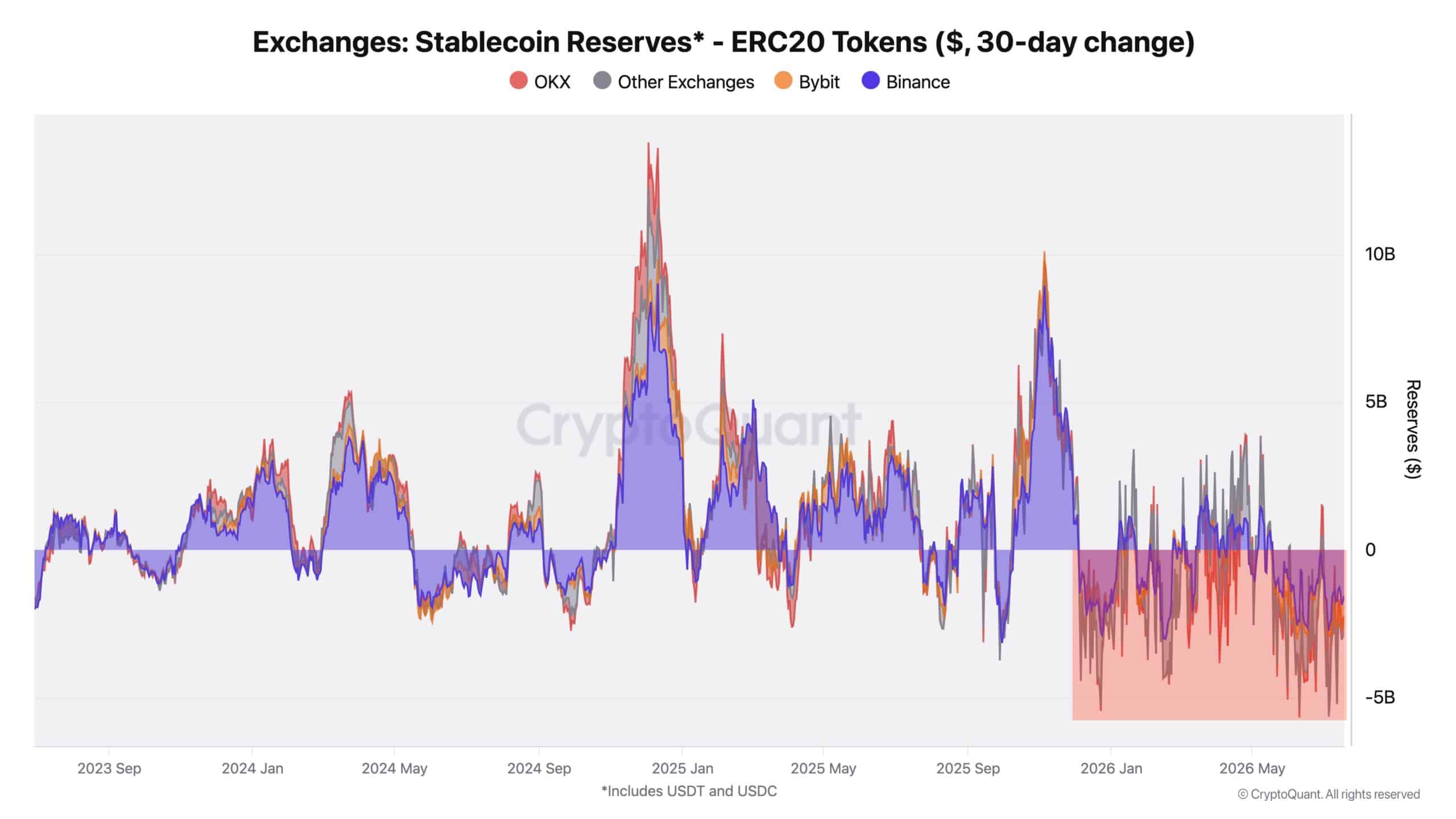
According to granular data provided by CryptoQuant, the trajectory of stablecoin exchange reserves has undergone a radical transformation this year. Historically, these reserves maintained a consistent positive balance, serving as a buffer and a catalyst for bullish surges. However, the current year has seen a sustained period of outflows.
The exchange reserve charts reveal a persistent, deep-seated negative trend. This "orange box" period, as highlighted in market analytics, represents a structural break from previous years. Investors are not just moving assets; they are actively withdrawing capital from the crypto ecosystem, effectively pulling the fuel out of the engine that would otherwise drive a bull market.
Chronology of the Capital Flight: A 30-Day Snapshot
The intensity of this capital flight has been particularly pronounced over the last month. The movement of stablecoins away from major liquidity hubs serves as a proxy for investor conviction.
- The Binance Exodus: As the world’s largest crypto exchange, Binance accounts for roughly 68.39% of all stablecoin reserves across major platforms. In the past 30 days alone, the platform has recorded approximately $1.55 billion in stablecoin withdrawals.
- The Bybit Contraction: Similarly, Bybit, which holds 6.49% of the aggregate exchange stablecoin reserves, saw an outflow of $786 million over the same period.
Combined, these two exchanges—which act as the primary gateways for global crypto liquidity—have seen over $2.3 billion in stablecoin exits. This is not a subtle shift; it is a clear statement from the market that the appetite for accumulation is currently non-existent.

Shrinking Market Capitalization: The Numbers Don’t Lie
Beyond the exchanges, the broader stablecoin ecosystem is experiencing a contraction that mirrors the price action of the top-tier assets. Data from DeFiLlama underscores a steady, relentless decline in total stablecoin market capitalization.
The Downward Slope
After reaching a high-water mark of $322.419 billion in April, the total market cap for stablecoins has shed approximately $12.355 billion. This decline has been consistent and unforgiving, with a further $1.167 billion vanishing in just the last seven days.
This sustained drain acts as a ceiling for the entire crypto market. Bitcoin, which serves as the industry’s bellwether, has been unable to reclaim the critical $64,500 resistance level for nearly 50 days. The lack of fresh capital inflows means that any attempts at a price recovery are met with immediate, overwhelming selling pressure. Until we see a reversal in the stablecoin supply trend—indicating that investors are once again moving capital back into the ecosystem—the path of least resistance for Bitcoin and its peers remains downward.
Macroeconomic Context: The Paradox of M2 Money Supply
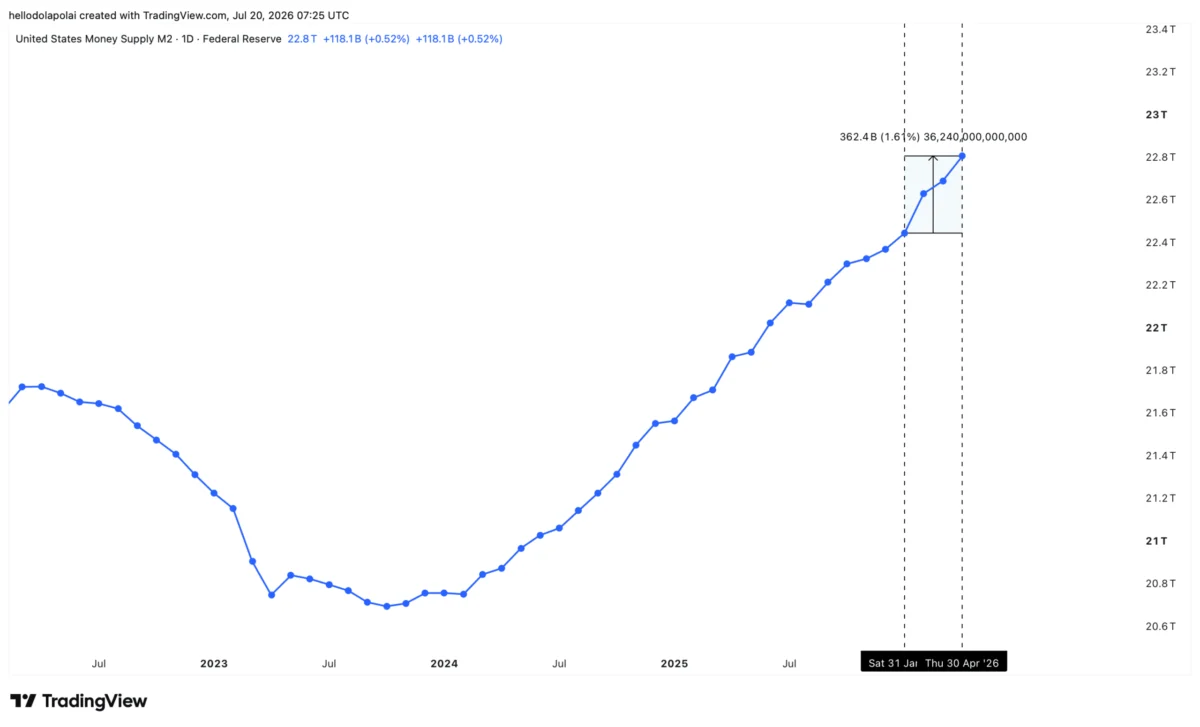
The irony of the current crypto winter lies in the broader global economic landscape. Typically, an increase in the U.S. M2 money supply—the measure of cash, checking deposits, and near-cash assets—would signal inflationary pressure that encourages investors to seek refuge in "hard" assets like Bitcoin.
Currently, the U.S. M2 money supply has reached record highs, hovering at approximately $22.8 trillion. In a different economic climate, this massive liquidity would be the spark for a crypto bull run. However, the current macroeconomic environment is heavily clouded by geopolitical instability, specifically the ongoing conflicts in West Asia, and a lingering uncertainty regarding central bank policy.
The "Risk-Off" Mentality
While a recent, cooler-than-expected Consumer Price Index (CPI) report provided a brief moment of optimism—triggering a minor relief rally—it failed to translate into a sustained institutional shift. Investors are, at present, deeply risk-averse. The "risk-on" environment required for a sustained crypto bull market necessitates a level of geopolitical stability and economic confidence that is currently missing. Consequently, liquidity is choosing to stay in "near-cash" forms or traditional defensive assets, rather than flowing into the volatile crypto space.
Implications for Market Participants
What does this mean for the average trader, institutional investor, or project developer?
1. The End of "Easy" Growth
The era of speculative, liquidity-driven growth appears to be on pause. Investors are no longer betting on market hype; they are waiting for fundamental, macro-driven catalysts. This implies that projects without strong utility or clear, sustainable revenue models will continue to struggle as capital becomes increasingly selective.
2. A Prolonged Accumulation or "Waiting" Phase
The data suggests that the market is currently in a "wait-and-see" mode. For long-term holders, this may represent an opportunity to accumulate at lower levels, but for short-term traders, the lack of stablecoin "dry powder" means that volatility will likely be range-bound rather than trend-setting.
3. The Need for Regulatory and Macro Clarity
The sensitivity of the market to CPI data and geopolitical tensions shows that crypto is no longer trading in a vacuum. It is deeply integrated with global macroeconomic health. Any potential rally will likely require more than just technical strength; it will require a clearer signal from the Federal Reserve regarding interest rates and a cooling of the regional tensions that currently dominate the news cycle.
Conclusion: A Market in Search of a Catalyst
The current state of the cryptocurrency market is defined by a vacuum of capital. The drainage of $1.11 trillion in market capitalization and the significant contraction of stablecoin reserves are not merely technical glitches; they are systemic signals that the "risk-on" appetite has vanished.
As Bitcoin continues to test the patience of its investors and stablecoin outflows persist, the market remains in a defensive posture. The liquidity that is currently sitting in the $22.8 trillion M2 money supply is effectively trapped, deterred by a combination of fear, economic uncertainty, and a lack of conviction in the short-term growth potential of digital assets.
Ultimately, the recovery of the crypto market is inextricably linked to the movement of these stablecoins. Until the "orange boxes" of exchange reserves turn from negative to positive, and until the broader macro environment provides a stable floor for risk assets, the market will likely continue its sluggish, sideways trend. For now, the "dry powder" remains dry, and the market waits—not for a miracle, but for the fundamental shift in investor sentiment that will finally unlock the capital necessary to spark the next cycle.
